The window to influence a purchase decision is shrinking. Today, buyers do much of their research using AI long before a vendor enters the picture — comparing categories, summarizing pricing and integrations, and screening out options that are hard to assess. By the time a prospective buyer identifies themselves to a brand, they've already formed opinions and, often, looped in colleagues who will have a say in the decision. The signal a brand finally receives isn’t the kickoff — the game is well underway, and further along than it was in the past.
This isn’t a problem that can be solved with more campaigns or more elaborate workflows. Brands need a system that can reason across everything they already know about a buyer, an account, and a potential buying group — one that can decide what to do next, continuously and at scale. That's what our expanded set of AI-first offerings on the Adobe Marketo Engage platform is designed to do.
What today's demand engines do well — and where they can go further.
Today's leading demand engines do a lot of things right. They execute at scale, run reliably, and give teams the precision to build and automate campaigns as intended. That foundation is critical and isn't going away. However, waiting for the right signal to trigger a predefined action built on rule-based logic can come at a cost — lost buyers who make decisions while your system waits for that golden signal or lead score. What’s more, your team might have the right clues within the data and signals you have, but you’re missing the context to act quickly for every potential buyer.
Here’s what we’ve observed:
- A single, isolated signal, such as a click, a download, or a page visit, can trigger a very specific response that’s built into your system’s logic, regardless of everything else happening around it — a response that often misses the bigger picture of customer intent.
- Marketing, paid media, and business development representative (BDR) outreach typically run as separate motions, in separate systems, with separate data, resulting in lost context as customers move across touchpoints.
- A lead can look uninteresting in isolation but “hot” in combination with signals from other people from the same account or buying group.
- Qualification is usually manual and dispersed over many tools. BDRs have to manually piece together demand signals and research the account, often missing the opportunity to connect with the right person at the right time with the right message.
Most of this isn't a data problem, at least not the kind that requires rebuilding your data foundation. It's a reasoning and optimization problem. With the right tools, marketing teams could get much more from the data and signals they already have. The more channels you bring together, the more data you have — and the richer the customer context becomes that you can use consistently across those channels for targeting, personalization and next-best actions.
The expanded Adobe Marketo portfolio was built to address the complex problems facing B2B marketing and sales teams today. Here are some of the things teams can do now:
- Anticipate customer needs by turning signals and data into next-best actions. Create a contextual intelligence layer from your existing Marketo Engage data that determines persona, buyer role, interests, and more. This intelligence layer can then develop these contextual insights into a semantic “story” that’s used to anticipate customer needs and make continuous engagement and personalization decisions at scale across journeys, channels, and content.
- Improve ROI by unifying marketing, paid media, and BDR channels. Run end-to-end customer journeys on a single canvas to create one shared view of the customer, driving more connected experiences and better ROI for higher-cost investments like events, paid media, and BDRs.
- Get better results with lead, account, and buying group intelligence. Expand customer context with account and buying-group details to expand reach and automatically surface missing buying-group roles to acquire new contacts with precision using paid media, BDRs or any connected channel.
- Qualify high-value prospects faster. Leverage one agentic workflow that spans inbound and outbound BDR prospecting, and prepares BDRs with shared customer context, AI-generated from engagement across marketing and paid media.
- Deploy quickly for fast time to value. Adobe Marketo Engage customers can leverage their existing data foundation — no data foundation rebuild required.
Adobe Marketo Engage: A powerful B2B foundation, now enhanced with agentic AI.
It’s essential for brands to keep what’s working and evolve at their own pace.
Thousands of marketing teams run their mission-critical demand centers on Marketo Engage today, and plenty of what runs on those instances requires rules-based precision. A compliance-mandated unsubscribe workflow, a fixed-cadence renewal reminder, or a free trial onboarding — these should run exactly the same way every time, with zero interpretation required. That precision is a cornerstone of what has made Marketo Engage a leader in marketing automation and that shouldn’t change.
What should change, is how fast and easily that precision work gets built and maintained. That's why Adobe created Coworker for Marketo Engage, a native, agentic experience inside Marketo Engage that lets teams build and maintain workflows as well as analyze and draw insights from data using natural language to prompt agentic AI. Marketing teams can also engage with prominent AI tools — such as Claude, ChatGPT, Copilot, and others — using the Marketo Engage MCP Server, giving them greater flexibility, connectivity, and efficiency.
Introducing Adobe Marketo Optimizer and Adobe Marketo Qualifier.
Keeping pace with AI-enabled buyers requires a system that can not only anticipate customer needs but also decide the next best action — and then continuously do that for each of their customers to orchestrate the right experience. That's the shift that Adobe is leading — going from marketing automation to marketing orchestration. It requires an AI-first approach to create the right capabilities for the “thinking” and the “doing” across teams. It’s the trust so many have in their Marketo Engage data foundation that inspired us to build these new products.
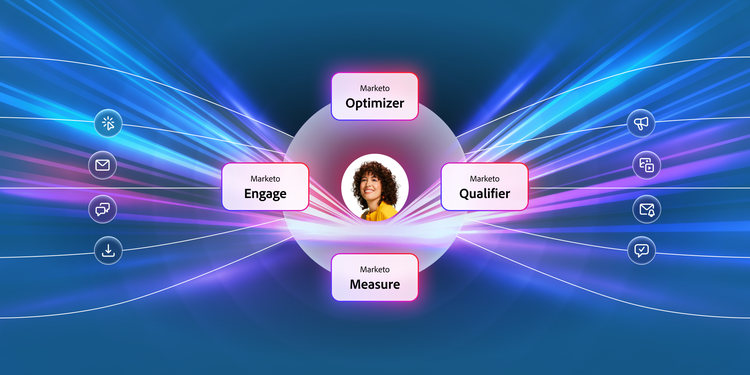
Adobe Marketo Optimizer was built for marketing teams to bring their lead, account, and buying group journeys together with powerful AI reasoning that enriches customer context with continuously updated semantic stories and scales engagement with next-best actions across marketing, paid media, and BDR channels.
Adobe Marketo Qualifier lets BDR teams unify inbound lead qualification and outbound prospecting into a single agentic workflow that’s deeply connected to the overall demand lifecycle and a common customer context. It was built to close the problematic “last mile” between demand generation and pipeline creation.
Both run on the Marketo Engage data foundation and can share a contextual understanding of each person, buying group, and account — no customer data platform (CDP) is required. And if your organization already uses Marketo Engage, you can get up and running quickly.