Announcing Adobe Marketing Campaign Analytics: AI-powered measurement to maximize your marketing ROI.
10-29-2026
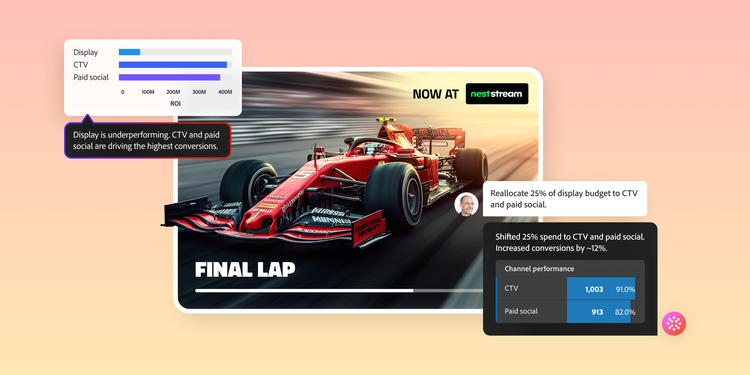
Every marketing team is faced with the same question — what did our marketing spend actually deliver? Budgets are staying flat, but the pressure on them is not. The 2025 CMO Survey from Duke University and Deloitte found a 52% rise in board pressure on marketing leaders to prove ROI. It’s more important than ever for organizations to have trusted answers on what drives performance, a clear plan for where their next investment should go, and the ability to change course while a campaign is still running.
We built Adobe Marketing Campaign Analytics to give teams exactly that. It’s a single application that unifies measurement and planning to help marketers understand incremental business impact, adapt budgets as performance and market conditions change, and continuously maximize marketing ROI.
Why measurement keeps falling short.
Customer journeys now span more channels and touchpoints than ever before. At the same time, marketers have less time to react and fewer signals to work from. Many teams still rely on measurement built for a simpler media landscape. Insights arrive after budget's been spent, with marketing teams dependent on analysts or outside vendors. These backward-looking insights are often grounded in last-touch attribution and disconnected channel measurement methods — so the numbers can’t be compared or added up into one view. The result is marketing spend that’s hard to defend, missed opportunities to improve ROI, slow course corrections for live campaigns, and teams working from different versions of what happened.
Marketing Campaign Analytics solves these issues by unifying measurement and planning on a causal modeling foundation, letting your teams see what’s working and act with the speed and agility that today’s marketing landscape demands.
Measure marketing’s true impact with one unified model.
Marketing Campaign Analytics combines marketing mix modeling (MMM) and multi-touch attribution (MTA) into a single model. It isolates the incremental impact of your marketing from other factors — like seasonality, promotions, and market conditions — while capturing how channels lift each other, so you can see what each channel contributes and what the mix delivers together.
Everything in Marketing Campaign Analytics is based on your in-house data foundation, so your teams stay in control of the model. Team members can see how it works, adjust the factors and underlying assumptions, and add their own business context. Before a model runs, they can check the data for quality and completeness. After it runs, transparent fit metrics show how well it is performing, and an automatic alert flags any drift in performance. That gives your team a model it can trust and defend.
Plan your budget, then optimize it mid-flight based on actual performance.
The same model powers planning, allowing you to get a recommended budget by channel to hit a revenue goal or stay within a budget cap. You can also test your own what-if scenarios, including scenarios involving multiple conversions, and compare their forecasts side by side before you commit.
Once a plan is live, you can see how every channel is pacing in one place. The model rescores in minutes as new data comes in, so you can adjust creative, targeting, or delivery while the campaign is in flight. When spend needs to shift, you can send channel mix and budget recommendations straight to your media team or agency.
Give your whole team answers and insights.
Marketing Campaign Analytics pairs with Adobe’s powerful agentic engine, Adobe CX Enterprise Coworker, to make sophisticated analysis accessible through natural language. Users can ask a question and get an immediate answer, often visualized in a chart that reveals contribution trends, channel-level ROI comparisons, or the spend thresholds where returns begin to level off. These visualizations help drive faster decisions on questions such as why performance moved, what happens if the budget shifts from display to CTV, and how the model arrived at a given number.
Agentic workflows proactively surface insights based on what matters to your business, so your team can act on the changes that drive outcomes. When something shifts during a campaign, such as a channel pacing behind plan or a model starting to drift, you get an alert while there is still time to adjust spend.
Teams can also use agentic AI to quickly interpret model results and produce executive-level readouts on marketing performance, along with strategic recommendations for how to improve results, letting them deliver a clear, presentation-ready story to leadership, instead of building one from scratch.
Marketing Campaign Analytics makes measurement work for the whole team. Data scientists can build and validate models faster and give stakeholders access to model insights without becoming a bottleneck. Marketing managers can turn analysis into budgets backed by the model. Channel managers can spot changes as they happen and act on them in real time.
Connect your data and scale across your business.
Marketing Campaign Analytics runs on the governed data layer of Adobe CX Analytics. You can bring in paid, owned, and earned data, including offline and walled-garden channels, through a library of integrations and APIs. Prebuilt connectors sync campaign and spend data from supported ad platforms automatically. Model results will also extend into Adobe Customer Journey Analytics, so you can connect the incremental impact of each marketing touchpoint to what customers do across their journeys. When you want to expand to a new region, brand, or business unit, you can easily build on the same data and modeling approach already in place.
Built on a proven foundation.
Marketing Campaign Analytics is an evolution of Adobe Mix Modeler. It carries forward the modeling rigor that customers like the National Football League, Fandango, and H&R Block already rely on, including unified measurement models, offline channel contribution, and scenario planning, and adds a set of new capabilities. Teams can now work with the model through a conversational experience, check data quality before a model runs, measure full-funnel attribution, see how channels lift each other, plan across multiple conversions, and bring model insights into Customer Journey Analytics.
Marketing Campaign Analytics at work today.
H&R Block does almost all of its business during the tax season — between January and April 15 — but its measurement used to happen only once a year, making in-flight campaign adjustments impossible. By bringing measurement in house with Marketing Campaign Analytics, H&R Block now controls the model, which refreshes weekly so the team can make investment decisions while campaigns are still running. The team has moved from waiting on answers to owning them, with the ability to see the assumptions behind the model, adjust it as strategy shifts, and prepare readouts for its leadership.
Kristen Harris, Director of Marketing, Data, Analytics and Technology, at H&R Block said, “Adobe has helped us move beyond proxy metrics to understand what truly drives completed tax returns. It connects digital and in-office performance into one view. We’re excited to keep innovating with Adobe as we expand attribution and unlock deeper insights with Marketing Campaign Analytics.”
Bring measurement in-house with Adobe.
Whether you need to prove marketing’s impact, plan where your next dollar goes, or get your teams working from one set of trusted numbers, Marketing Campaign Analytics helps you do all three.
Josh Smiley is a Senior Product Marketing Manager in Adobe’s CX Analytics organization, leading go-to-market strategy for Marketing Campaign Analytics.
Recommended for you