
Most companies have AI running somewhere. Pilots launch, tools go live, and roadmaps fill up. Then progress stalls, and no one can quite say why.
We set out to answer that question. Working with Incisiv, we surveyed 5,633 senior executives across 12 industries and 11 markets, all with authority over AI investments, and conducted more than 50 in-depth interviews. We expected the answer to lie in technology — which models companies used, how much they spend, and how early they started. It didn’t. The strongest predictor of whether AI scaled was how the organization was structured around it, not what it bought.
Two companies can run the same model, spend the same amount of money, and hire similar teams. One compounds returns, the other stalls. The difference is the operating model — who owns AI, how it's measured, how business and IT work together, and how the work itself is redesigned.
Where AI deployment halts.
Among the surveyed organizations, 58% are stuck in the Frozen Middle. They're piloting or deploying AI, but the coordination needed to scale it remains limited. Tools are in production, and early results exist, but there's no enterprise operating model. As a result, functions cross the finish line one at a time rather than together. New pilots launch while older ones plateau. One chief strategy officer put it plainly when he finally counted how many AI initiatives had actually changed the way the business operated — “the number was bad.”
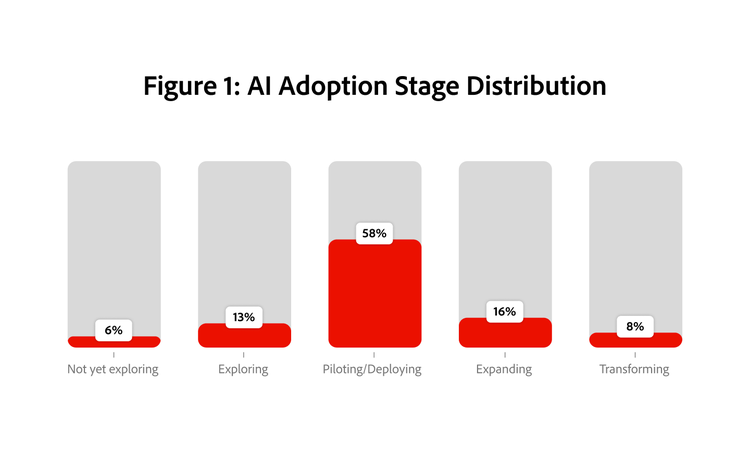
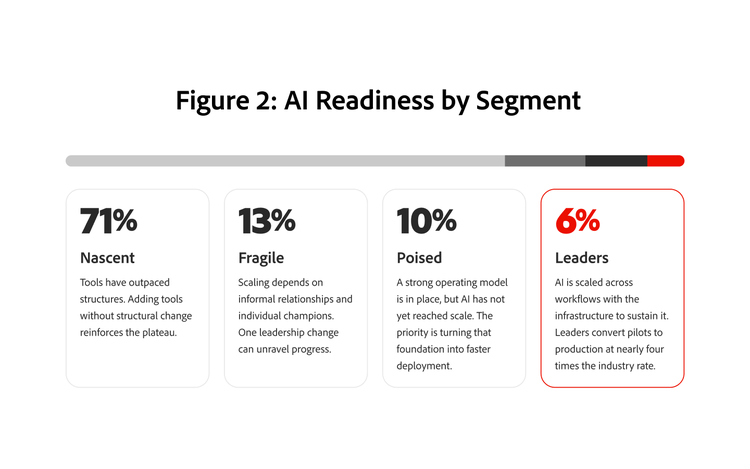
Only 6% of companies, representing 342 organizations in our dataset, have both scaled AI and developed the operating model to sustain it. We call them Leaders. They convert pilots into production at nearly four times the rate of all other organizations.
Structural shifts are the real work.
Maturity breaks down the same way across industries: strategy and governance rank highly, while structure and workflows lag behind. That's not an accident. Leaders can approve a policy or sign off on a strategy in a meeting. Changing roles, shifting decision rights, and redesigning how teams operate on a day-to-day basis take much longer, so companies often postpone those efforts.
When we asked executives what they'd do differently, the answers consistently came down to timing: set clearer metrics, secure funding sooner, appoint an owner earlier, involve IT earlier, and invest in change management sooner. The foundational calls that should have come first were often made after deployment, by which point the opportunity to establish a baseline had already passed.
Building pathways from experimentation to production.
Of every 100 AI ideas proposed, only about 15% make it into production. Approximately 35% of proposals don’t make it past the IT evaluation stage because business teams often lack the architectural and data-related information needed to scope implementation effectively. Another 18% are rejected during security review. In financial services, healthcare, and life sciences, that rate nearly doubles.
The ideas aren't the problem. Companies often lack preapproved pathways that help move initiatives into production: approved integration patterns, standardized security reviews, and established budget categories. Without these mechanisms, proposals must navigate the entire process from scratch, significantly reducing their chances of success.
5 things Leaders do differently.
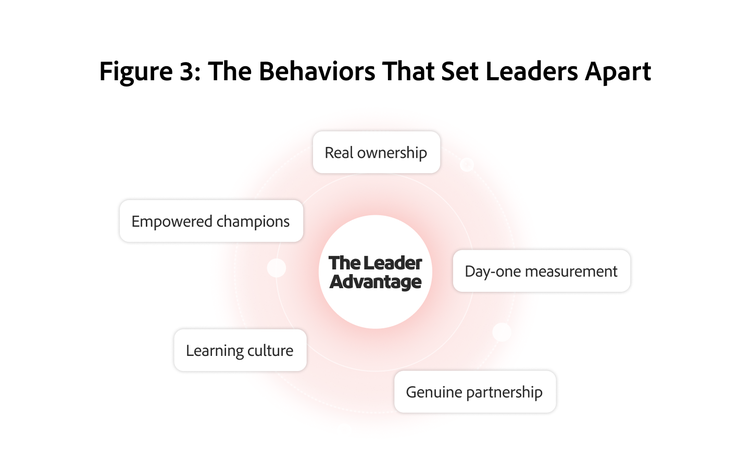
- Name a real owner. Only 20% of companies have a designated AI owner with budget authority and accountability for outcomes. Among Leaders, that figure rises to 92%. A committee can coordinate activity, but no committee truly owns the outcome.
- Measure from day one. Only 11% of companies measure AI ROI comprehensively. Most track usage, but not quality, rework, or the real cost of reviewing AI-generated output. Leaders set a baseline before a model goes live because once it's in production, that baseline can't be recreated.
- Put business and IT in the same room, early. Of the surveyed companies, 78% still manage AI like a ticketing system: the business team submits requests and IT delivers solutions. Leaders build the model together and align on what success looks like even before the project brief is written.
- Treat failure as data, not blame. A third of companies repeat the same AI mistakes because no one identifies and flags the patterns. Leaders keep their destructive failure rate under 1% by creating an environment where failures can be discussed and used as learning opportunities.
- Identify your champions and empower them. Among Leaders, 42% consider this as their single most effective move, and it's also the least expensive. Find the people already making AI work in real-world workflows. Give them recognition, a modest budget to extend what they have built, and the autonomy to scale their work to other teams.
The gap compounds.
Leaders extract 1.4x to 1.6x more value from the same technology than other organizations. The models are the same, but the difference lies in how organizations are built around them.
Ownership drives measurement. Measurement gives business and IT teams shared evidence. This shared evidence drives a collaborative partnership, which makes failure safe to examine. Examined failures surface champions. Champions strengthen the case for more ownership. If these measures are not incorporated, organizations in the Frozen Middle fall further behind with every cycle.
Before you buy another tool, do these 5 things.
- Name an AI owner.
- Set a baseline before launch.
- Bring business and IT into the room before the brief is written.
- Treat failure as evidence, not a career risk.
- Identify and fund the people already making AI work.
Read Adobe’s 2026 State of AI Readiness report to see where your organization sits and what the Leaders did differently.