If you run product launches at your company, you already know the feeling. Your engineering is world-class. Your products are extraordinary. But your launches consistently underdeliver.
Every year, companies across hardware, industrial manufacturing, consumer goods, automotive, retail, and medical devices pour billions into research and development (R&D). And still, the launches stall. Not because the product isn't ready, but because the system around it isn't.
Upstream manufacturing delays force creative teams to wait for physical products to photograph. Agencies spend weeks producing assets that may need to be rebuilt the moment a specification changes. Regional teams wait for localized content that no one has started working on. And the leadership navigates the whole thing through spreadsheets and status meetings that surface problems only after they've already compounded.
This isn't a resourcing problem. It's a structural one.
Sequential launches are leaking revenue before the product ever ships.
Product launches have always been linear. Design finishes, then manufacturing begins, and then photography, agency production, marketing, and regional adaptation. Each gate waits on the one before it. And here's what that costs you:
- Over $200 million in revenue loss from a single auto program launch delay, and over one in three launches experience production delays, according to PwC
- 15%–35% drop in net present value (NPV) of R&D investment when launches fall behind schedule, according to Oakstone Partners
- 45% of product launches are delayed by at least one month, and one in five of those miss internal targets entirely, according to Gartner
Those figures only capture direct losses. They don't account for forfeited first-mover advantages, eroded retailer relationships, or the compounding cost of rebuilding from scratch at every launch because nothing from the last one was built to be reused.
The hidden billion-dollar cost seen with Adobe’s customers.
Across Adobe’s work with manufacturers, the same pattern shows up in industry after industry. Different launch cadences, different operating models, different products, but common failure modes — misaligned teams without visibility into the end-to-end process, and an inability to produce content at the pace and scale that launch deadlines demand.
Consumer goods. A diversified consumer goods company is targeting 1,000 new product introductions over three years, up from less than 200 last year. One division alone launches over 90 products annually, each tied to a hard retailer stock-in-date. For each missed stock-in, first-year revenue for a new SKU drops from around $10 million to $1 million overnight. At their current miss rate, around $800 million in launch-driven revenue is at stake across the plan period.
High-tech hardware. A global hardware manufacturer valued at over $50 billion brings 60,000 new SKUs to market each year. Their teams have the capacity to create rich content for 10% of them. New SKUs drive 40% of revenue, yet 90% of them launch without marketing support due to capacity constraints. The gap is worth over $1.5 billion annually.
Automotive. For car manufacturers, every model-year changeover involves a legacy process that spans many disconnected teams and agencies. Each sequential step is forced to slow down due to dependencies on upstream steps, like manufacturing or big, expensive video shoots. With an American automaker, Adobe estimated untapped savings and revenue capture of $530 million through a more integrated workflow and accelerated timeline that eliminate duplicative spends and delays from manual content production.
Heavy equipment. A global heavy equipment manufacturer runs nearly 600 product updates a year across 26 business divisions, each taking eight weeks to produce market-ready content. Their global customer base operates in 18 languages — launch content was initially available in only 5. The combined cost of the language gap, the content bottleneck, and unnecessary agency spend totals $780 million in lost revenue every year.
The industries differ, and so does the lost value, but the pattern is the same — an inability to scale and orchestrate the content engine effectively reduces an organization's value capture by hundreds of millions annually. Most of the loss often shows up in missed revenue, not on a profit and loss (P&L) line.
Refactoring launches to be conducted in tandem.
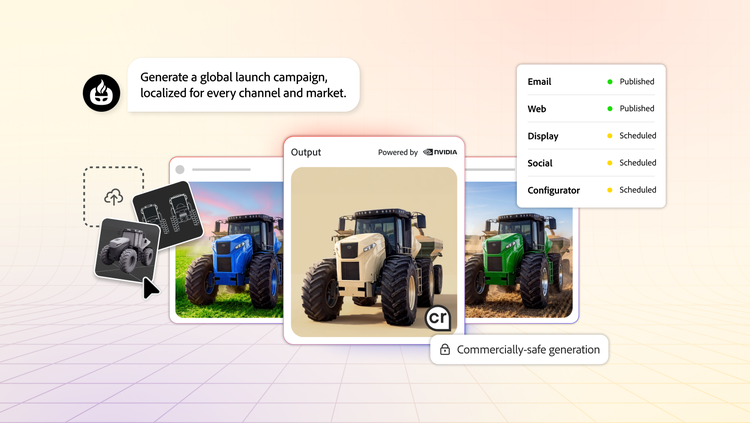
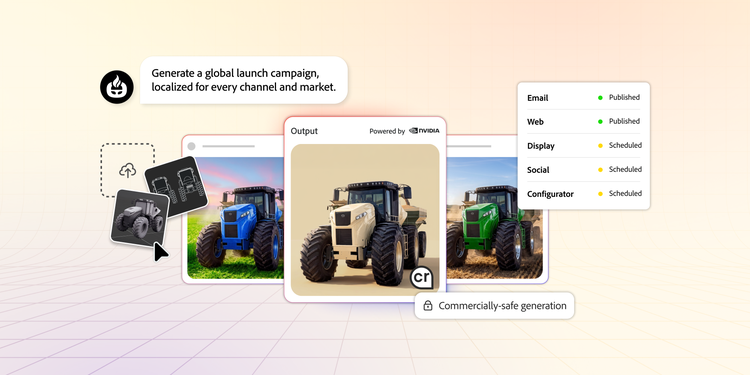
There's a different way to run a launch, one that a growing number of leading companies have already started adopting. Instead of waiting for the physical product to exist before the launch can begin, they treat the launch as running in parallel with manufacturing and supply chain from the moment the product design is finalized.
Content, campaigns, channel enablement, and regional adaptation start when a product's CAD files are stable, not when the first physical unit comes off the line. Creative and marketing aren't downstream of manufacturing anymore. They run alongside it.
Adobe calls this launching in tandem, and it's the structural change that separates companies that pull away from those that still manage traditional sequential handoffs. They aren't faster because they launch differently. They launch differently, which is what makes them faster. Everything else this post covers — product fidelity, digital twins, and generative content at scale — exists to make tandem launches operationally safe and economically viable.