Customer Education Maturity Assessment: What the top 10% customer education teams do differently.
10-15-2026
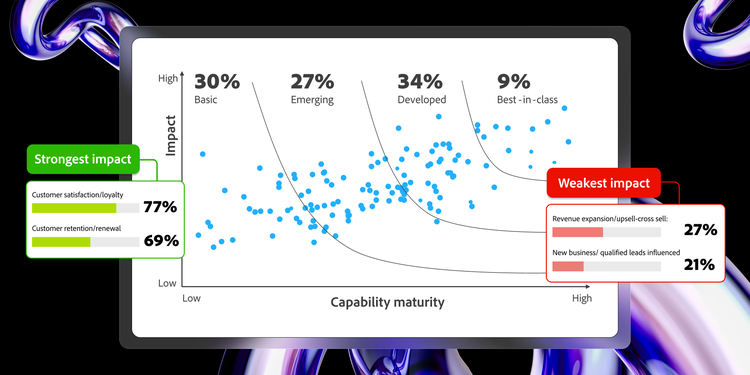
Enterprises are investing heavily in customer education. Eighty percent have an annual customer education budget, 37% spend more than US$500,000 a year, and 85% have at least three people supporting the function.
Yet only 9% of organizations qualify as best-in-class.
A larger content library, a customer training academy, or a dedicated learning platform can expand a program’s capacity and reach. Maturity depends on how effectively those investments help customers build proficiency, adopt products, find relevant learning, and realize value.
Adobe Learning Manager partnered with Everest Group to develop the 2026 Customer Education Maturity Assessment (CEMA) report, a study of what distinguishes customer education programs at different stages of maturity. The research surveyed 150 customer education leaders across North America and EMEA and included interviews with leaders across customer education, enablement, customer success, marketing, product, support, and sales.
The CEMA report assesses both the impact customer education creates, and the capabilities organizations need to deliver it consistently and at scale.
What is customer education maturity?
Customer education maturity measures how consistently an organization can use customer training and education to improve customer experience, product adoption, operational performance, and business outcomes at scale.
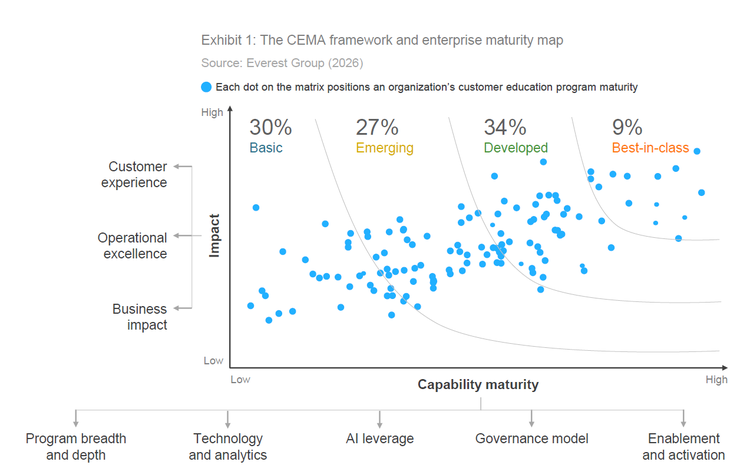
CEMA evaluates maturity across impact and five capability areas: program breadth and depth, technology and analytics, AI leverage, governance, and enablement and activation.
A mature customer education program provides structured paths for customers to build proficiency, connects learning with customer data and business systems, makes education available across relevant customer touchpoints, and measures its relationship with outcomes such as product adoption, support efficiency, retention, and growth.
An LMS for customer education can provide the foundation for these experiences by connecting customer learning, data, delivery, and measurement at scale.
How is AI changing customer education?
AI is changing customer education by improving how learning is created, discovered, personalized, practiced, and analyzed. Organizations are already using AI for search and content discovery, content creation and updates, learner support, and personalized recommendations.
AI for personalized learning can also help programs move beyond static learning paths by using learner and customer context to determine what may be most relevant next.
The difference often comes down in part to customer context. 59% of organizations use learner profile data for personalization and 55% use course history or assessment performance. Only 9% use CRM, customer success, or account-health data, 7% use support activity and customer pain points, and 4% use product usage or in-product behavior.
This context gap helps explain why many AI applications remain stronger at finding and recommending learning than at anticipating what an individual customer needs next.
1. Your product keeps changing. How can AI keep customer training current?
A product release rarely creates one content update. New features can affect onboarding, existing courses, assessments, support content, certifications, and learning for different customer roles. Add multiple products, regions, and languages, and keeping customer training current becomes a continuous workload.
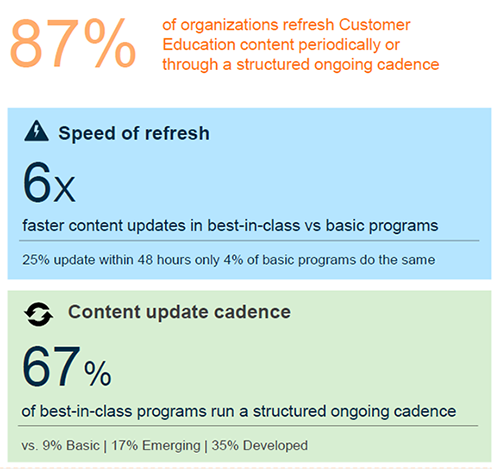
Customer education leaders are already feeling that pressure. Fifty-one percent of enterprises in the Customer Education Maturity Assessment research cite limited internal capacity to produce and update content at the required pace. Product changes, learner feedback, support inputs, and product-use insights also come from different teams, which makes timely updates harder to coordinate.
The consequence is a growing gap between the product customers are using and the training available to help them use it. Customer education teams can also spend so much time maintaining existing content that there is less capacity to address new customer needs.
AI can help shorten that cycle, particularly when it works with the product knowledge and source material teams already trust. For example, Adobe Learning Manager’s Content Composer can help you create courses in a fraction of the time by turning existing source material into course briefs, outlines, content, activities, and assessments.
https://video.tv.adobe.com/v/3497281?hidetitle=true
For customer education teams, that can reduce the lag between a product change and accurate training reaching customers, while preserving expert oversight over what gets published.
2. Onboarding gets customers started. How does customer education build product proficiency?
Most customer education programs have invested heavily in helping customers get started. The difficulty comes after onboarding. As the content library grows, customers can be presented with more courses and resources without a clear path showing what they should learn next, which skills they need for their role, or how to progress toward deeper proficiency.
The Customer Education Maturity Assessment research findings show this gap. 91% of organizations provide education for onboarding and implementation, 85% for support and self-service, and 83% for ongoing product adoption. Only 47% extend customer education into advanced use and deeper product proficiency. The report also identifies organizing growing content libraries into role-, journey-, and proficiency-based pathways as a key challenge.
Without that progression, customers may repeat material they already know, miss learning relevant to their role, or rely on CSMs and support teams to tell them what to learn next.
AI for personalized learning can help make progression more responsive without requiring customer education teams to manually create a different path for every customer. For example, Adobe Learning Manager’s Learning Path Agent uses conversational goal discovery to understand what a learner wants to achieve, recommend relevant topics, and create a learning journey that can adapt as their needs change.
https://video.tv.adobe.com/v/3497634?hidetitle=true
3. What does AI for personalized learning need to know about your customers?
Personalization is limited when learning data is disconnected from product and customer signals.
A learner’s role, course history, and assessment scores are useful signals, but they do not tell you which features the customer is using, where adoption has stalled, what support issues they are encountering, or where the account sits in its lifecycle.
The Customer Education Maturity Assessment research shows how significant this context gap is. Fifty-nine percent of organizations use learner profile data for personalization and 55% use course history or assessment performance. Usage drops sharply for signals closer to the customer experience: 14% use maturity or adoption-gap data, 9% use CRM, customer success, or account-health data, 7% use support activity or customer pain points, and only 4% use product-use or in-product behavior.
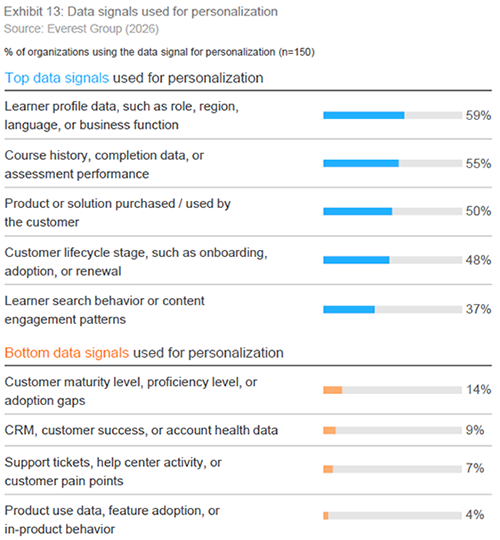
Without that context, AI can recommend learning but may struggle to understand why a particular customer needs it now. The Customer Education Maturity Assessment report identifies fragmented data infrastructure as one of the factors keeping AI closer to search and routing than to context-aware personalization and next-best-action guidance.
The report points toward a more mature model in which learner data is combined with product use, lifecycle stage, account health, support interactions, and adoption gaps. With that context, AI can help customer education respond more closely to what a customer is trying to achieve and where they may need help next.
4. How can customer education deliver learning at the moment of need?
Customer education teams can build a comprehensive customer training academy and still hear customers ask where to find help. The problem often appears when a customer needs guidance in the middle of using a product. The right answer may already exist in a course, video, document, or help resource, but finding it requires the customer to stop what they are doing, navigate to another destination, and search for the right content.
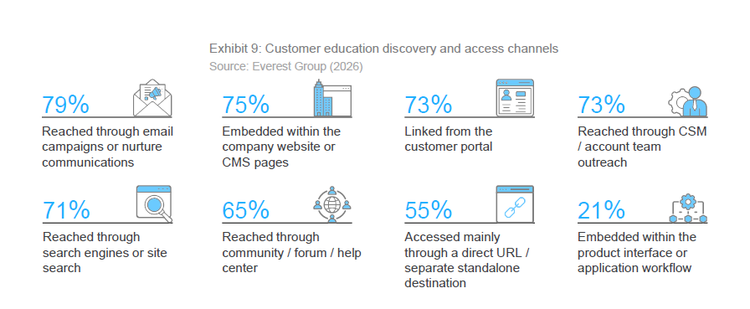
The Customer Education Maturity Assessment report shows that customer education discovery still relies heavily on customers moving between channels. Email is a discovery route for 79% of organizations, company websites for 75%, and customer portals for 73%. Only 21% embed learning within the product interface or application workflow.
The consequence is unnecessary friction. Customers may turn to a CSM or support team, open a ticket, or continue without the answer, even though the organization has already invested in creating the learning they need.
Conversational AI can make that existing knowledge easier to access. Instead of asking customers to determine where an answer lives, it can let them ask a question in natural language and surface relevant guidance. For example, Adobe Learning Manager’s Answers Agent provides contextual answers with citations and recommends relevant courses based on a learner’s query. It can draw on learning content such as courses, videos, documents, and PDFs and generate useful outputs such as summaries, scripts, and talking points.
https://video.tv.adobe.com/v/3497494?hidetitle=true
5. How do you measure the impact of customer education?
Participation and completion may be relatively visible, but understanding where customers are struggling, which content is effective, or how learners are progressing across their journey often requires deeper analysis.
The Customer Education Maturity Assessment research shows how quickly that visibility drops. Eighty-three percent of organizations track learner reach and 81% track completion at an intermediate or granular level. Only 45% have comparable visibility into content effectiveness and format performance, and 37% into the full learner journey, including drop-off points and time spent.
“We track how learners engage, how much of the course they finish, and what customers tell us. We share those findings with leaders and other teams so we can decide which new trainings to build and fix anything that is causing frustration for users.”
- Senior leader
Customer Success, a US-based automotive manufacturing company
The consequence is that questions CE leaders routinely need to answer can take more effort than expected. Where are customers dropping off? Which content is working? Which customer groups need more support? How is certification progressing? The data may exist, but accessing the right view can involve manual exports, custom reports, or support from analytics teams.
AI can make learning data easier to access and interrogate. For example, Adobe Learning Manager’s Learning Insights Agent allows customer education leaders to ask questions about learning data in natural language and receive answers without having to build a report or depend on a BI request.
https://video.tv.adobe.com/v/3497499?hidetitle=true
Proving the relationship between education and business outcomes is harder still. Learning activity may sit in one system while product usage, support interactions, account health, renewal, and revenue sit elsewhere. The Customer Education Maturity Assessment research identifies fragmented systems and the difficulty of mapping individual learner activity to account-level outcomes as barriers to attribution.
6. How do you govern an AI-powered learning platform for customer education?
Customer education already brings together product teams, subject-matter experts, customer success, support, and CE. AI adds decisions that need clear ownership. Which customer data can be used to personalize learning? Who reviews AI-generated content before it reaches customers? How are accuracy and quality maintained as content changes? And what controls are needed for customer-facing AI experiences?
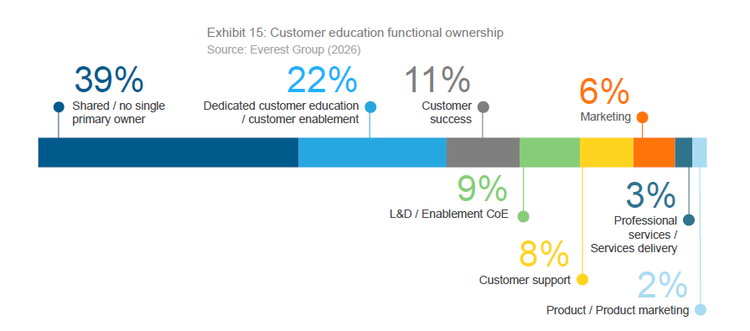
The CEMA report found that organizations experimenting with AI-enabled content may lack defined ownership, review standards, quality controls, and update workflows. The report found that 39% operate with shared ownership and no single primary owner for customer education. While 80% have an annual customer education budget, only 22% place the program within a dedicated customer education or customer enablement function.
For customer education leaders, this makes the governance and security of the underlying AI-powered learning platform an important consideration. For example, Adobe Learning Manager applies Adobe’s responsible AI principles around accountability, responsibility, and transparency. Its AI capabilities operate within Adobe’s cloud environment, with enterprise security and compliance standards that include GDPR, SOC 2, and ISO 27001.
Governance also needs to extend to the AI experience itself. Adobe Learning Manager grounds capabilities such as Answers Agent in trusted learning content and provides citations with responses, while Content Composer keeps authors involved in reviewing, refining, and approving learning before publication.
What do best-in-class customer education programs do differently?
Only 9% of the organizations assessed in the CEMA report reached the best-in-class stage of customer education maturity. Their advantage does not come from adopting every available technology or producing more learning. They have built the foundations that allow customer education to work as a connected part of the customer journey.
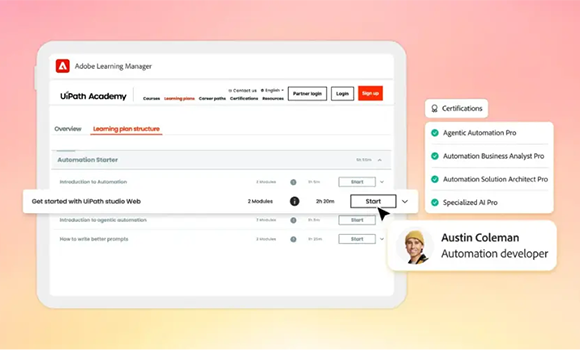
UiPath Academy shows what customer education at scale can look like. The Academy has grown to more than 2.2 million registered users, with more than 70% of UiPath’s paying customers having at least one Academy user. UiPath has built that reach around role-based learning paths, certifications, and learning localized across multiple languages, supported by Adobe Learning Manager as its core learning platform.
Best-in-class programs use role-based learning pathways, AI-enabled scale, integrated delivery, and outcome intelligence to support customer value. Learning is available across customer touchpoints rather than confined to an academy, and customer context helps determine what customers see next. Among these organizations, 83% have a fully established academy, more than half use in-product nudges to surface learning, and all use recognition to reinforce participation.
The lesson for customer education leaders is not to replicate every practice at once. The top 10% show what becomes possible when the fundamentals are connected: trusted content, customer context, integrated technology, clear accountability, and evidence of impact. AI can then help the program respond faster and more intelligently to what customers need.
Explore the Customer Education Maturity Assessment report to see where your customer education program stands and what to prioritize next.
Recommended for you
https://business.adobe.com/fragments/resources/cards/thank-you-collections/learning-manager