Why creative intelligence is the next frontier in marketing and advertising performance.
Sam Garfield and Zack Ackerman
03-09-2026
For the better part of two decades, marketing and advertising technology investment has been centered on audience precision and media efficiency. While these efforts yielded significant results, most of the easily achievable improvements have been made. Now, attention is shifting to the next frontier — creative intelligence.
While studies show that creative quality is a strong contributor to advertising effectiveness across key metrics, most teams operate with surprisingly little visibility into what makes one creative execution outperform another. As a result, organizations invest heavily in production without knowing which approaches will succeed. This disconnect creates a clear opportunity for investment in creative intelligence to deliver improved business performance and competitive advantages for marketing and advertising teams.
To better understand this opportunity and the evolving creative intelligence landscape, we partnered with Winterberry Group, a growth consultancy specializing in the intersecting disciplines of marketing, advertising, technology, data, and analytics. In a comprehensive whitepaper leveraging a combination of quantitative industry surveying, expert interviews, secondary research, and market modelling, the team assessed how creative intelligence is being applied across the content lifecycle, how adoption is occurring across industries and organization types, what primary use cases are driving demand, and what the outlook is for future growth.
This blog will cover:
What creative intelligence means and why it matters now
Where creative intelligence delivers the biggest impact
Recommended next steps for getting started
What is creative intelligence?
Creative intelligence refers to understanding why customers engage with pieces of creative content. It goes beyond measuring whether a campaign worked to answer why it worked — identifying the creative elements and choices that drive engagement and results.
While there are historical forms of creative testing and measurement (A/B testing, focus groups, click-tracking) that are widely used today, the next evolution in creative intelligence has only recently become accessible.
Technological advances now allow teams to deconstruct advertising assets automatically, cataloging thousands of creative decisions (for example, color palette, logo placement, copy clarity, etc.) and correlating those decisions with performance outcomes. This evolution is also driven by advanced integration between creative and media technology.
The business case is straightforward. Research shows that 40–50% of creative assets produced never get activated in campaigns. Creative intelligence helps organizations eliminate a substantial amount of this wasted production effort, while fine-tuning assets that are activated for optimal results. By unlocking predictive, in-flight, and post-campaign insights, teams can ensure their creative and media dollars are allocated in the most efficient and effective way.
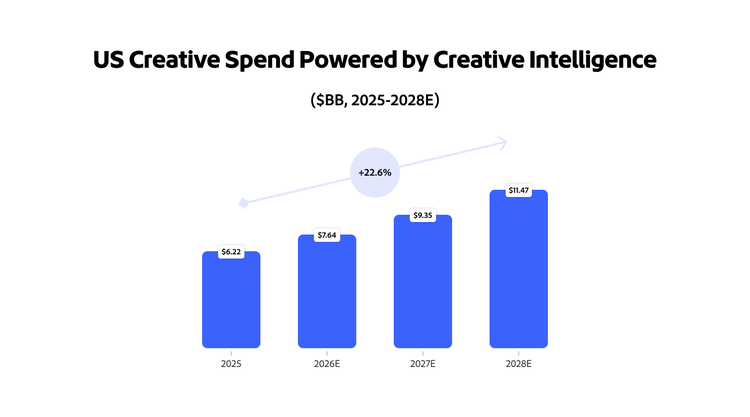
This value proposition is resonating with businesses across industries and resulting in significant investment. In the US alone, creative spend powered by creative intelligence is projected to reach US$11.47 billion by 2028, growing at approximately 23% annually.
Source: Winterberry Group Market Model 12.25
Where creative intelligence delivers impact.
The application of creative intelligence spans the entire campaign lifecycle, but three areas stand out for immediate return on investment.
1. Eliminating production waste through pre-testing.
Before committing production budgets, marketers can now evaluate creative concepts against historical performance patterns and platform-specific best practices. Predictive scoring assesses work-in-process assets across a variety of dimensions, including audience attention patterns, channel constraints, and brand compliance.
This upfront evaluation prevents costly mistakes. For example, when analysis indicates that copy exceeds optimal length for display advertising or that a proposed asset’s colors or environments are not in compliance with brand standards, teams can adjust before investing in final production. The result is a higher percentage of assets being used and better performance from those that go live.
With access to historical asset- and attribute-level insights for paid campaigns via GenStudio for Performance Marketing and for owned channels via Adobe Content Analytics, teams can begin the creative process with a clear view of what works creatively and where resources should be invested.
GenStudio for Performance Marketing also enables additional pre-testing by allowing teams to quickly assess content against their brand, persona, and channel guidelines before activation. Together, these capabilities help organizations create more effective content more efficiently and earlier in the creative cycle.
“Brands increasingly manage creative through scoring models rather than manual preflight reviews, codifying creative rules — such as logo placement or promotional messaging — into measurable criteria.”
Vice President of Product and UX
Creative Data Company
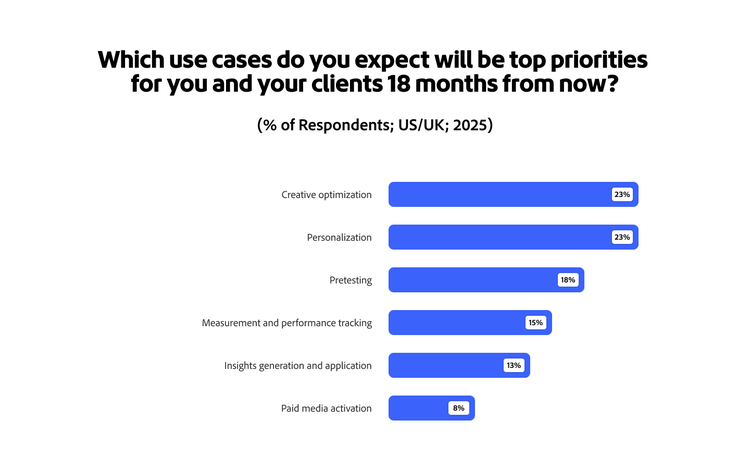
2. Scaling personalization economically.
Personalization has long promised better results but faced practical barriers around production volume and cost. Creative intelligence platforms address this through modular assembly, combining proven components into audience-specific variations without manual design work for each permutation.
During campaign execution, systems automatically select creative variants based on real-time signals, including audience segment, device type, and prior engagement behavior. This enables the level of personalization audiences expect — without proportional increases in production workload.
GenStudio for Performance Marketing recognizes this need with its Adobe Real-Time CDP integration. Marketers can build content that starts with full customer context, messaging preferences, buyer segment, journey stage, and behavioral data — to tailor ad creative and copy by audience segment. With high-quality variants at the ready, creative activation systems can quickly serve the right piece of content to each individual.
Source: Winterberry Group Survey, n=125 (2025)
3. Measuring creative contribution to outcomes.
Perhaps the most strategically important application involves quantifying creative's actual contribution to results. By tracking which specific creative elements appeared in high-performing campaigns and controlling for media and audience variables, organizations can finally answer questions such as:
Do authentic customer testimonials outperform stylized lifestyle imagery?
Which emotional tones drive consideration versus immediate purchase?
These insights inform not only optimization within active campaigns but also broader strategic decisions about creative investment and approach. For instance, when organizations can demonstrate that creative quality contributed X percentage points to conversion rate improvement or Y dollars to incremental revenue, creative budgets become easier to justify, and teams gain clearer direction about what to prioritize.
Adobe Content Analytics enables teams to easily answer these questions by pairing the analysis of creative and behavioral data across owned digital channels. This provides a holistic view of the customer journey through a content lens, allowing organizations to identify the most effective assets, attributes, and placements that drive results. Not only does this help demonstrate value for in-flight or completed campaigns, but it also allows creative teams to optimize future campaign assets based on high-performing, ROI-driving attributes.
Getting started and scaling your creative intelligence practice.
Creative intelligence represents a fundamental shift in how marketing organizations approach advertising effectiveness. For organizations getting started in their creative intelligence journey, the recommended next steps are:
Assess current creative workflow inefficiencies: Identify where your organization experiences the most pain — production bottlenecks, high asset abandonment rates, or difficulty scaling personalization.
Start with measurement to build the business case: Establish baseline creative performance measurement across current campaigns to document which approaches are working and where improvement opportunities exist.
Pilot pre-testing on high-volume channels:Paid social and programmatic display offer controlled environments for testing predictive creative scoring.
Integrate creative and media planning earlier: Break down silos between creative development and media activation teams through joint planning sessions.
Build cross-functional capabilities: Invest in training team members who understand both creative strategy and data analysis. Creative intelligence augments human judgment — it doesn't replace it.
“Best suited are people who sit between analytics and creativity — part analyst, able to form hypotheses and interrogate data, part strategist translating insight into direction and narrative, and part creative able to turn insight into campaign ideas.”
VP of Creative Strategy
Digital Marketing and Advertising Company
For marketing and advertising leaders navigating budget pressure while facing demands for better performance, creative intelligence offers a path forward. By transforming creative from a fixed cost into a measurable, optimizable driver of results, organizations can finally close the loop to understand not just who saw their content and where, but why that content succeeded or failed.
Sam Garfield serves as the Head of Digital Strategy, Communications, Media, and Travel at Adobe, where he provides thought leadership and works with CMT companies on digital transformation efforts. In his previous role, he was the strategic lead responsible for setting the vision, strategy, and focus of AARP Services’ data infrastructure and analytics offering. Prior to that, Sam spent 16 years at Discovery Inc., focusing on financial systems, process improvement, and data analytics. He was the Vice President of Data Strategy and Advanced Audience Platforms, providing leadership on the data strategy and roadmap for Engage, Discovery’s advanced TV product. He has received bachelor’s and master’s degrees in Business Administration from the University of Maryland.
Zack Ackerman is a Data Strategy Manager in Adobe’s Digital Strategy Group, where he advises clients across industries on their digital transformation efforts for customer experience and content supply chain. Prior to Adobe, Zack spent four years in corporate and investment strategy for travel, hospitality, and healthcare brands. He received his bachelor's degree from the University of Virginia and his master's degree from Virginia Commonwealth University.