2026 AI AND DIGITAL TRENDS IN CONTENT CREATION AND MANAGEMENT
Scaling an AI-Powered Content Supply Chain.

Inside Adobe’s 2026 AI and Digital Trends in Content Creation and Management report.
Content demand is growing and brands need operations that can keep up around the clock. Generative AI is already accelerating content production and agentic AI is poised to further transform how content is created and managed. But adoption challenges stand in the way of scalability — from fragmented data to skills gaps and unclear measures of success.
This year's report examines where organisations stand today and what it takes to move from early adopter to AI leader:
- Agentic AI enables end-to-end operations: Over half of organisations say their current content supply chain is largely linear and resource-intensive.
- Discoverability is the new imperative: 48% are optimising their content to be interpreted and surfaced by AI-powered discovery tools.
- Bets are being placed on agentic AI to reshape operations: As many as 69% expect agentic AI to assist employees with research, insights or knowledge retrieval.
- AI adoption is hitting real limits: 75% say data integration and quality issues are major obstacles to agentic AI implementation.

2026 AI AND DIGITAL TRENDS IN CONTENT CREATION AND MANAGEMENT
Scaling an AI-Powered Content Supply Chain
Content demand is accelerating, driven by rising expectations for personalisation and the need to market to both human audiences and AI agents. Adobe's AI and Digital Trends in Content Creation and Management report shows how organisations can move past AI adoption hurdles to build scalable content operations.

Jump to the Key Content Creation and Management Trends




Introduction
Enterprise content supply chains are under mounting pressure to deliver more assets, to more channels, at a pace that traditional workflows were never designed to support. The shift toward AI-powered content operations offers a path forward. However, creating multi-channel and AI-discoverable content that is personalised at scale while maintaining brand consistency demands more than siloed AI pilots that lack a unified strategic vision. To capture AI’s full value, leadership must work with practitioners to reimagine the end-to-end content supply chain — from workflow and planning through creation and production, asset management, delivery and activation and reporting and insights.
Our global survey of 3,000 executives and practitioners for the Adobe 2026 AI and Digital Trends report reveals that generative AI is already accelerating content ideation and production. Agentic AI, meanwhile, promises to go further by providing the always-on brand intelligence that orchestrates tasks across the entire content supply chain — at scale, with governance and increasing precision. Yet adoption of agentic AI remains in the early stages and persistent challenges around data readiness, talent gaps and measurement frameworks threaten to stall progress. Brands must align strategic priorities across the organisation, address underlying structural and workforce pitfalls and invest in the right foundational tools and practices to move from isolated AI wins to fully integrated, scalable content operations.

Section 1
Transforming Content Creation and Management with AI
Generative AI has quickly moved beyond experimentation to become an integral part of production for content teams. Meanwhile, early adopters are already layering agentic AI on top to connect previously siloed processes.
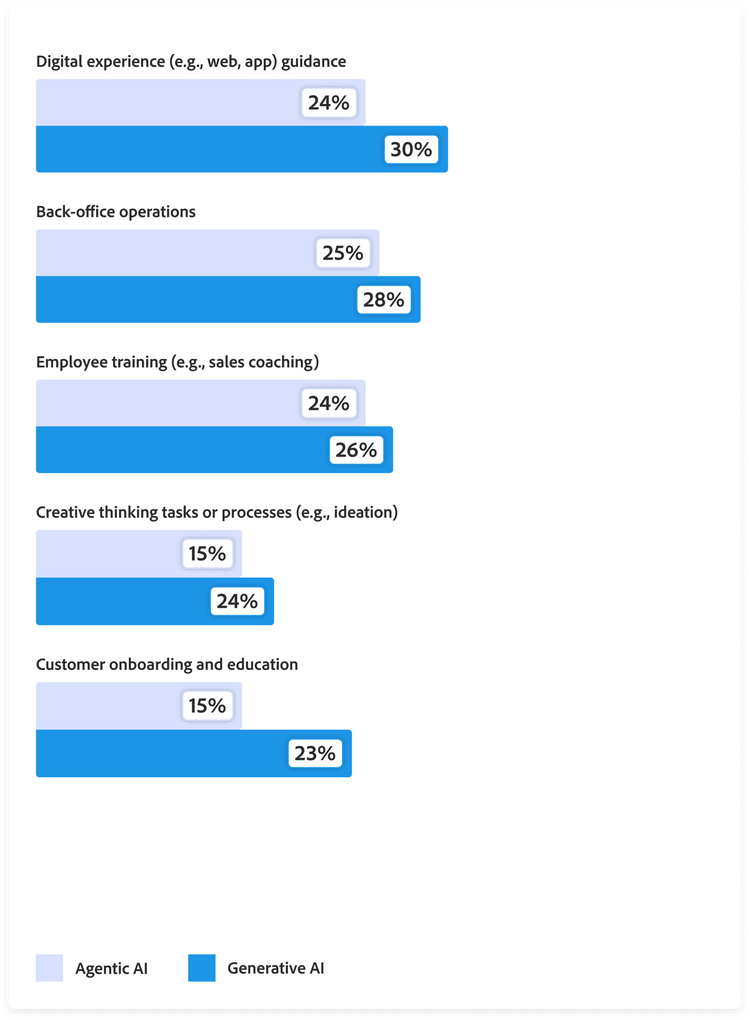
Nearly half of organisations have embedded generative AI organisation-wide or across multiple functions for marketing content creation and activation, at a rate higher than any other workflow. Agentic AI is still in the early stages, but some organisations are already making headway, with nearly a quarter having deployed it in the same area.
Creativity is another area undergoing meaningful investment, with 24% having deployed generative AI to an equal degree for creative thinking tasks or processes, such as ideation. Meanwhile, 15% have already achieved widespread deployment of agentic AI to augment such tasks (Figure 1).
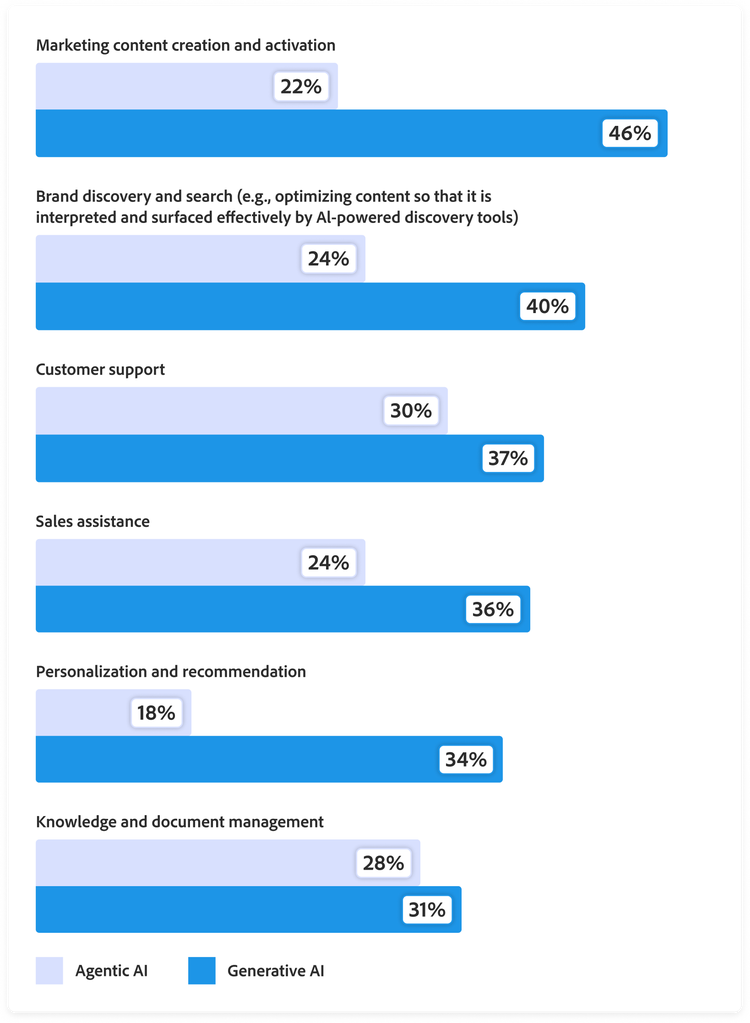
Improvements brought by generative AI are showing up across multiple dimensions of content operations. Over three-quarters (76%) say generative AI has moderately or significantly improved the volume and speed of content ideation and production at their organisation. The gains extend beyond core creative teams: 70% say generative AI improved content creation among non-creative teams. Another 69% report employee productivity and efficiency improvements thanks to their organisation’s adoption of generative AI.
However, these productivity gains have not yet resolved a fundamental structural problem. Over half (53%) describe their organisation’s current content supply chain as largely linear and resource-intensive. This is precisely the gap that agentic AI is positioned to close. Where generative AI accelerates individual tasks, agentic AI introduces real-time, brand-compliant intelligence that orchestrates routeing, approvals, scheduling and asset reuse — transforming linear pipelines into dynamic, end-to-end operations.
Scaling AI across the content supply chain requires making existing assets machine-readable and discoverable, especially as customers increasingly rely on AI-enabled platforms to find and research brands. To enable the widespread adoption of generative AI, about half (48%) of organisations are optimising their content to be interpreted and surfaced effectively by AI-powered discovery tools. Only slightly fewer (41%) are investing in the same foundational practice in their efforts to adopt agentic AI. However, about a third (34%) say their organisation has not made this investment for either generative or agentic AI or are unsure. Closing this gap is essential. Agents can only surface and reuse assets that have been properly tagged, structured and catalogued.

Section 2
Strategic AI Investment Priorities and Ambitions
With early returns from generative AI now visible, organisations are channeling investment toward a more ambitious goal: using agentic AI to intelligently orchestrate content processes at scale.
Delivering more personalised customer experiences tops the list of AI investment goals for organisations over the next 18 months. Automating repetitive tasks and workflows is also a major focus, with 45% rating this a top-three AI investment priority at their organisation. And nearly one-third (31%) are committed to increasing and accelerating content creation and activation efforts through their AI investments, recognising the importance of maintaining a scalable and adaptable content strategy.
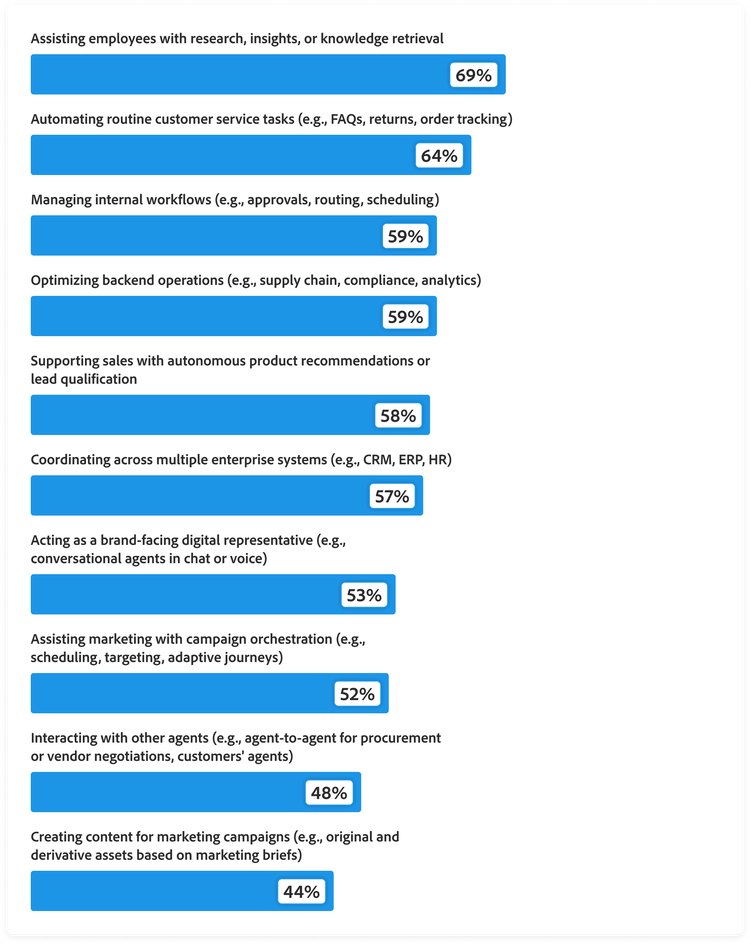
To achieve these goals, organisations are betting on agentic AI to reshape internal operations in the near term. The expected use cases span the full breadth of content workflows. As many as 69% expect agentic AI to assist employees with research, insights or knowledge retrieval and 59% foresee it managing internal workflows, such as approvals, routeing and scheduling. Fewer (44%) anticipate that agentic AI will create content for marketing campaigns — including original and derivative assets based on marketing briefs. This suggests that some organisations recognise the clear opportunity to enhance their marketing strategies with AI-driven content creation, but the path to broad adoption remains uncertain for many (Figure 2).

Section 3
Challenges in AI Integration, ROI and Governance
The path from AI experimentation to scaled, enterprise-wide embeddedness is not without significant obstacles. Data readiness, talent shortages and measurement gaps are converging to slow progress for brands — while the additional imperative of governing on-brand, compliant content at scale adds another layer of complexity.
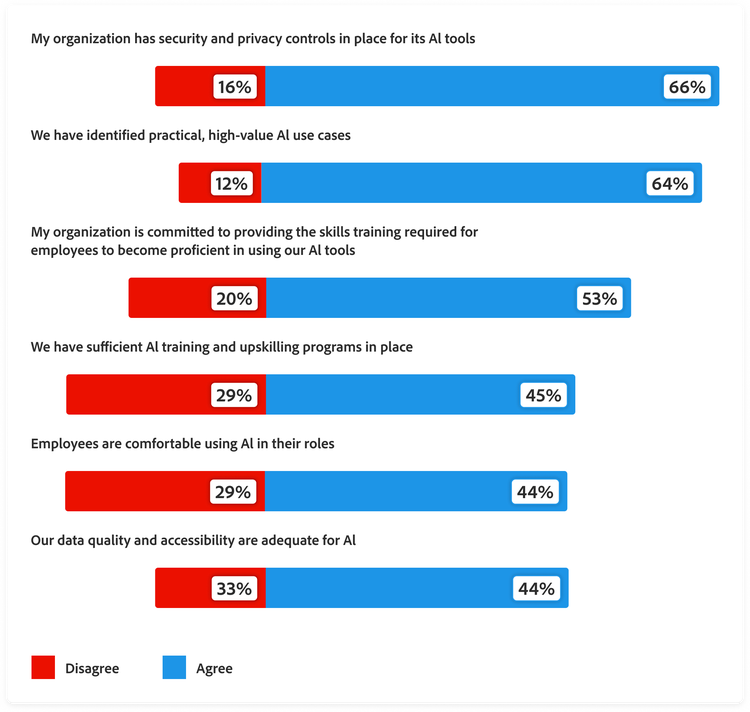
Data quality remains the most pervasive barrier. Less than half of brands (44%) believe their data quality and accessibility are adequate for AI today, suggesting further complexity involved in the scalability of AI-driven solutions. Moreover, 52% feel that their ability to advance AI initiatives is limited by their current level of data unification and structure. The challenge intensifies for agentic AI specifically: data integration and quality issues are major obstacles to agentic AI implementation for three-quarters (75%) of organisations, highlighting the need for robust data management practices.
Workforce talent is nearly as big a challenge: 71% identify a lack of relevant skills and limited upskilling resources as barriers to agentic AI implementation. And while 53% of organisations say they are committed to providing the training employees need to become proficient with AI tools, fewer (45%) believe they have sufficient AI upskilling programmes in place today (Figure 3). Without the people who can build, manage and optimise agentic workflows, even the best data infrastructure will underdeliver.
A disconnect is emerging between what leadership says is most important for benchmarking AI’s value and how success is actually measured. When asked for the single most important success metric for AI initiatives according to their organisation’s senior executives, a third (33%) identified customer satisfaction and loyalty, making it the topmost selected option. Revenue growth followed at 19% and operational efficiency and cost savings at 14%. However, over half (56%) also say their organisation’s leadership prioritises purely financial metrics when assessing the success of AI initiatives. This lack of clarity only compounds the disconnect around strategic priorities for AI: many (39%) consider unclear measurement of AI’s value or ROI as a top contributor to misalignment between senior executives and day-to-day practitioners.
As the volume of AI-generated content increases, effective governance frameworks become essential to ensure brand consistency, regulatory compliance and quality control. Organisations scaling AI across their content supply chains face the daunting challenge of maintaining brand standards when content is quickly produced across multiple channels. Nearly half (47%) of these organisations utilise generative or agentic AI for journey design and omnichannel activation to achieve personalisation at scale, yet only 16% rank brand adherence safeguards as a top-three priority for maintaining customer trust when deploying AI agents.
Despite the importance of governance, over half (55%) confirm having strong AI governance policies today, but only 43% report their policies are consistently followed. Furthermore, about a fifth of brands (21%) identify governance, risk or compliance concerns as major challenges in implementing agentic AI solutions.
Investing in responsible AI practices is key. Nearly two-thirds (65%) have adopted guidelines for ethical AI use of generative AI, although only 37% have extended similar efforts to agentic AI. Additionally, 59% of organisations have centralised oversight for generative AI tools and performance, compared to just 46% for agentic AI. As organisations continue to invest in AI to transform content creation and management, establishing the proper governance guardrails for AI-generated output will be essential. The organisations that fail to do so face the risk of creating non-compliant content that dilutes their brand, delivering disjointed experiences for customers.

Section 4
Key Insights and Next Steps
Generative AI is already enabling marketing and creative teams to push the volume and speed of production to new heights. However, as AI increasingly becomes the first touchpoint for customers, brands will need to restructure their entire content supply chain to remain discoverable and competitive.
Agentic AI offers the potential to optimise operations and orchestrate content creation and management at scale to deliver the highly personalised, on-brand experiences customers expect. Brands will not be able to realise this potential with isolated AI tools or point solutions. Successful deployment requires an integrated content supply chain that connects people, workflows, assets and data end to end.
Organisations can take key steps to prepare for an agentic future:
- Optimise content to be AI-readable and discoverable. Properly tag, structure and catalogue content to reach a customer base increasingly partial to AI discovery tools.
- Unify data to successfully scale agentic AI. Improve data quality and accessibility to enable agentic AI tools to optimise workflows with real-time insights.
- Align leadership’s AI vision with workforce readiness. Invest in upskilling resources to build AI talent and establish measurement frameworks that clearly demonstrate AI’s real value.
Research Methodology
Recommended for you