2026 AI and Digital Trends - 4 key takeaways at the intersection of AI, agents, and human-centered customer experience.
There’s a lot to be optimistic about when it comes to how generative and agentic AI are empowering customer experience orchestration. From AI-powered experiences that feel human and brand-aligned to highly anticipatory real-time engagement, the vision for the next few years looks both engaging and personalized. Our latest research, Adobe’s AI and Digital Trends report, underscores the excitement brands are feeling about AI’s potential to deliver experiences that are conversational, contextual, authentic, and orchestrated, for both humans and AI agents.
Now in its sixteenth year, this research, conducted in partnership with Oxford Economics, surveyed 3,000 executives and practitioners and 4,000 customers globally to better understand how brands are leveraging AI to capture customer interest, build brand loyalty, and augment customer experience (CX) workflows — and how customers are responding to these market dynamics.
This year’s report surfaces the CX trends that will guide how organizations scale, invest, and focus. The full report is worth a read, and I’ve highlighted the most compelling data points I believe will shape conversations over the next 12 months.
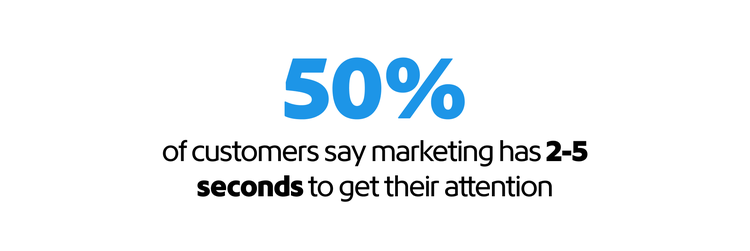
1. The window to make an impression is short: Customers say content in channels like social media, digital ads, and promotional emails, have only two to five seconds to capture their interest.
Brands have been noticing this trend for a while, but the data actualizes it in terms of seconds. We live in an attention-based economy. Every day consumers are overwhelmed with content and marketing messages that are irrelevant, poorly timed, or even misleading. When your brand has just a few seconds to capture attention and connect, delivering contextual, authentic experiences across every channel and interaction is business critical.
As you'll see in our forthcoming AI and Digital Trends consumer report, customer dynamics are undergoing a seismic shift, 51% of customers now name value for price as a top factor shaping trust — ahead of more traditional factors like brand reputation, consistency of experience, and values.
This consumer data also indicates that 25% of customers now use AI platforms like ChatGPT as their top research tool, making them more popular than brand sites, reviews, or traditional media. AI is becoming an increasingly integral part of customers’ everyday shopping behavior, with nearly half of respondents saying they would use it to search for personalized product recommendations (49%) or access instant customer service (44%). Now more than ever, marketing and creative teams will look to generative and agentic AI to plan, ideate, produce, and deliver content more efficiently, driving standout customer experiences and capturing the attention your brand deserves.
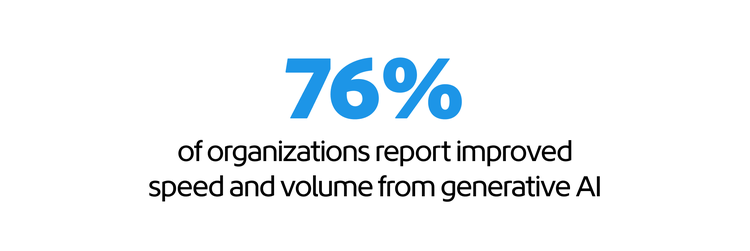
2. Generative AI experimentation pays off: 76% of organizations report improvements driven by generative AI in volume and speed of content ideation and production.
The AI and Digital Trends research reveals that organizations report “moderate” to “significant” improvements driven by generative AI not just in content ideation and production (76%), but in employee productivity and efficiency (69%) —and even marketing-driven revenue growth (65%). The evidence is clear. Brands are making substantial progress and should continue that momentum of improvement.
To meet customers at the right place and right time, across any touchpoint, brands will have to move from experimentation to execution, scaling AI across multiple functions or deploying it enterprise‑wide. This is a challenge that many brands are struggling with, so clarifying how to scale generative AI experiments will be a top priority for brands this year.
3. Expectation for agentic AI: Nearly two-thirds of organizations expect agentic AI to free employees for more strategic and creative work.
The data reveals the incredible expectations brands have for agentic AI. Sixty-three percent of organizations expect agentic AI to free employees for more strategic and creative work. A third of them are prioritizing the implementation of emerging technologies like agentic AI over more widely adopted ones like generative AI. The expectation is understandable when you consider the anticipated benefits of agentic AI — systems designed to take autonomous action across internal and customer-facing workflows. A large portion (42%) even said they plan to design distinctive AI agent personalities for different audiences.
The ambition to reap the benefits is what is driving organizations to transform quickly. At the same time, customer openness to agents is still somewhat guarded. One-fifth of customers are not open to creating their own personal agent, and close to 40% have not even considered this prospect. While customers may not be open right now, the dramatic evolution of customer behavior over the previous 18 months, during which AI-driven visit share has grown at a rate of 1151%, as seen in our AI traffic report, confirms the speed at which these behaviors are evolving. Brands are right to prepare for more shifts in customer behavior and increase adoption of agentic AI over the next 18 months.
Data is a fundamental requirement for orchestrating customer experiences with an agentic AI system. Yet the research shows that just 39% of brands have a shared customer data platform capable of supporting agentic AI, and fewer than half (44%) say their data quality and accessibility is currently adequate for AI in general. Despite brands’ ambitious goals and inherent expectations of agentic AI, they aren’t feeling confident about how their data platform would effectively leverage these tools. We’ve been talking about data platforms for years, way before agentic AI, but the speed at which brands are investing in and building a strong, AI-ready data foundation isn't matching the rate of AI transformation — creating a significant hurdle to innovation.
This disconnect is only one of several barriers to transformation. Brands report that the tools for tracking ROI on AI initiatives remain underdeveloped. Fewer than half of the brands surveyed have implemented a measurement framework for determining ROI on generative AI investments and even fewer (31%) have a measurement or ROI framework for agentic AI. Nearly half of the organizations surveyed do not have a framework in place for either technology or are unsure whether one exists. Generative AI has seen more progress than agentic AI in terms of enablement for widespread adoption, but brands’ practices for agentic AI will need to catch up.
Shoring up the AI readiness gap will also require alignment across the organization. However, nearly one-third of respondents report misalignment between executives and day-to-day practitioners on AI strategy, and 47% say alignment is only partial at best. There is work to be done to prepare your organization for the future of customer experiences, but the potential is incredibly encouraging.
Balancing the challenges with the potential.
Brands everywhere are racing to capture and keep customer interest in a moment of rapid technological change. The AI and Digital Trends research offers clear insight into these shifting market dynamics and the incredible opportunities that lie ahead. That said, organizations will need to balance the challenges with the potential. The brands gaining an edge are already reimagining their digital and customer experience strategies, showing up in ways that feel authentic, relevant, and conversational across a growing landscape of channels, interfaces, content formats, and customer segments. Over the next 12-18 months, your brand will need more coordinated and automated workflows, stronger visibility, and more conversational engagement, all supported by high‑value AI that delivers long‑term impact on customer experience.
To help chart the path forward, I’ll be sharing a new blog series exploring the future of customer experience in the age of AI. Stay tuned.