
The 2025 holiday season didn’t just break spending records, it marked a turning point for how consumers discover and choose brands. A record $257.8 billion was spent online, including more than $4 billion per day for 25 days during the 2025 holiday season, up from 18 days in 2024.
Buy Now Pay Later services also reached a $20 billion milestone and traffic to retail sites from generative AI tools (shoppers clicking on a link to a retail site) increased by 693.4% compared to the year prior, according to recently released Adobe Analytics data recapping the 2025 holiday season.
While it is too soon to know whether the 2026 holiday season will top many of these new records, one of the major trends Adobe observed during the 2025 holiday shopping season (Nov-Dec) regarding AI-driven referrals to retail sites is unlikely to decline.
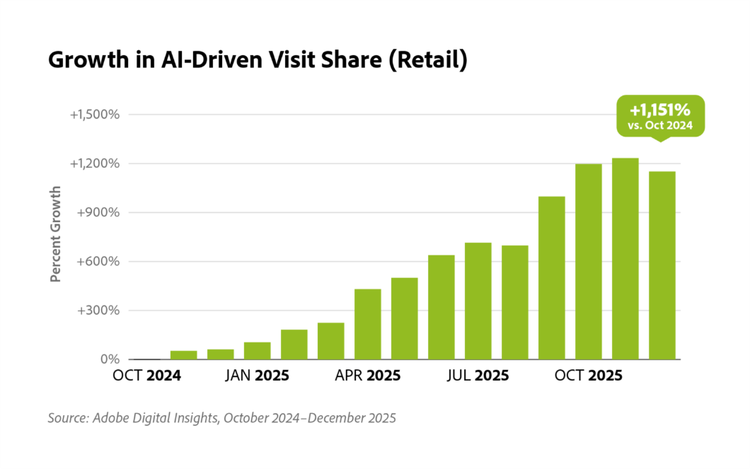
From retail to tech: AI-driven traffic surged across industries.
Adobe’s latest report shows that AI-driven traffic surged across industries during the 2025 holiday season. Retail saw the biggest jump, with traffic up 693% year over year.
Other industries followed suit: travel traffic increased 539%, financial services 266%, tech and software 120%, and media and entertainment 92%. Retail sites also experienced the strongest year-over-year growth in generative AI traffic among all industries. In November, AI-driven traffic to retail sites jumped 769%, followed by another strong increase of 673% in December.
Adobe’s insights are based on direct transactions online, covering over 1 trillion visits to U.S. retail sites—more than any other technology company or research organization. A companion survey of more than 1,000 U.S. respondents provides an additional layer of context on how consumers are leveraging AI in their online shopping journey from discovery and product research to purchase decisions during the holiday season.
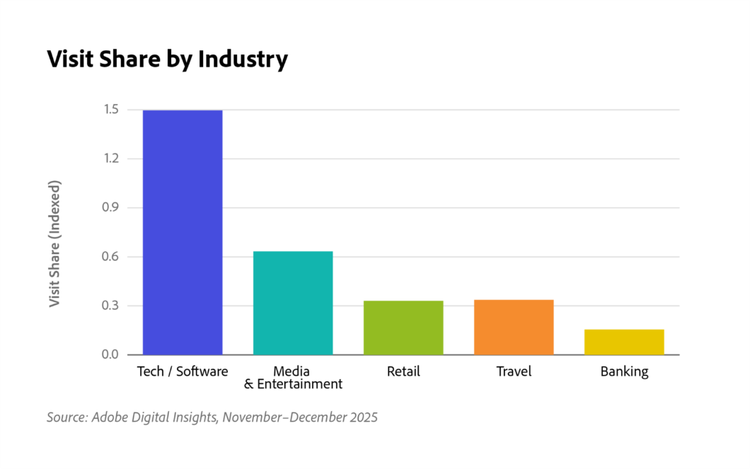
AI traffic isn’t only browsing, it’s converting.
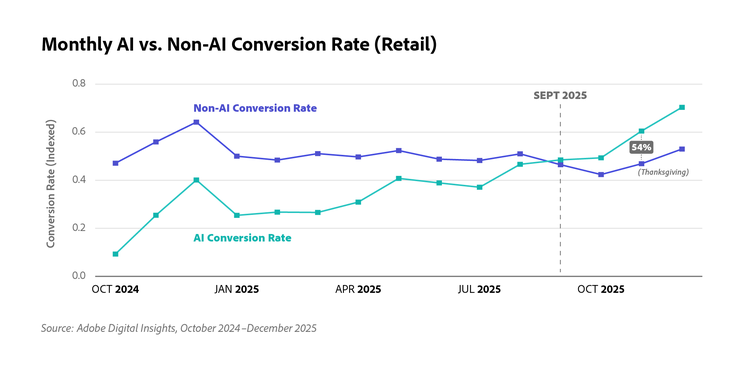
That deeper engagement translated directly into higher conversion during the 2025 holiday season. AI referrals moved from lagging to leading, converting 31% more than other traffic sources—nearly doubling YoY. This is in addition to a significant boost in AI-driven revenue per visit (RPV), which is up 254% this holiday season year-to-date. Key shopping events widened the gap: AI conversions were 54% higher than non-AI on Thanksgiving and 38% higher on Black Friday.
Adobe is also sharing new data on what happens after shoppers click through from a generative AI-powered chat service or browser—and this is where things get especially interesting for retailers. Shoppers who arrive to retail sites from generative AI assistants were 33% less likely to leave immediately (a 14% improvement since the beginning of 2025), with AI referrals consistently outperforming in bounce rate, reflecting stronger content relevance and user intent.
In practical terms, this means shoppers arriving from AI assistants aren’t just landing and leaving. They’re spending 45% more time on-site and viewing 13% more pages per visit, signaling higher intent and stronger alignment with what they’re looking for.
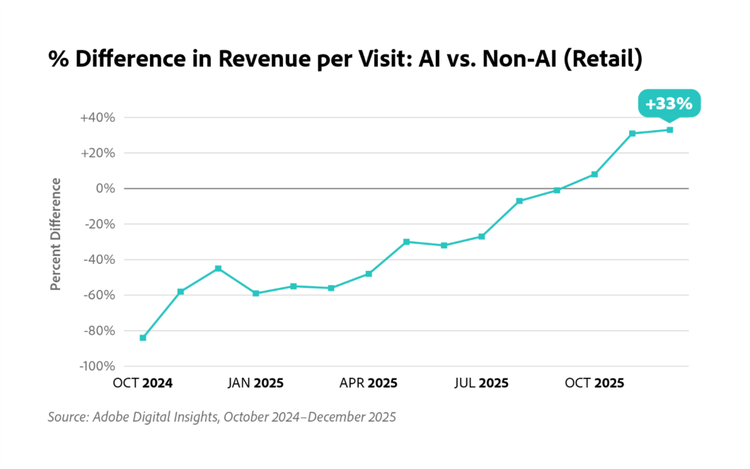
With AI-generated results more relevant and closely aligned with consumers' shopping intent, 81% of consumers using AI Assistants for their online shopping report that they have improved their shopping experience. As the conversion gap narrows, AI-driven revenue per visit continues to climb. From January to July 2025, revenue per visit from AI traffic increased by 84% compared to non-AI sources.
Why consumers are starting to trust AI recommendations.
Equally important for all industries is that Adobe’s data shows consumers really trust these AI-generated results. Nearly half of consumers (47%) reported trust in AI, according to the Holiday 2025 Consumer Survey. According to Adobe’s survey, consumer satisfaction with AI-generated links is high. Sixty-four percent of shoppers using AI report being satisfied with the links they receive, and more than 55% say they actively click on them.
As trust grows, purchase confidence is also rising. Over half of consumers (65%) using AI for online shopping report that they are more confident in their purchase after the help of AI, with 68% reporting they are less likely to return the product after using AI for the purchase. This also contributed to online returns being down 1.2% YoY this holiday season.
As more consumers turn to large language models (LLMs) to research products, compare options, and make decisions, one thing is becoming clear: generative AI is no longer a side channel for commerce discovery.
Traffic from tools like ChatGPT, Gemini, and Perplexity is growing rapidly. More importantly, it’s high-quality traffic that converts. For retailers and brands, this signals a lasting shift in how consumers discover and evaluate products. Generative AI’s role in commerce isn’t a passing trend. It’s becoming a core part of the digital shopping journey.
Vivek is the director of Adobe Digital Insights who has worked with some of the largest CPG & Technology organizations, in the world, to drive key digital marketing & data science initiatives. As the Director for Adobe Digital Insights (ADI), he launched & spearheads the popular Adobe DEI (Digital Economy Index) & Holiday Retail reports, as well as other industry reports that profile emerging technology, creativity, and travel trends. Prior to joining Adobe, Vivek worked with E. & J. Gallo, where he was part of their Consumer & Product Insights Group, advising brands on how to track and measure the impact of global marketing campaigns. Additionally, Vivek has lead data science teams to develop effective propensity models and automate digital campaign management. Vivek holds a MS in Predictive Analytics and Data Science from Northwestern University and BBA from Georgia State University.