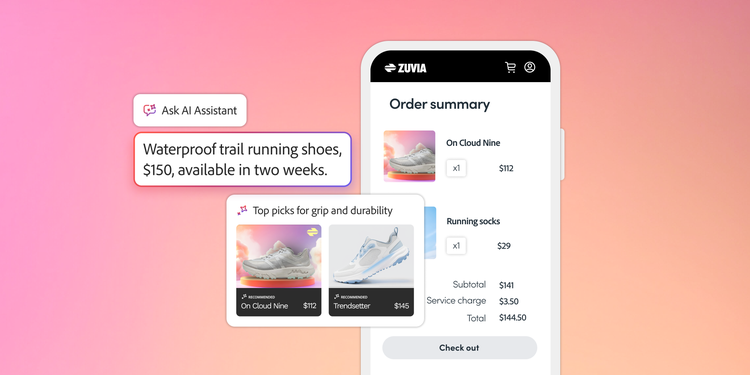
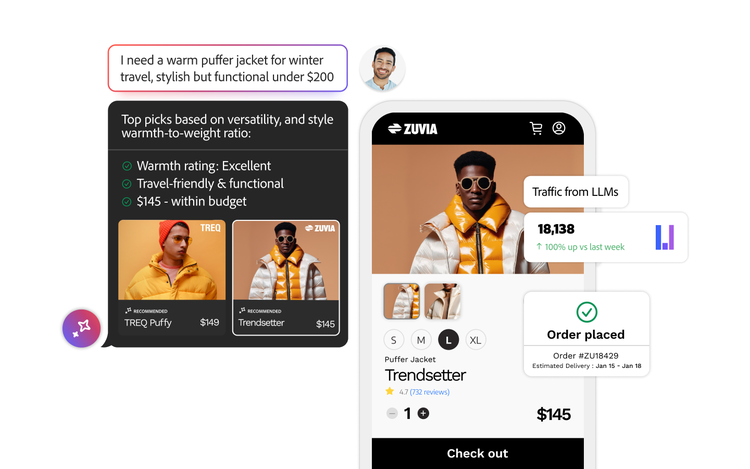
Adobe Commerce is committed to supporting agentic commerce standards, including Universal Commerce Protocol (UCP) and Agentic Commerce Protocol (ACP), building on our earlier announcement of support for Agent Payments Protocol (AP2). This enables brands to gain visibility across AI-driven shopping channels while maintaining full control over customer relationships, branding, and commerce data.
Commerce is evolving, and buyer expectations are rising.
AI-powered agents are fundamentally changing product discovery and purchase behavior. During the 2025 holiday season, generative AI tools drove a 693.4% increase in traffic to retail sites.
Shoppers are increasingly turning to LLMs like ChatGPT and Gemini to help them find the products they need. And shoppers aren’t using these agents merely as entry points — they are relying on them to compare products, narrow choices, and make purchase decisions. That behavior is translating directly into performance. As per the Adobe Digital Insights Report, January 2026 — AI referrals to your storefront convert 31% higher, generate 254% more revenue per visit, and bring in shoppers who spend 45% more time on-site.
As AI-referred shoppers arrive more qualified, more engaged, and more ready to buy, the old model for ecommerce is being rewritten:
- LLM-based interfaces are a primary entry point for product discovery and recommendations.
- Customers demand fast, conversational buying experiences without switching between apps or channels.
- Trust, security, and data accuracy are essential as agents transact on a customer’s behalf.
- Product catalogs and content must be AI-ready to remain visible and competitive.
In this new model, discovery, decisioning, and action collapse into a single conversation.
To stay visible at the moment of intent, brands must make their product data, pricing, product availability, and purchasing logic readable and actionable by AI agents, while still appealing to the people who will land organically on their storefronts.
Adobe powers both agentic and human-driven commerce.
As commerce evolves, brands must be ready to serve both AI agents and humans.
Adobe Commerce is designed to help brands excel in both, enabling them to capture AI-driven demand to increase acquisition and enhance storefront experiences and shopping journeys that boost engagement and loyalty.
A native gateway to agentic commerce.
UCP and ACP serve different consumer surfaces and onboarding models. Adobe Commerce is committed to supporting both these standards so brands can participate wherever agent-led shopping happens.
Through this support, brands can:
- Engage shoppers across LLM-based interfaces with accurate, real-time product data.
- Enable secure, in-agent customer checkout through standards-aligned payment flows.
- Scale agentic interactions using standardized interfaces and reusable integrations, reducing the need for one-off custom builds.
- Maintain accuracy, control, and differentiation as product discovery shifts into AI interfaces.
Adobe Commerce is moving towards supporting UCP and ACP by making merchant product catalogs, pricing, and inventory machine-readable by AI agents and available to the latest LLM surfaces like Gemini and ChatGPT. These capabilities are intended to enable seamless and secure transactions through both protocols — completing the agentic buying journey — and to integrate with existing order-management endpoints to handle fulfillment and other in-house processes.
Building for the agentic era: Discovery, action, and differentiation.
As brands prepare for the agentic era, success depends on strengthening three layers of commerce.
The first is discovery — ensuring brands are visible and accurately represented when AI agents guide customers in the discovery phase. Adobe Brand Visibility, formerly Adobe LLM Optimizer, powers this layer by structuring product catalogs and brand narratives for discoverability and accuracy, expanding reach and driving acquisition.
The second layer is agent-to-agent commerce, where brands must be ready for AI agents not just to discover their brand, but to take action on a customer’s behalf, such as checking availability or completing transactions. Adobe’s support for agentic commerce protocols allows AI agents to securely interact with merchant systems and turn discovery into acquisition.
The third layer focuses on raising the bar on brand-owned experiences for humans to drive differentiation and loyalty. Adobe Brand Concierge delivers conversational, on-site shopping guidance within owned experiences, helping customers explore and decide with confidence. Adobe Experience Manager Sites Optimizer ensures readable, performant storefronts for humans and AI agents. And Adobe Commerce Optimizer delivers high-performing storefronts and a scalable, flexible catalog that together create fast, engaging shopping experiences across all sales channels.
Looking ahead.
“Brands face a dual imperative — optimize for AI agent discoverability while deepening direct customer relationships through superior experiences,” said Loni Stark, Vice President, Strategy and Product at Adobe. “Adobe Commerce is committed to supporting current and emerging agentic standards so brands don't have to, freeing them to invest in richer product experiences and human touchpoints that build true brand loyalty.”
Agentic shopping isn’t a niche trend. It’s the new front door for commerce — a structural shift in where buying begins, how intent is expressed, and how transactions are executed. And it’s here to stay.
With support for UCP and ACP, and additional capabilities planned throughout the year, Adobe Commerce provides a foundation for agentic commerce, helping brands engage customers wherever and however intent emerges.
Kartavya is a seasoned product marketing leader with deep experience driving go-to-market strategy for both B2B and B2C organizations across a range of industries. At Adobe, he leads positioning, messaging, launch, and marketing strategy to help customers unlock value from intelligent, scalable Commerce solutions. A strong advocate for responsible and transformative AI, Kartavya champions the adoption of generative and agentic technologies to help teams and businesses work smarter, move faster, and deliver more impactful customer experiences.