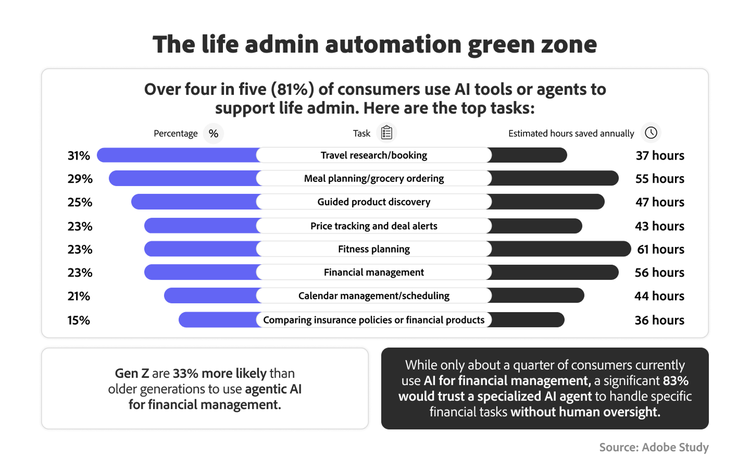
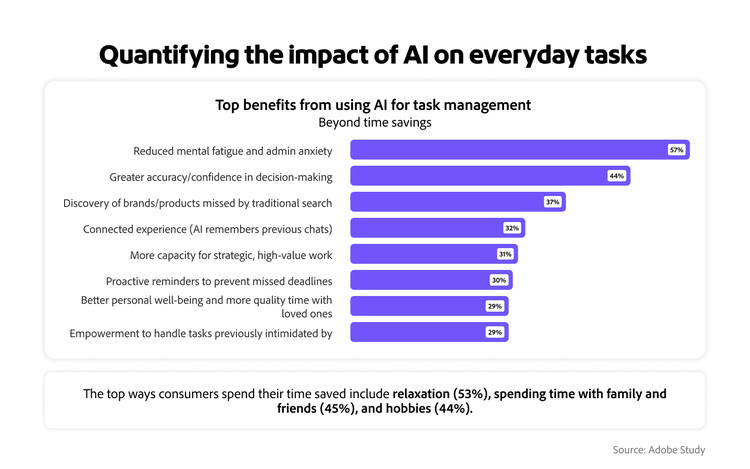
The payoff is both practical and psychological. Users report saving an average of 56 hours annually on tasks such as financial management, and 57% of consumers report a significant reduction in mental fatigue and everyday stress after integrating AI tools into their routines. This reclaimed time and lighter cognitive load may help ease the ongoing strain of everyday decision-making.
Which tasks create the most mental fatigue?
According to consumers, financial management is the most mentally draining administrative task in everyday life, with 41% ranking it as their top source of stress. Other tasks that ranked highly include:
- Meal planning and grocery ordering (29%)
- Calendar management and scheduling (17%)
- Comparison of insurance policies or financial products (16%)
- Email organization (15%)
- Travel research and booking (10%)
Meal planning and grocery ordering weigh more heavily on some households than others: in Adobe's survey, women were 62% more likely than men to say these tasks drain their mental energy. Across generations, financial management remains the leading source of mental fatigue, underscoring the appeal of AI tools that can simplify high-effort decisions.
How are consumers spending the time saved by AI?
Consumers are using the time reclaimed through AI automation to focus on personal well-being and quality of life. The most common ways consumers spend that extra time include:
- Relaxing or engaging in leisure activities (53%)
- Spending time with family and friends (45%)
- Pursuing hobbies or personal interests (44%)
- Exercising or practicing self-care (41%)
- Learning new skills (19%)
- Working more or focusing on career development (14%)
Gen Z is more likely to put the time they reclaim toward self-care, a reminder that different consumers reinvest the hours AI gives back in different ways.
How do AI agents reduce mental fatigue?
Reduced mental fatigue has become an important measure of value for consumers using agentic AI. In Adobe's survey, women were 15% more likely than men to say AI tools help reduce cognitive strain, while Gen Z was 21% less likely than older generations to associate AI adoption with mental relief. These findings reinforce how conversational and AI-assisted experiences are reshaping expectations for convenience, efficiency, and personalized support.
How is AI changing expectations for digital experiences?
Consumers are looking for digital experiences that feel more supportive and easier to navigate, especially in industries such as finance, insurance, healthcare, and ecommerce, where decision-making can be more complex. As AI becomes more common in everyday life, expectations for convenience, personalized discovery, and tailored support are shaping how consumers interact with brands online.
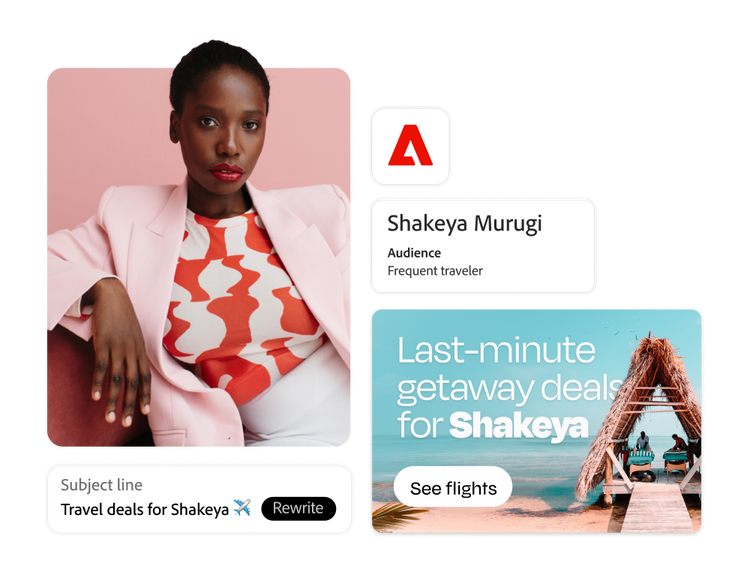
Within Adobe CX Enterprise, Coworker is an AI-powered teammate that helps marketing teams activate agentic workflows across supported Adobe applications. By reducing manual handoffs, it can help teams plan, produce, and deliver personalized experiences at scale while keeping governance and human oversight in place.
How proactive AI agents build consumer trust and brand loyalty.
As AI interactions become a bigger part of everyday life, consumers are placing greater importance on trust, transparency, and personalization. They are more likely to remain loyal to brands when AI interactions feel helpful, proactive, and authentic.
Why do proactive AI experiences increase loyalty?
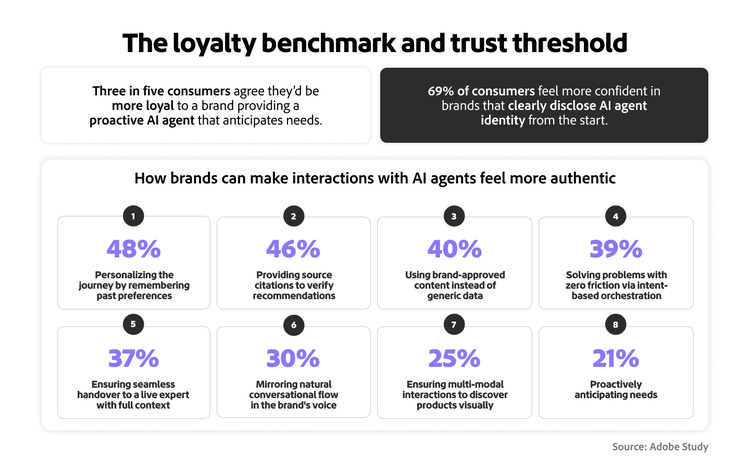
Three in five consumers say they would be more loyal to a brand that offers a proactive AI experience designed to anticipate their needs. In Adobe's survey, men were 16% more likely than women to report increased loyalty after these anticipatory, intent-based interactions.
What makes AI interactions feel trustworthy?
Transparency also plays a big part in building consumer trust. Among consumers, 69% feel more confident in brands that clearly disclose when they are interacting with an AI agent from the outset. They increasingly expect AI-powered interactions to combine personalization with transparency, so they feel supported and informed throughout the customer journey. As adoption of agentic AI grows, consumers are placing greater value on brand-controlled experiences that make conversational AI interactions feel trustworthy and authentic.
How do different generations define authentic AI experiences?
Consumers across generations have different expectations for what makes conversational AI interactions feel authentic.
Gen Z and baby boomers place the greatest importance on source citations and verification, with 48% of respondents in both groups saying they want AI-generated information, product recommendations, and personalized discovery experiences to include clear sourcing.
Millennials and Gen X consumers are more focused on continuity and personalization. Among respondents, 46% of millennials and 54% of Gen X consumers say AI experiences feel more authentic when brands remember their preferences across sessions and deliver persistent, tailored interactions.
For the marketing teams delivering these experiences, Coworker acts as an AI-powered teammate that activates agentic workflows across supported Adobe applications. By coordinating work from planning through execution, it can reduce manual handoffs and help teams deliver personalized experiences at scale while maintaining business context, approvals, governance, and human oversight.
How agentic AI is reshaping customer journeys and digital experiences.
As consumers grow more comfortable using agentic AI in their personal lives, their expectations for brand interactions are evolving as well. Consumers want digital experiences that feel proactive, personalized, and conversational rather than static or transactional.
The growing acceptance of AI for administrative tasks in everyday life—such as financial management, travel planning, and product discovery—signals a broader shift toward AI-assisted customer journeys. Consumers are becoming more willing to trust systems that reduce effort, simplify complex decisions, and deliver tailored recommendations in real time.
This creates pressure on brands to deliver digital experiences that balance automation with transparency and personalization. AI-enabled platforms can help businesses create more adaptive customer journeys while maintaining control over data, brand voice, and customer trust.
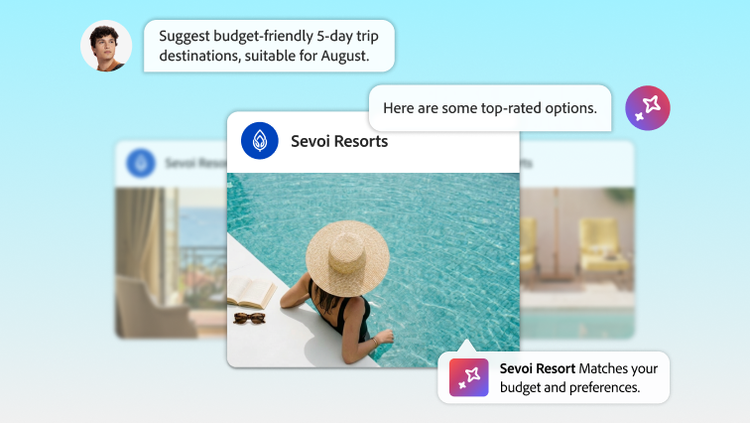
Adobe Brand Concierge is a CX Enterprise application that helps brands create conversational, personalized discovery experiences on their owned digital properties. It uses approved brand content to guide customers through questions, comparisons, and recommendations while preserving brand voice and governance.
As trust in agentic AI continues to grow, brands that can make AI interactions feel transparent, relevant, and genuinely helpful will likely find it easier to build stronger customer relationships.
Watch the Adobe Brand Concierge overview video to see how conversational AI can support product discovery and customer decision-making.
Methodology.
Proprietary research conducted by Adobe informs this article. The study surveyed 1,007 consumers across the US, providing a 95% confidence level and a ±3% margin of error. Respondents were asked about their use of agentic AI for administrative tasks in everyday life. As with all self-reported data, the results may reflect personal perceptions and experiences rather than actual behavior.