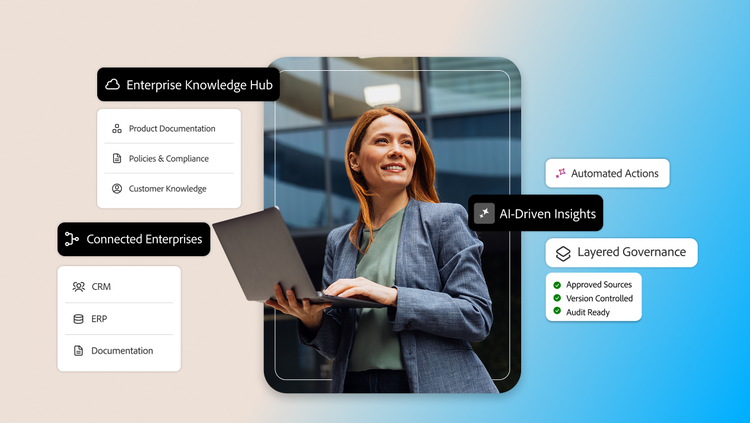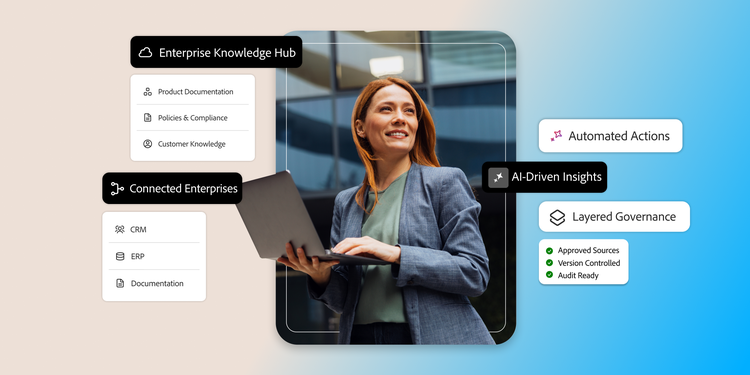
Enterprise AI is moving beyond answering questions.
The first wave of generative AI gave employees and customers a conversational way to find information. Retrieval-augmented generation, or RAG, improved those experiences by retrieving relevant enterprise content and supplying it to a large language model before the model generated an answer.
That was an important step. But it remained largely an information experience: a person asked, the system retrieved, and the model responded.
Agentic AI changes the stakes. An AI agent can interpret a goal, determine which systems or knowledge sources to consult, gather additional context, and initiate actions. It may draft a support response, complete a security questionnaire, trigger a publishing workflow, order a replacement component, or schedule a service technician.
When AI moves from explaining what should happen to helping make it happen, enterprise knowledge can no longer be treated as background reference material. It becomes operational infrastructure.
The shift from retrieved answers to autonomous action.
A conventional RAG implementation starts with a question. The system searches a defined knowledge source, retrieves relevant passages, adds them to the model’s prompt, and generates an answer grounded in that material.
This approach helps organizations use private, current, or restricted information without retraining a general-purpose model. It can also preserve access controls when retrieval is performed using the user’s credentials.
In his Adobe DITAWORLD 2026 session on the impact of generative AI on content strategy, Fabrice Lacroix, founder and CEO of Fluid Topics, explained the progression from large language models to RAG, agentic AI, and Model Context Protocol. He described how RAG retrieves enterprise knowledge, adds it to a prompt, and uses a general-purpose model to formulate a response.
The challenge appears when the required knowledge is distributed across many repositories. Lacroix described enterprise scenarios involving “10, 15, or 20 applications” that may contain relevant knowledge. The system must search those sources, merge the results, determine whether enough context has been found, and keep copied information synchronized with the original systems.
Model Context Protocol, or MCP, supports a different pattern. MCP is a protocol that allows AI systems to connect with external tools, applications, and information sources. Instead of receiving a fixed package of retrieved content, an agent can determine which available source to query, what to request, and whether it needs more information.
As Lacroix explained, “It is the agent LLM that thinks, reasons and goes to the endpoints to get information and build the context.” This is what makes agentic AI materially different. The AI system is not only producing language. It is participating in a process.
Consider a maintenance scenario. A machine reports a hydraulic pressure problem. An agent may need to consult technical documentation to diagnose the issue, identify the affected configuration in a product lifecycle management system, locate a superseding part in a catalogue, confirm availability in an enterprise resource planning system, arrange shipment, and schedule a technician.
Lacroix used this example to illustrate a process that might otherwise involve between two and 10 people and may need to operate globally, around the clock. The opportunity is substantial. So is the dependency on trustworthy knowledge.
AI exposes the content debt enterprises could previously ignore.
Traditional content delivery hid many content problems. A frequently visited page was more likely to be reviewed, corrected, and maintained. An outdated topic buried deep in a repository might receive little traffic and cause limited visible damage. Duplicate procedures could coexist for years because users followed familiar navigation paths and rarely encountered the conflicting version. Conversational and agentic systems remove that protection.
In his Adobe DITAWORLD 2026 welcome address, Vivek Kumar, Senior Director of Products at Adobe, explained that AI makes every topic, procedure, and content fragment potentially accessible. The least-viewed topic in a repository can suddenly become the source for an answer. He illustrated the risk with an AI assistant retrieving a procedure that had not been updated in four years because it appeared relevant to the customer’s question.
“AI didn’t create this documentation problem,” Kumar said. “AI has exposed it.”
The underlying issue is not a shortage of content. It is the absence of dependable knowledge.
A procedure is content. So is a product description, troubleshooting topic, policy, or service instruction. Knowledge emerges when those components include the context that explains what they apply to, how they relate, which version is authoritative, who approved them, and when they should no longer be used.
For AI, these distinctions are essential. A technically correct instruction may still be wrong for a particular product version, market, customer entitlement, operating condition, or regulatory jurisdiction. An agent needs more than text that resembles the question. It needs evidence that the selected content is appropriate for the action being considered.
The scale of the broader content problem is documented in ‘Component Content Management Systems: Supercharge Long-Form Content for Personalized and Consistent Experiences’, a 2021 Forrester Consulting study commissioned by Adobe. Based on a survey of 450 decision-makers at organizations with at least 500 employees and US$500 million in annual revenue, the report found that 64% considered meeting modern content-creation demands a challenge. It also found that 68% identified lack of content reuse as a content-management challenge, while 58% struggled to maintain publishing and update speed. Agentic AI does not make those weaknesses disappear. It gives them a faster route into business processes.
Structure turns content into machine-usable knowledge.
This is where structured content and a component content management system, or CCMS, take on a larger role.
A CCMS manages information as modular components rather than only as complete documents. Those components can carry explicit metadata, relationships, conditions, version history, review status, and reuse references. They can be assembled into multiple publications and delivered through websites, applications, knowledge bases, support systems, or AI experiences.
The value for AI is not simply that XML is easier for a machine to parse. The larger advantage is that structure makes meaning and control explicit.
Metadata can identify the product, model, audience, language, region, lifecycle state, effective date, and security classification. Taxonomies provide controlled terms. Relationships connect concepts, procedures, warnings, parts, and supporting evidence. Versions and baselines identify exactly which content was approved for a particular release. Review workflows show that human judgment was applied before content became authoritative.
Kumar described the result as a progression from a content repository to a knowledge graph. “Knowledge emerges from connected content,” he said. “Relationship matters, context matters, meaning matters.”
That foundation allows AI systems to retrieve smaller, more precise units of knowledge while preserving the information required to evaluate them. It also gives organizations a way to trace an AI-generated response or action back to the source material that informed it.
The Forrester study provides quantitative support for this approach. Sixty-nine percent of respondents reported that keeping content in a flexible format such as XML enables easier reuse or syndication. The report also found that 80% or more of respondents at organizations using a CCMS said it helped eliminate regulatory-compliance, reputational, financial, and workforce risks associated with content creation and delivery.
These findings point to the same conclusion: organizations cannot meet growing human and machine demand by creating more disconnected documents. They need content that can be governed once, understood in context, and reused reliably.
Governance becomes part of AI control.
Many AI programs focus first on the model, interface, or agent framework. Those are visible investments, but they cannot compensate for weak content governance.
An enterprise knowledge foundation for agentic AI needs to answer several operational questions:
- Is this the current approved version?
- Does it apply to this product, audience, region, and circumstance?
- Was it reviewed by the appropriate subject-matter expert?
- Can this user or agent access it?
- What other content depends on it?
- What changed, who changed it, and when?
- Can the system cite the source used for the answer or action?
These are familiar CCMS concerns, but agentic AI gives them broader business significance.
- Versioning becomes a safeguard against obsolete instructions.
- Metadata becomes a routing mechanism for agents.
- Approval status becomes an input to trust.
- Audit history becomes evidence for compliance and investigation.
- Access controls help prevent agents from exposing or acting on restricted information.
The Forrester report found that incorrect or unclear documentation creates significant risk for support operations and that more than half of respondents identified fragmented content strategy, content silos, review and collaboration, personalization, omnichannel delivery, and content velocity as major challenges.
That does not mean a CCMS eliminates every risk or makes every AI action trustworthy by default. It shows that organizations already associate structured content controls with reducing the conditions that create risk.
Human oversight also remains necessary. Agentic systems can accelerate routine work, but organizations still need clear boundaries for which actions require review, approval, or escalation. The objective is not to remove people from every process. It is to reserve human judgment for decisions where it creates the most value.
Adobe Experience Manager Guides as an enterprise knowledge foundation.
Adobe Experience Manager Guides provides a structured content foundation that can support this model.
Organizations can manage modular DITA content, metadata, versions, references, reviews, translations, and publishing from a governed environment. Application programming interfaces, or APIs, can connect content operations with other enterprise systems, while structured outputs can support websites, applications, knowledge bases, chat experiences, and other downstream uses.
In ‘The Business Value of Adobe Experience Manager Guides’, a November 2022 IDC Business Value Study sponsored by Adobe, IDC reported findings from in-depth interviews with six organizations using Experience Manager Guides. IDC calculated average annual benefits of $3.8 million per organization, a 287% three-year return on investment, and a 13.9-month payback period for the participating organizations.
The study also found that technical-writing teams were 17% more effective after adopting Experience Manager Guides. It reported a 16% reduction in duplication-related effort, representing an average annual productivity value of $437,570 per organization.
Those results should not be treated as guaranteed outcomes for every implementation. They show that the content foundation required for AI readiness can also produce measurable value through reduced duplication, more effective content operations, and improved productivity.
Adobe has also demonstrated AI-assisted capabilities for importing, creating, modifying, tagging, and validating structured content. In his Adobe DITAWORLD 2026 session on using AI in Experience Manager Guides to work smarter and produce content at scale, Mike Buoy, senior solution consultant at Adobe, demonstrated workflows in which authors reviewed proposed plans and tracked changes before accepting them. This human-in-the-loop approach allows AI to accelerate content work while the organization retains control over what becomes part of the trusted knowledge base. Large-scale implementations show why that control matters.
In his Adobe DITAWORLD 2026 session, Brian Scordinsky, client technology director supporting global assurance at EY, described EY Atlas as a global assurance knowledge platform operating at enterprise scale.
EY Atlas supports more than one million documents, three million rendered content pages, more than 40 languages, and 66 location-based channels. It serves more than 200,000 users and receives more than one million hits per month. Its AEM Guides environment maintains 12.7 million pieces of metadata and 42 million link references.
Scordinsky described Atlas as “the front end of a global knowledge supply chain.” Behind the experience is a structured ecosystem supporting authoring, publishing, search, subscriptions, analytics, security, localization, and increasingly generative AI-enabled agent experiences.
A related Adobe DITAWORLD 2024 session reported that EY Atlas served more than 200,000 users, including over 26,000 clients, and was supported by more than 600 content producers. In that session, Scordinsky said, “AEM does all the heavy lifting for our content operations.” He added that the metadata maintained in AEM Guides powers search and would eventually support large language models and generative AI chat experiences.
At this scale, metadata, versions, links, and publishing controls are not administrative details. They are the operating model for trusted knowledge.
Build the knowledge layer before scaling the agent layer.
Enterprises do not need to restructure every piece of content before beginning an agentic AI initiative. They do need to identify which knowledge will inform high-value or high-risk actions and make that content reliable first.
A practical approach begins with four priorities.
1. Identify the decisions and actions the agent will support.
Define the business process before selecting the content. Determine what the agent will be permitted to recommend, initiate, or complete, and where human approval will remain mandatory. This establishes which knowledge sources are critical and what level of confidence is required.
2. Assess the content behind those actions.
Examine the knowledge the agent will use. Look for duplication, conflicting guidance, missing metadata, outdated versions, unclear ownership, inaccessible source material, and gaps in approval history.
The objective is not a broad content inventory. It is a focused risk assessment of the information that will guide AI-supported decisions.
3. Structure and govern the highest-value knowledge.
Break large documents into reusable components where appropriate. Apply controlled metadata. Establish relationships among procedures, products, parts, policies, and supporting concepts.
Define review, approval, versioning, access, retention, and lifecycle rules so that people and AI systems can distinguish current knowledge from content that is incomplete, superseded, or unsuitable for use.
4. Connect content through governed interfaces.
APIs and MCP-compatible services can make enterprise knowledge available to agents without abandoning permissions, source control, or auditability.
Each connection should preserve enough context for the agent to understand what the content means, when it applies, and whether it can be trusted.
This sequence matters. Connecting an agent to more repositories does not automatically create better knowledge. It can simply give the agent faster access to more inconsistency.
Enterprise knowledge is becoming strategic infrastructure.
The strategic role of the CCMS is changing. It remains a platform for creating, managing, translating, and publishing content. But it also becomes the governed knowledge layer between enterprise expertise and AI-driven action.
Kumar summarized the shift directly: “What was once considered documentation infrastructure is rapidly becoming AI infrastructure.”
The next phase of enterprise AI will not be won by the organization with the most content or the most agents. It will be won by organizations that can provide machines with knowledge that is structured, current, contextual, permission-aware, and traceable.
When AI only answered questions, weak content created poor experiences. When AI can act, the quality of enterprise knowledge becomes a business control.
Organizations preparing for agentic AI should begin by identifying the content behind their most important decisions, assessing whether it is structured and governed well enough to support action, and closing the highest-risk knowledge gaps before they scale. Adobe Experience Manager Guides can provide the controlled content foundation needed to turn enterprise information into trusted, reusable knowledge for AI-powered experiences and workflows.
Next steps.
Learn how Adobe Experience Manager Guides can help transform structured enterprise content into a governed knowledge foundation for AI-powered experiences and agentic workflows.
Frequently Asked Questions
What is the difference between RAG and agentic AI?
The core difference is what each one does with knowledge: RAG retrieves it to answer a question; agentic AI acts on it to complete a task.
RAG (retrieval-augmented generation) starts with a question. The system queries a defined knowledge source, retrieves the relevant passage, adds it to the model's prompt, and generates an answer grounded in that material. Its scope ends there — RAG informs, but it works from a fixed set of retrieved content and never decides what to consult or takes any action.
Agentic AI is built around a business outcome. An AI agent interprets a goal, decides for itself which systems and knowledge sources to consult, gathers additional context, and then initiates actions — drafting a support response, ordering a replacement part, or scheduling a technician — with humans stepping in to review or approve where it matters.
In short: RAG produces language; agentic AI takes action.
What is Model Context Protocol (MCP), and why does it matter for enterprise AI?
Model Context Protocol (MCP) is a protocol that lets AI systems connect with external tools, applications, and information sources. Instead of receiving a fixed package of retrieved content, an agent using MCP can determine which available source to query, what to request, and whether it needs more information.
MCP matters because enterprise knowledge is distributed across many systems; it lets an agent gather context across them rather than relying on fixed content.
What makes enterprise knowledge "AI-ready"?
AI-ready enterprise knowledge contains five defining attributes: it is structured, current, contextual, permission-aware, and discoverable.
Structured means the information is captured in modules with clear metadata and can be used whenever needed without time-consuming copy-paste leading to duplication or errors.
Current means AI only fetches the latest and most credible content through versioning and lifecycle rules.
Contextual means each component carries the metadata — product, model, audience, region, lifecycle state, effective date — that conveys to an agent when it applies.
Permission-aware means access controls travel with the content so agents do not expose or act on restricted information.
Traceable means any AI-generated response can be linked back to its original, approved source that informed it.
What is "content debt," and how does AI expose it?
How do you make AI-generated answers and actions traceable and auditable?
Recommended for you
https://business.adobe.com/fragments/resources/cards/thank-you-collections/experience-manager-guides