Here's a question I often ask marketing and creative leaders: Are your best creative minds spending time ideating, curating, and elevating your brand, or are they focused on resizing assets?
The question often elicits laughter, but also a cringe of recognition of the uncomfortable truth.
Your best designers, creative directors, production teams, agencies, and contractors aren't just creating standout content for campaigns. They're spending countless hours adapting those creative executions for every format, audience, geography, offer, language, and channel. For most enterprises, that adaptation only transpires at the pace of manual work, putting speed to market at risk.
The creative work may be finished, but the production work is just beginning — and that's becoming one of the biggest challenges facing creative and marketing teams today. That said, some of the world’s leading brands have embraced new ways of working and re-thought creative production, including organizations like Serta, Best Buy, and the National Hockey League, which we’ll explore shortly.
The bottleneck has changed.
For years, marketing organizations have worried about how to create enough content. Even teams that haven’t explicitly prioritized scaling are concerned about driving greater speed to keep content fresh while maintaining quality.
Today, many organizations are discovering that core creation itself isn't the primary constraint — production is.
A hero asset is approved. Then, the requests begin: Resize for social channels. Swap the offer. Create versions that resonate with and feel relevant to multiple audiences. Localize for multiple markets, and remember, localization is far more than translating the copy.
The math for a single campaign multiplies quickly — eight sizes, five markets, and three offers make for 120 variations before anyone asks for a holiday version. Then all the work begins again when next year’s version of the product is inevitably released, or as the brand’s messaging shifts ever so slightly. What began as a single approved hero asset suddenly becomes hundreds of production tasks or updates. At the same time, content demand continues to grow while budgets, timelines, and resources remain under pressure. Teams aren't simply asked to create more; they're expected to create more without sacrificing an ounce of quality — and deliver all of it faster.
Who's doing the work?
Another question I like to ask is: Who is building all these variants today?
Sometimes it's an internal production team. Sometimes it's an agency. Often, it's a combination of creative resources, marketing operations teams, agencies, and contractors manually using professional tools to remove backgrounds, resize images, and replace copy. For years, that was the only way to guarantee aesthetic quality, protect brand integrity, and produce work that teams could be proud to put in-market.
The challenge is whether that model can keep pace when every campaign requires more assets than it did a few years ago, and those assets are expected much faster. As marketing becomes more personalized and dynamic, manual production becomes increasingly difficult to scale. Returns will always be diminishing.
This is why we're noticing a growing interest in “banners at scale.”
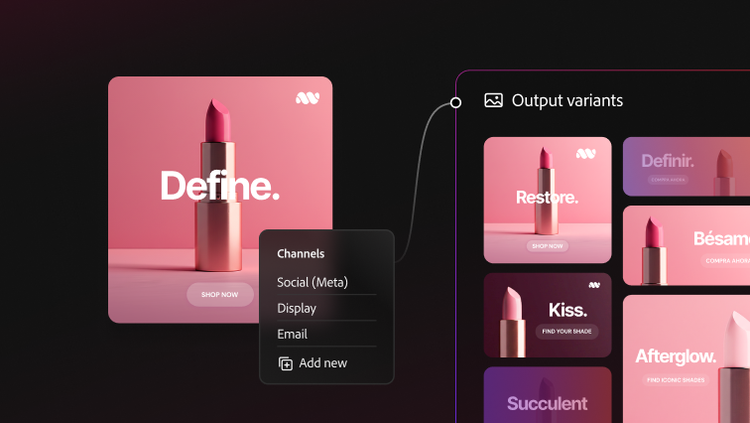
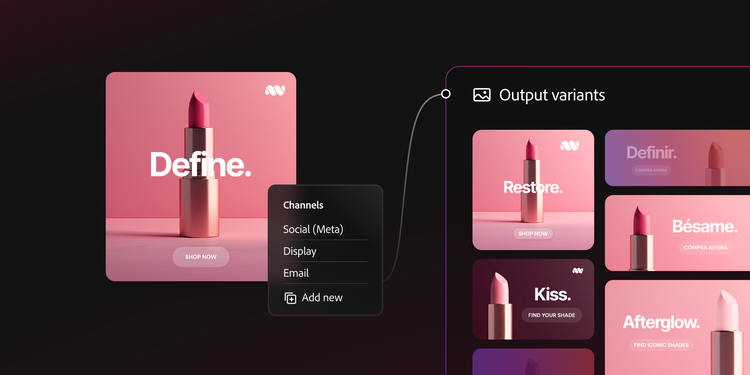
The idea is straightforward — build a production system once, then rerun it whenever products, offers, audiences, formats, or markets change. Rather than rebuilding creative assets manually, teams can focus their energy where it matters most: strategy, concepting, storytelling, and building a brand customers want to spend time with. This "build once, run whenever things change" approach is central to Adobe Firefly Creative Production workflows.
What “banners at scale” really means.
Many people hear the phrase "banners at scale" and immediately think about display advertising, but the production challenge is much broader. The use case also applies to virtually any 2D marketing asset — static or animated — that requires multiple versions across channels, audiences, formats, geographies, offers, and campaigns.
Now, starting with approved hero creative, hundreds of activation-ready assets can be produced.
The opportunity hidden in production.
The future of marketing won’t belong exclusively to the organizations that generate the most content. It will belong to the organizations that can operationalize content most effectively.
Those that can move from one approved idea to hundreds of customer experiences without multiplying effort will have an advantage that becomes increasingly difficult to replicate.
We're already noticing organizations demonstrate what's possible when they modernize content production:
- Serta Simmons Bedding creates banners 50% faster, helping turn a clear business problem into measurable production efficiency.
- Lumen reduces time spent creating ad variations by 65%, aligned with its unique campaign and brand style.
- What once took the NFL weeks of manual creative production can now be completed in minutes, empowering teams to produce, personalize, and deliver exponentially more brand-safe assets while leveling up creativity.
- Best Buy is using Firefly Creative production to scale on-brand content by generating and adapting assets so their team can produce more variations for more channels with less manual work.
While every organization's journey is different, the pattern is remarkably consistent. The biggest gains often don’t come from creating more ideas. They come from reducing the friction between an approved idea and a customer-ready experience.
I'll leave you with one final question:
If your creative teams weren't spending time resizing, versioning, rebuilding, and localizing assets, what could they create instead?
The answer to that question is where the next opportunity lies.
Learn more about how Adobe Firefly Creative Production can streamline repetitive production tasks, accelerate creative delivery, and help your team produce high-quality, on-brand assets across channels and formats.
Recommended for you
https://business.adobe.com/fragments/resources/cards/thank-you-collections/firefly