Data validation: Processes and techniques explained.

Adobe for Business Team

09-09-2026

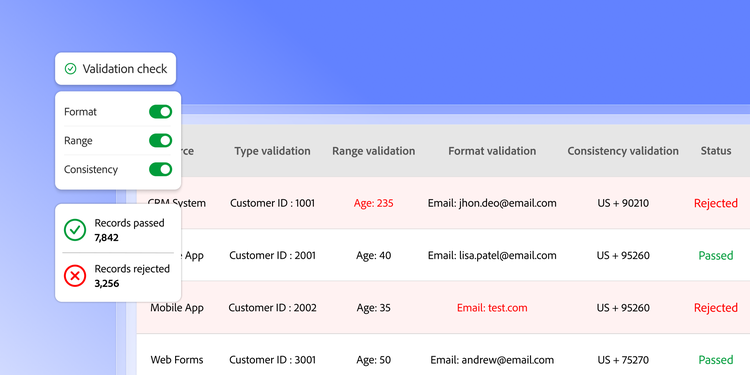
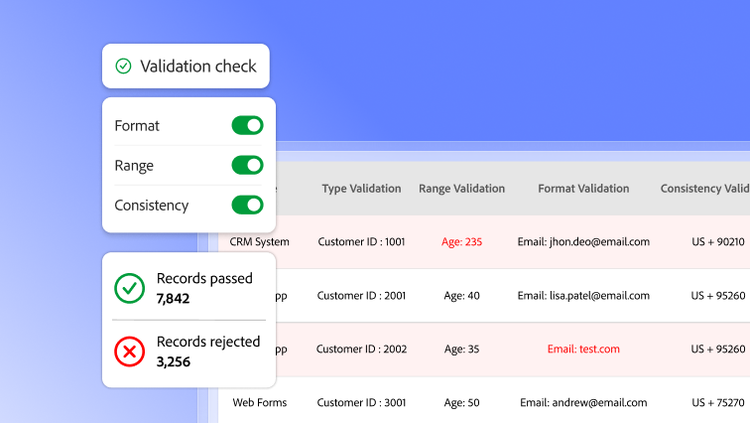
Data validation interface displaying customer records, validation rules, and pass/fail outcomes for data quality checks.

Bad data does not announce itself. It quietly distorts reports, breaks downstream pipelines, and erodes confidence in every decision that follows. Data validation is the systematic check that catches these problems before they compound.

In this article, you’ll learn:

What is data validation?

Data validation is the process of verifying that data meets predefined rules before it enters a system or drives a decision. Those rules cover format, completeness, range, and consistency. When a date field accepts "13/32/2024" without complaint, it represents a validation failure, and every record downstream of that field now carries a defect.

Every team that touches data encounters validation, whether they call it that or not. A marketing analyst importing a CRM export, an engineer loading an API response into a data warehouse, or a data steward reviewing a third-party audience feed all depend on validation checks to catch errors at the source. The common thread is that each of these handoffs introduces risk: the sending system's definition of "valid" may not match the receiving system's requirements.

Validation becomes critical at three specific moments. First, when data enters a system for the first time. Second, when it moves between systems during data transformation, where format mismatches and encoding differences are common. Third, when it is aggregated for reporting, where missing values or inconsistent field definitions can silently skew totals and averages. Each handoff is a point where errors can propagate if no checkpoint exists.

It is worth distinguishing data validation from data cleansing. Validation identifies whether data breaks a rule. Cleansing corrects or removes the offending record. Validation answers, "Is this data acceptable?" while cleansing answers, "How do we fix it?" Both are steps in a broader data quality management workflow, but they serve different purposes and occur at different stages.

Key takeaway: Validation is the checkpoint. It does not fix data. It decides whether data is fit to move forward.

Why does data validation matter for business decisions?

Downstream decisions are only as reliable as the data feeding them. Consider a customer segmentation model built on records in which 15 percent of email addresses are malformed. The resulting segments will include unreachable contacts, wasting campaign spend on people who will never receive the message, much less convert. The model itself may look statistically sound, but its outputs are operationally useless.

Summary:

  1. Bad data caught early costs less to fix.
  2. Unreliable records waste media spend and distort models.
  3. Compliance frameworks require provably accurate data.
  4. Enrichment and standardization only work on a validated foundation.

What are the main data validation techniques?

Validation techniques are not interchangeable. Each targets a specific class of error, and applying the wrong technique wastes computing resources while missing the actual problem. The descriptions and table below map each technique to its error class, a concrete failure example, and the business risk it prevents.

Technique
Error Class Detected
Example Failure
Business Risk
Type
Wrong data type
Revenue = "N/A"
Model errors
Range
Out-of-bounds value
Age = 847
Segment distortion
Format
Pattern mismatch
Phone = "555-CALL-NOW"
SMS unreachability
Consistency
Cross-field contradiction
US country, CA postal code
Duplicate or lost records
Uniqueness
Duplicate records
Same email, different tier
Broken personalization
Completeness
Missing required field
No company_name
Misrouted leads
Referential integrity
Broken foreign key
Order with no customer
Orphaned transactions

How do data validation processes work step by step?

A data validation process is a repeatable sequence applied consistently, not a one-time manual check. Organizations that treat validation as an ad hoc activity spend more time firefighting downstream errors than building reliable pipelines.

Data standardization and data cleansing typically follow this process. Once records are validated and classified, standardization normalizes formats (for example, converting all date fields to ISO 8601), and cleansing corrects or removes invalid records before they proceed to storage or activation.

Summary:

  1. Define rules before touching data.
  2. Profile first and calibrate rules to reality.
  3. Automate rule application; manual checks do not scale.
  4. Classify failures by severity before routing.
  5. Log everything and feed results back upstream.

How should organizations choose and implement a validation approach?

The right validation approach depends on three organizational conditions: data volume, the number of source systems, and the technical maturity of the team managing the pipeline. Applying an enterprise-grade rule engine to a single-source, low-volume feed is overengineering. Applying manual spot-checks to a multisource, real-time pipeline is underengineering.

Decision framework:

Evaluation checklist for a validation solution:

Adobe Experience Platform applies validation at the schema layer using the Experience Data Model standard, which enforces field type, format, and completeness rules at ingestion, before data enters the unified profile. For enterprises managing customer data across multiple channels and source systems, this embedded validation reduces the manual rule-writing burden and provides a standardized ruleset aligned with common customer data structures. Data modeling decisions made upstream in the Experience Data Model schema directly determine which validation rules apply, making schema design and validation inseparable at enterprise scale.

For teams not yet at enterprise scale, the decision framework above still applies: start with documented rules, profile your data before deploying checks, and build toward automation as volume and source complexity grow. Data hygiene best practices, including consistent rule documentation, closed-loop feedback to source teams, and regular rule audits, remain the foundation regardless of tooling.

Key takeaway: Choose your validation approach based on data volume, source count, and compliance requirements. Then select tooling that fits, not the reverse.

Frequently asked questions.

What is the difference between data validation and data verification?

Data validation checks whether data conforms to predefined rules covering correct format, type, and range. Data verification checks whether data accurately reflects the real-world source it was copied from. Validation is typically automated and rule-driven. Verification often requires comparison against an original document or system of record.

What happens if you skip data validation?

Skipping validation allows malformed, incomplete, or inconsistent records to enter downstream systems. The consequences include broken analytics models, unreachable contacts in marketing campaigns, orphaned transactions in databases, and compliance violations when regulated fields contain stale or inaccurate values. Errors caught late cost significantly more to fix than errors caught at ingestion.

How does data validation relate to data quality management?

Data validation is one component of data quality management. Quality management encompasses validation, cleansing, enrichment, standardization, and governance. Validation is the first checkpoint: it identifies records that break rules. Cleansing and standardization address what happens to those records after failures are classified and routed.

What are the most common challenges in data validation processes?

The most common challenges are schema drift (source systems changing field formats without notice), rule maintenance overhead as datasets grow, and the difficulty of validating unstructured or semi-structured data. Real-time pipelines add latency constraints, meaning validation checks must complete fast enough to avoid blocking ingestion throughput.

Who is responsible for data validation in an organization?

Responsibility typically sits across data engineering, data governance, and the teams consuming the data. Engineers build validation pipelines. Governance teams define the rules and compliance requirements. Consuming teams, including analytics, marketing operations, and product, specify what "valid" means for their use cases. Effective validation requires all three groups to agree upfront.

Start building more reliable data pipelines.

Data validation is the first line of defense against errors that compound silently into bad decisions, failed campaigns, and compliance gaps. Explore how Adobe Experience Platform supports enterprise data validation and data quality management across every channel and source system at Adobe Experience Platform.

https://business.adobe.com/fragments/resources/cards/thank-you-collections/rtcdp