As state and local governments move more of their services online, digital accessibility is vital to ensuring that every resident, regardless of physical ability, can independently access essential resources, take part in civic life, and exercise their right to public justice. In its most recent and final ruling, the U.S. Department of Justice (DOJ) underscores this urgent need to make web content fully accessible to the American public.
Under the rule, state and local entities must ensure all website content and mobile apps comply with the Web Content Accessibility Guidelines (WCAG) 2.1, Level AA technical standard. The DOJ initially set a compliance deadline for April 2026, but recently extended it to April 2027 and April 2028, depending on a jurisdiction’s population size. But even with the extension, achieving digital accessibility at scale is a major undertaking, especially for agencies that handle highly specialized documents every day.
In January 2026, one of America’s largest state court systems was challenged with converting large volumes of individualized court orders to accessible PDFs by the April 2026 deadline. Faced with what first seemed like an impossible task, the courts used the Adobe PDF Services API to remediate unprecedented numbers of court documents in record time, at a fraction of the cost, with significantly less risk.
The Challenge.
This major state judiciary generates millions of court orders each year in its electronic filing system. These documents are produced as PDFs, which must be made accessible to ensure all court users, including people with disabilities, can access court information online.
In many instances, public-facing PDFs can be templatized, allowing accessibility to be built in from scratch using tools like Adobe Experience Manager Forms. But court orders are highly individualized documents, with each one tailored to the specific facts, evidence, parties, and rulings of a given case. This makes accessibility hard to automate. As a result, court staff had to manually remediate each document after it was created. This proved to be a slow process that simply wasn’t practical on such a massive scale.
Adding to the challenge was the fast-approaching compliance deadline for the DOJ’s digital accessibility rule. First issued in 2024, the mandate requires state and local governments, including courts, to make all online content accessible to people with disabilities in accordance with WCAG guidelines. With the April 2026 compliance deadline mere months away, the court system needed a solution that could rapidly progress its accessibility posture. This meant remediating both its large existing backlog of court orders and its ongoing output of new documents.
The courts had recently worked with Adobe to modernize their document workflows with generative AI capabilities. In the wake of that successful engagement, the judiciary saw Adobe as the natural choice to support its document accessibility efforts.
Automating accessibility at scale with Adobe.
The courts turned to Adobe PDF Services API to automatically remediate PDFs as soon as they’re created in the judiciary’s e-filing system. This would allow court orders to enter and remain in the court management system as accessible documents from the start of their lifecycle.
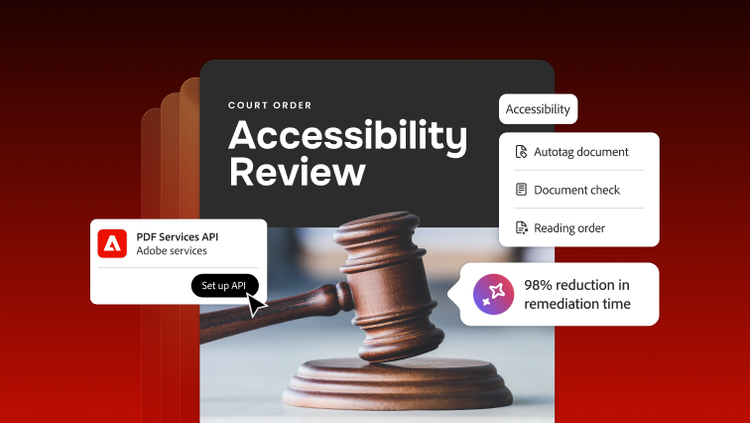
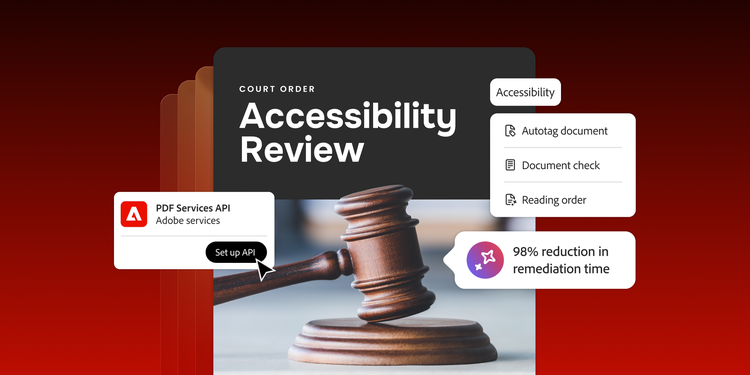
PDF Services’ cloud-based capabilities made it easy for staff to manipulate documents and automate various types of document workflows. One stand-out feature was the PDF Accessibility Auto-Tag API, which adds tags to PDF files to make their text easily readable by assistive technologies. This proved invaluable not just in improving accessibility within individualized PDFs but also in doing so at scale. With this new AI capability, the courts soon began to make rapid progress in remediating the massive backlog of court-order PDFs. Meanwhile, the solution was easily integrated into the courts’ live production workflows, ensuring that every new e-filing from that point forward would be fully accessible from the outset. Overall, PDF Services enabled high-volume processing that the courts’ manual efforts could not match.
Results.
The courts quickly saw unprecedented benefits on all fronts. Within seven weeks of deploying PDF Services, the judiciary remediated 57,000 documents and applied automatic remediation to all incoming court orders, effectively ending the need for a remediation queue.
This put the court system on track to achieve WCAG compliance in advance of the April deadline, a feat that seemed insurmountable just weeks prior. To date, the judiciary estimates that 8 million WCAG 2.1 AA-compliant documents will exit its production pipeline over the next year.
Time savings.
Replacing manual processes with automation reduced remediation time by a staggering 98%. This did wonders for reducing administrative burden on staff and shortening time-to-compliance. Previously, it took an employee nearly an hour and a half to remediate one document; now with PDF Services, it takes less than two minutes.
To put this into a grander perspective, remediating 57,000 documents by hand would have taken 76,000 employee hours, making it physically impossible to achieve before the compliance deadline. With Adobe, the courts were able to do it in just 1,520 employee hours, ahead of the deadline.
Reduced cost and risk.
Saved time translates to saved costs. By drastically reducing remediation time, the judiciary was able to cut the cost of remediating 57,000 documents by over $1.7 million. Automatic compliance also helps the court system avoid the financial risk of Americans with Disability Act (ADA) litigation. The reason is simple: A document that is born accessible cannot cause an accessibility lawsuit.
From a cost perspective, this translates to $0 of litigation exposure per accessible document. With the average ADA lawsuit costing between $50,000 and $375,000, avoiding just seven cases fully covers the annual cost of the entire PDF Services deployment.
Trust, accountability and better public outcomes.
Accessibility in the courts is essential to upholding the rule of law. A truly open and accessible justice system ensures that every member of the public can exercise their rights, regardless of physical limitations. By aligning court documents with WCAG requirements, the judiciary isn’t just checking a compliance box — it’s making sure that all members of the community have equitable access to court information and the justice system at large.
Why this matters to other state and local agencies.
These challenges are not unique to this major court system. Nationwide, numerous state and local agencies rely heavily on PDFs and face the same accessibility and compliance pressures. And very few, if any, have the staffing capacity to remediate documents one by one. The good news is that Adobe’s PDF solutions can scale up or down to support these organizations, no matter their size or structure, whether they’re among the largest state governments or the smallest municipal offices.
The DOJ’s 2027 compliance deadline is less than a year away, and the 2028 deadline will be here before we know it. By using Adobe PDF Services as a powerful accessibility engine, public agencies have new opportunities to reduce remediation backlogs, improve WCAG compliance, lower legal risk, ease administrative burden, and create a sustainable way to make information accessible to the communities they serve.