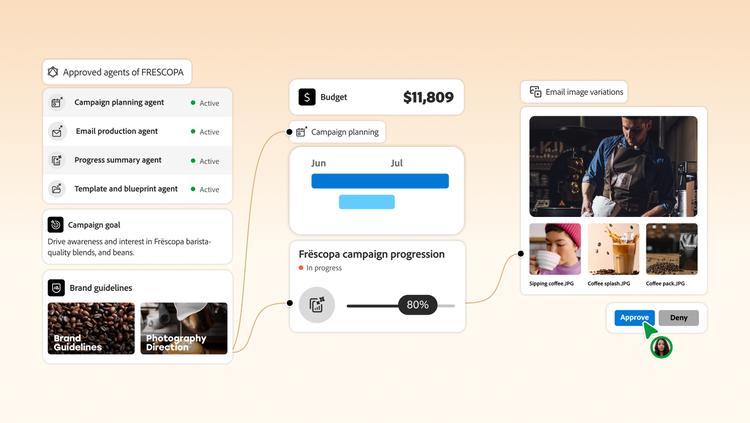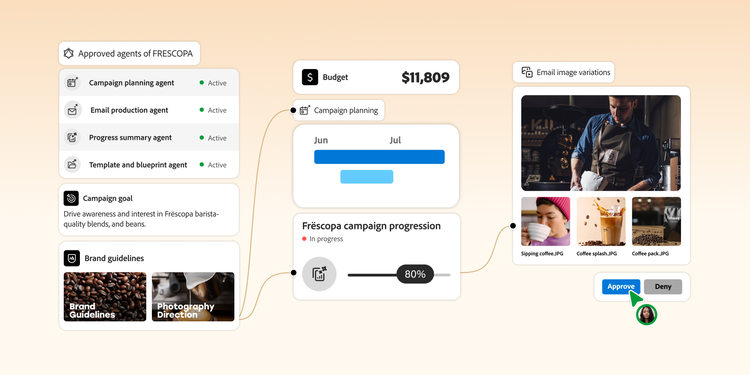
The marketer’s job is changing, and the risk of error is evolving with it. For the last two years, AI has helped marketers do the work: drafting emails, summarizing campaigns, and suggesting segments. Now, agents are beginning to do real work: taking a goal, planning the steps, executing across systems, and returning a result rather than simply providing information to help a human. With this change, the marketer’s job shifts from producing the work to directing and supervising it.
That is where marketing has the most to gain. So much of the work is automatable because it is multistep and repeatable. However, because the output directly touches the brand and the customer, the margin for error is slim. Agents, therefore, have very little room to rely on their best guesses. When a person reviews every output, mistakes are caught immediately. When an agent runs a 10-step campaign on its own, a wrong assumption early in the process becomes the input for the next step. Errors then compound unnoticed because agents often just fill information gaps with confident guesses and rarely signal that something is missing. If work built on those guesses is released, it reaches real customers in your brand’s voice, creating a risk that someone must answer for.
What makes an agent trustworthy isn’t the model, it’s the context.
Every serious marketing platform today runs on comparable AI models. What separates an agent you can trust from one you can’t isn’t the model but the context the agent has when it acts: what it knows, what it is allowed to do, and what “good” means for your brand. A capable model with the wrong context makes confident mistakes, but the same model with the right context performs useful work safely. So, the real question for a marketing organization assessing whether agents can be trusted is not, “Which AI?” but “Which context?”.
What makes a workflow context-aware?
The richest, most trustworthy data about how a marketing organization’s work actually gets done is defined within its workflows: the campaign goal, deadlines and dependencies, approval responsibilities, completed tasks, and outstanding work. All the situational awareness an agent needs is therefore already available in a governed, accountable form.
Bringing this approach safely into production comes down to six design decisions. For marketers, these decisions add up to one simple need: one place where people and agents work together, every agent has the right context, operates within the right limits, and leaves a trail showing who did what.
1. Agents are first-class participants in the work model.
Treating an agent as an assignee alongside a person requires a change to the data model, rather than simply adding a bot to the system. An agent needs its own identity and credentials and a permission scope based on roles and attributes. This ensures that its actions are bounded by policy rather than a prompt. Resource controls that humans have not traditionally needed, such as cost budgets and concurrency limits, are required because agents scale with tokens and parallel execution rather than headcount. Assignment, authorship, and approval fields must be able to reference an actor, whether a person or an agent, ensuring accountability spans both.
2. Context is assembled for each step from the record.
This is where the discipline of context engineering comes into play. Context is composed fresh for each step rather than loaded once and reused. The goal is to provide the smallest set of current, high-signal, and permissible information needed for the task at hand because more data is not necessarily better. A model has a finite attention budget. As the context window fills, the model’s ability to identify what matters most degrades, and the most important information can become buried in a wall of context.
Tasks in an agentic workflow need to retrieve relevant context in real time by combining task-relevant search results from structured queries, semantic search, and graph traversal with compressed summaries from prior steps. This provides the agent with the most current, highest-signal information for the task at hand. To operate at enterprise scale, permission filters must be applied to the data at runtime, ensuring that the agent uses only the context its identity is authorized to access. The resulting context must also be preserved and made referenceable in the workflow history, so that stakeholders can see exactly which context informed each action and its corresponding output.
3. Decisions are bounded by the record.
For agents to be useful at scale, they have to make good decisions on their own. If a person has to check every action for mistakes, the agent saves no time. The solution is to separate guidance from rules. The context an agent receives guides its thinking and planning, like a brief describing what you want. But the rules that can't be broken, such as brand requirements, legal limits, or approval thresholds, shouldn't depend on the agent getting it right. Instead, the system checks every action against those rules before it takes effect. If an action fails a check, the agent is sent back to try again and adjust its work until it complies.
4. Handoffs are typed and gated.
A handoff is any point where work passes from one party to another: from a person to an agent, between agents, from an agent to another system, or back to a person. Handoffs are where multistep work most often breaks down, so each one needs clear rules. Every handoff should carry the information the next step needs and a record of who or what was authorized to do the work. It should also verify that the result is complete and in the expected format before the work proceeds. Without these checks, a mistake at one step gets passed along, and every step after it drifts further from what was intended.
5. Governance is enforced at every handoff, with a record of who did what.
People set policies, and the system enforces them automatically whenever work moves from one step to the next. At each handoff, the system checks that the agent's decisions and actions meet every requirement, such as proper authorization, company policies, and approval thresholds. Only then does the work continue. These checks add a second layer of quality control on top of whatever checks the agents run themselves. They also make sure that every agent follows the same rules every time the workflow runs.
6. Everything is observable across human and agent work.
Every step leaves a record of what happened: the information the agent used, the tools it called, the decisions it made and why, how confident it was, the result, how long it took, and what it cost. This isn't just housekeeping. It's a core feature. In a workflow with many steps, you can't work out what went wrong at step 14 just by looking at the finished work. So the system keeps a saved log of each run, giving teams one reliable account of what happened. Together with the governed workflow, this history is how teams oversee a growing number of agents without losing track of them.
One source of truth holds it all together. The workflow system remains a single, unified platform, providing the governance needed to ensure quality at enterprise scale, while the models and agents (Adobe’s agents, third-party agents, custom in-house agents, etc.) working within it are swappable. The system’s control is singular precisely so execution can be plural. This lets enterprises adopt agents without committing to a single vendor’s model or being constrained by the specific agents supported by the system.
How Adobe Workfront does this and why it is different.
This is the architecture we are building into Adobe Workfront, and it fits naturally because a context-aware work record is what Workfront has always been designed to provide. Its structured intake, attributable approvals, dependency-aware coordination, and portfolio visibility were built to coordinate people and their work. That same foundation is exactly what agents need to be trusted with work: a reliable record of the goal, even when the request originates as a conversation, an approval model that already knows who can sign off, and a dependency map that understands how the work connects. Turning Workfront into the place where humans and agents work together is a natural progression, not a reinvention.
In this model, Adobe Workfront AI Collaborators are the voice and the hands. They allow marketers to express intent and execute the work required to deliver on that intent across Adobe and third-party systems, all within the governed, trusted Workfront platform they already know and trust. And we’re moving fast. Adobe Coworker projects, powered by Workfront, are the next tangible examples of how Workfront powers human-agent work at scale, delivering a broader set of capabilities than ever before.
Here is what makes Workfront and Adobe different from any standalone work management tool. A workflow is only as context-aware as the context it can access, and a standalone tool can see the work but not the brand, customer, content, or campaign behind it. Workfront sits inside the Adobe marketing stack, alongside the systems that manage customer profiles and consent (Adobe Experience Platform and Adobe Real-Time CDP), customer journeys (Adobe Journey Optimizer), analytics (Adobe Customer Journey Analytics), and the content and digital assets (Adobe Experience Manager and the GenStudio solution for content supply chain), together with Adobe Brand Intelligence. That means a Workfront workflow can natively make an agent aware not only of the work but also of the brand it must stay true to, the customer it serves, the content it can use, and the results it drives, all in one place and at enterprise scale. No other work management platform offers this same level of connected marketing context.
We are honest about still building toward this rather than claiming it’s finished. However, it’s the structural advantage that comes from where Workfront sits that is the true differentiator and one that a standalone tool cannot close by adding features. It’s the difference between a workflow system that’s aware of your tasks and a workflow system that’s aware of your marketing operations.
Context-aware workflows are the foundation.
The marketing organizations that succeed in the agentic era will not be the ones with the most agents. They’ll be the ones whose agents can be trusted with real work. That requires trust, and trust comes from the workflow surrounding the agents, not the agents themselves. A context-aware workflow is one in which goals are set, guardrails are enforced, the right context is delivered, human oversight is maintained, and outcomes are verified and measured. This is what lets marketers delegate work to agents with confidence, CIOs govern and audit operations, and businesses scale at breakneck speed. That workflow system is what Adobe Workfront is building natively within Adobe’s world-class marketing stack to power human-agent work. The future is arriving quickly, and the opportunity to shape it is now.
Learn more about AI Collaborators in Adobe Workfront.
Recommended for you
https://business.adobe.com/fragments/resources/cards/thank-you-collections/workfront