Holiday marketing calendar: Why campaign timing matters more than ever.

Summary of key findings.

Holiday campaign timing is critical as shoppers increasingly rely on AI tools to guide their purchases, raising expectations for accurate promotions, reliable delivery, and a smooth checkout process. Time a campaign well, and consumers will spend more, but launch too early, and they’ll tune out before they’ve even started shopping. By pairing well-timed campaign rollouts with engaging short-form videos, retailers can reduce friction and build lasting customer loyalty.

  • Over half (52%) of consumers now use AI tools to guide their holiday shopping journeys.
  • Strategic ad timing encourages 72% of consumers to increase their seasonal spending with a brand, boosting their seasonal budgets by up to 31%.
  • Nearly 1 in 10 shoppers will unsubscribe from a brand that launches holiday campaigns too early, and Gen Z consumers are 75% more likely to stop buying from that brand than older generations.
  • Short-form video ads (under 30 seconds) rank as the number-one format consumers are most likely to engage with during the holiday rush.
  • A majority of shoppers (63%) approve of winter holiday ads launched five or more weeks before the holiday, but 14% or fewer are receptive to the same early rollout for minor holidays such as New Year's Day, Valentine's Day, or the Fourth of July.

What 1,000+ shoppers reveal about holiday marketing lead times.

Holiday shoppers today are navigating an increasingly crowded digital landscape, with little patience for irrelevant messages or promotions that arrive too early. As more people turn to generative AI tools to help plan their holiday shopping, brands face a balancing act: use what they know about shoppers without overwhelming them. To understand how these changing behaviors affect holiday shopping trends, Adobe for Business surveyed over 1,000 US consumers about their expectations for holiday marketing timelines, brand trust, and AI-powered shopping features.

For marketers, the findings point to a need for greater flexibility during the holiday season. Campaigns can’t follow a fixed calendar when consumers have different expectations depending on the holiday, product category, and shopping journey. Adobe CX Enterprise can help teams transform consumer insights into campaigns that reach shoppers at the right time. Within Adobe’s content supply chain solution, Adobe GenStudio for Performance Marketing helps teams create and manage on-brand campaign content—including email and paid media variations—using brand, product, and persona guidelines.

How does AI search change customer behavior during the holiday season?

AI is changing how shoppers discover products during the holidays, but the experience doesn’t end with a recommendation. Once an AI tool sends a shopper to a brand’s website, expectations for the rest of the journey become just as important. These shoppers show up already expecting accurate stock, clear pricing, and a seamless checkout experience. To better understand this evolving customer journey, we examined exactly what shoppers expect after receiving an AI-generated recommendation and being directed to a brand’s website.
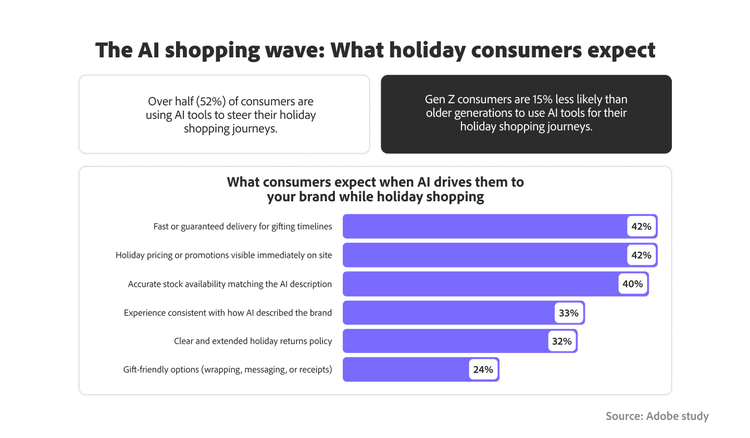
Bar chart showing holiday consumer expectations after AI search, led by fast delivery and on-site pricing at 42%.

Shoppers rank two factors above all else once they land on a retail site after receiving an AI-driven recommendation: guaranteed delivery timelines (42%) and clearly displayed promotional pricing (42%). If the website experience doesn’t align with the information provided by the AI tool, brands risk creating friction at the moment when shoppers are most ready to make a purchase.

What is the AI shopping gap?

Generative AI tools and conversational search agents use natural-language queries to help shoppers find and compare products. During the holidays, this discovery process can put pressure on retailers to keep pricing, inventory, and delivery information accurate and up to date. When the experience on a brand’s website doesn’t match the information provided by an AI tool, it creates what we call the AI shopping gap: a disconnect between the AI-driven recommendation and the on-site experience that follows.

“AI shopping gap — the disconnect between the AI recommendation and the on-site experience that follows.”

General-purpose generative AI tools are more than twice as likely as on-site brand AI tools to be used to guide holiday shopping journeys (44% vs. 20%). Once shoppers arrive at a retailer’s website, their expectations vary by device and demographics.

For iOS users, immediately visible holiday-specific pricing and promotions are the top expectation, cited by 45% of respondents. Among Android users, accurate stock availability and fast or guaranteed delivery aligned with holiday gifting timelines are tied at 42%.

Gen Z consumers place an even greater emphasis on convenience and low-effort holiday shopping. They’re 23% more likely than older generations to expect gift-friendly options, such as wrapping or gift messaging, after an AI-driven recommendation. Women are also 24% more likely than men to expect holiday-specific pricing and promotions at this stage.

For brands, AI recommendations may get shoppers through the door, but the on-site experience still has to deliver. Accurate product information, visible promotions, and fulfillment options that match shopper expectations can help turn AI-driven discovery into a completed holiday purchase.

How can businesses use AI to improve holiday marketing?

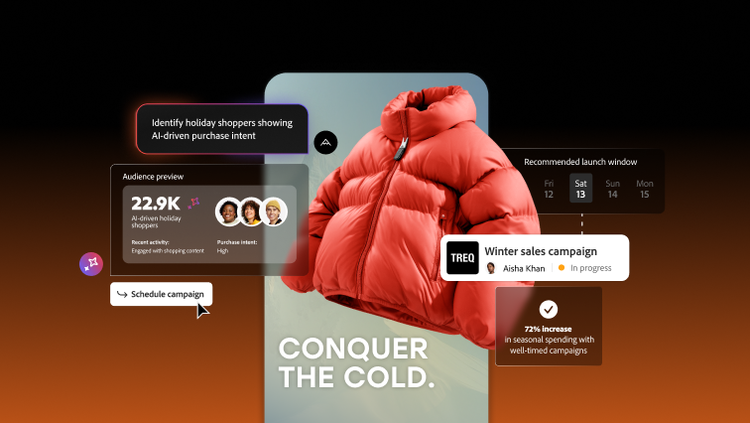
AI can help marketers make holiday campaigns more responsive to shoppers’ purchase readiness. This matters because timing has a measurable effect on seasonal spending, with 72% of consumers saying that well-timed holiday advertising would lead them to spend more with a brand and increase their seasonal budgets by up to 31%.

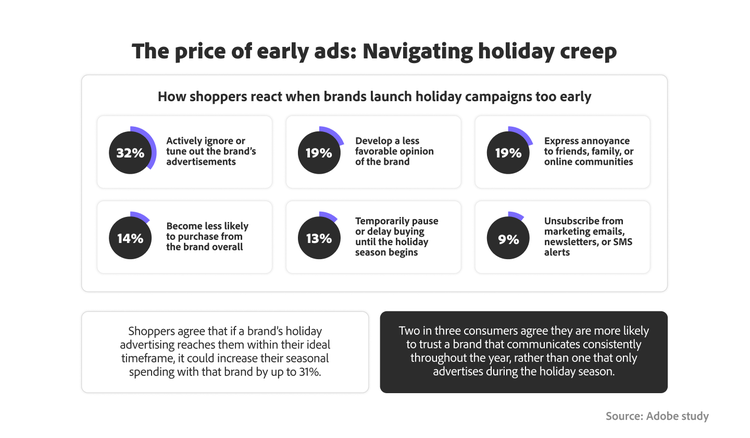
Infographic showing consumer reactions to early ads, with 32% ignoring ads, 19% reporting brand annoyance, and 9% unsubscribing from brand communications.

Building your holiday marketing calendar: When is it too early to begin?

Getting the timing wrong can have the opposite effect, with nearly 1 in 10 shoppers saying they’d unsubscribe from a brand that starts its holiday marketing too early. Gen Z consumers are particularly sensitive to early holiday campaigns, as they’re 75% more likely than older generations to stop purchasing from a brand when holiday marketing begins too soon. However, when the timing is right, 75% of Gen Z shoppers say they’d increase their holiday spending with a brand, resulting in an average budget increase of 34%.

Managing these different timelines calls for flexible campaign planning. GenStudio for Performance Marketing provides campaign date fields and a timeline view to help teams organize campaign activity; the survey findings can inform the timing decisions marketers make.

There’s no single holiday marketing calendar that works for every occasion. Consumers have very different expectations about when brands should begin promoting different holidays, with winter holidays receiving the longest runway.

For Christmas and other winter holidays, 63% of consumers are comfortable with marketing that begins five or more weeks in advance. In comparison, at least 85% of shoppers want brands to wait until four weeks or less before New Year's Day, Valentine's Day, and the Fourth of July.

When is it too early? Optimal lead times for holiday marketing
Holiday
1–2 weeks before
3–4 weeks before
5–8 weeks before
More than 9 weeks before
New Year’s Day
47%
38%
11%
3%
Valentine’s Day
40%
48%
9%
3%
Fourth of July
46%
43%
8%
2%
Halloween
19%
57%
20%
4%
Thanksgiving
21%
59%
17%
3%
Christmas/winter holidays
3%
34%
45%
18%

Note: May not total 100% due to rounding off.

Percentage of consumers expecting holiday marketing five or more weeks in advance:

  • Christmas/winter holidays: 63%
  • Halloween: 24%
  • Thanksgiving: 20%
  • New Year’s Day: 14%
  • Valentine’s Day: 12%
  • Fourth of July: 10%

Timing preferences also vary by generation and gender. Older generations are 20% more likely than Gen Z consumers to prefer that winter holiday advertising begin five or more weeks in advance, while women are 23% more likely than men to prefer the same extended lead time.

How holiday timing expectations differ by industry.

Holiday marketing timing also varies by product category. What works for a grocery brand may not work for a travel company or an electronics retailer. Therefore, marketers need to account for the different ways consumers plan and shop across categories.

Appropriate winter holiday marketing lead times in the retail sector
Industry
1–2 weeks before
3–4 weeks before
5–8 weeks before
More than 9 weeks before
Apparel & accessories
9%
43%
39%
9%
Automotive parts & accessories
26%
44%
24%
6%
Beauty & personal care
19%
45%
30%
6%
Books & media
17%
44%
32%
8%
Electronics
10%
42%
37%
12%
Food
32%
46%
17%
5%
Health & wellness
23%
48%
23%
6%
Travel & accommodation
8%
23%
37%
32%

Note: Only includes Christmas, Hanukkah, and Kwanzaa.

The travel and accommodation industry stands out as the category for which consumers want the most advance notice, with nearly one-third (32%) welcoming advertisements more than nine weeks before a holiday.

Industries in which consumers are most comfortable seeing holiday marketing five or more weeks in advance:

  • Travel and accommodation: 69%
  • Electronics (e.g., TVs, smartphones): 49%
  • Apparel and accessories (e.g., clothing, jewelry): 48%
  • Books and media: 40%
  • Beauty and personal care: 36%
  • Automotive parts and accessories: 30%
  • Health and wellness products: 29%
  • Groceries and food delivery: 22%

The groceries and food delivery industry has the strongest preference for just-in-time marketing, with 78% of consumers saying campaigns should begin no more than four weeks before a holiday. In higher-consideration categories, nearly half of consumers favor a lead time of five or more weeks for apparel (48%) and electronics (49%). Gen Z shoppers prefer lead times of five or more weeks for travel and accommodation (60%), electronics (42%), and apparel and accessories (39%).

What are the ad formats and channels that win during the holidays?

During the holiday season, shoppers interact with brands across multiple formats and touchpoints, from social media and email to digital ads and AI-powered shopping tools. To keep up, brands need the flexibility to scale content across channels without sacrificing consistency. At the same time, the fundamentals of customer loyalty remain important: consumers want compelling offers, fast and affordable delivery, and messages delivered through the channels they already use.

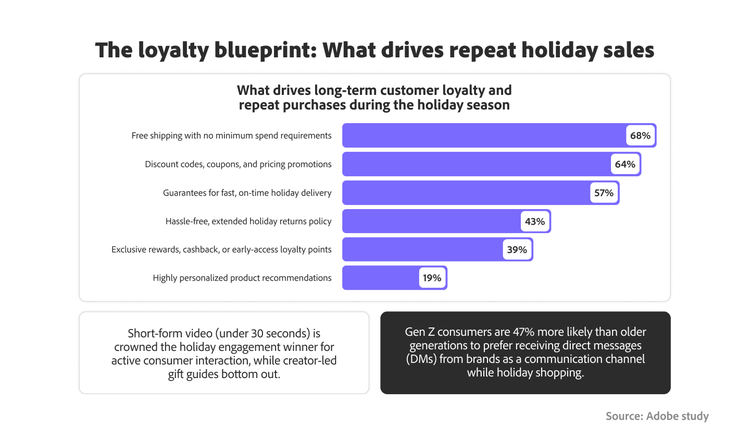
Bar chart ranking holiday loyalty drivers, led by free shipping at 68%, discounts at 64%, and fast delivery at 57%.

What drives holiday brand loyalty?

The basics still matter the most during the holidays. Consumers say free shipping without a minimum purchase requirement is the most effective way for brands to build loyalty during the holiday shopping season, followed by discounts and fast delivery. However, the ways consumers engage with brands also shift during the holidays.

How consumer engagement with brands shifts during the holidays
Compare prices more
52%
Pay greater attention to reviews
36%
More time spent browsing on social media for gift inspiration
34%
Pay closer attention to email marketing and newsletters
29%
Make faster purchases due to shipping deadlines
28%
More likely to buy from a brand that aligns with personal values
24%

Gen Z consumers are 39% more likely than older generations to spend more time browsing social media for gift inspiration during the holidays, while women are 34% more likely than men to do the same. However, both men and women are equally likely to buy from brands that closely align with their values during the holiday season (24%).

Which holiday ad formats are the most engaging?

Holiday advertisement formats ranked by consumers’ likelihood to interact
1
Short-form video ads (under 30 seconds)
2
Long-form holiday video ads (over 30 seconds)
3
Interactive social media ads
4
Standard static banner ads
5
Personalized email lookbooks or curated digital gift guides
6
Creator or Influencer-led holiday gift guides and unboxing content

Short-form video leads the pack, with videos under 30 seconds ranking as the holiday ad format consumers are most likely to engage with. Long-form video and interactive social media ads follow, while static banners, personalized email content, and creator-led gift guides round out the list.

However, Gen Z consumers have slightly different preferences, which have been ranked as follows:

  1. Short-form video ads (under 30 seconds)
  2. Interactive social media ads (polls, swipe-up stories, and shoppable posts)
  3. Creator or Influencer-led holiday gift guides and unboxing content
  4. Long-form holiday video ads (over 30 seconds)
  5. Standard static banner ads
  6. Personalized email lookbooks or curated digital gift guides
How consumers prefer brands to reach them during the holidays
Email
57%
Direct mail
34%
SMS
27%
App notifications
23%
Social media DMs
21%
On-site brand AI tools
19%

Email remains the leading channel for holiday communications, with 57% of consumers preferring brands to reach them by email. Direct mail ranks second at 34%, followed by SMS at 27%.

Gen Z consumers are 89% more likely than older generations to want holiday communications through app notifications, while iOS users are 37% more likely than Android users to prefer this channel. Women are 30% more likely than men to want brands to reach them via SMS.

Aligning AI-powered discovery with campaign timing to prevent holiday shopper fatigue.

As the holiday shopping journey becomes more dynamic, marketers need to account for shifting consumer behavior at every stage. More than half of consumers (52%) use generative AI tools to support their holiday shopping, increasing the importance of accurate product information, promotional details, and delivery expectations throughout the purchase journey. At the same time, consumers have little patience for holiday marketing that arrives too early. Among respondents, 32% say they ignore ads that appear too early, and 1 in 10 shoppers say they would unsubscribe from the brand responsible.

The opportunity lies in connecting two sides of the holiday journey: AI-powered discovery and timely campaign execution. When marketers can quickly create and adapt content while maintaining brand consistency, they can respond to changing consumer expectations without having to rebuild campaigns from scratch.

Taken together, GenStudio for Performance Marketing supports the content side of that opportunity. It helps teams create and manage on-brand email and paid-media content variations using configured brand, product, and persona guidlines. Marketers can use consumer research like this to inform timing and channel decisions; GenStudio supports the content work that follows.

Adobe GenStudio for Performance Marketing, part of the Adobe CX Enterprise Content Supply Chain Solution, helps marketing teams create, manage, and refine campaign content across paid media, email, and display advertising. By using generative AI alongside brand, product, and persona guidelines, teams can generate on-brand content variations and adapt creative assets to different audiences and channels.

Paired with marketers’ timing decisions, on-brand content variations can help teams adapt creative for audiences and channels highlighted in this research.

To learn how your team can create and manage on-brand campaign content variations, explore Adobe GenStudio for Performance Marketing and Adobe's Content Supply Chain Solution.

Methodology.

This article is informed by proprietary research conducted by Adobe. The study surveyed 1,003 consumers across the United States, providing a 95% confidence level with a ±3% margin of error. Respondents were asked about holiday marketing timelines, brand trust, and their plans to use AI-powered shopping tools during the holiday season. As with all self-reported data, results may reflect personal perceptions and experiences rather than actual behaviors.

Frequently asked questions.

Let’s talk about what Adobe can do for your business.

Get started