Human-agent work is already reshaping marketing. The question is who leads it.

Ravi Duddukuru

08-11-2026

Enterprises are shifting to a new operating model where agents participate in work alongside marketers to complete tasks, and return with final results instead of suggestions.

We call this human-agent work. Rather than a copilot that gets consulted, agents act as true participants and operate in the same systems, draw on the same context, and are held to the same standards as your team. However, few enterprises — and even fewer marketing organizations — have the infrastructure ready to adopt this new model.

A capable agent dropped into a marketing operation, without knowing how you operate, what's worked before, or who needs to approve what, is essentially a brilliant stranger. It can't absorb organizational knowledge the way a new hire does, so workflows break and every output requires a second look.

BCG found that turning an agent from a brilliant stranger into a trusted partner is what separates enterprises that are seeing returns on their AI investments from those that aren't. Organizations that gave agents the shared context they need saw roughly a threefold increase in productivity and cut cycle times by up to 80%.1 Skipping this step leaves enterprises stuck spending more time checking an agent’s work rather than reducing the overall time spent.
Marketing has the most to gain from agents — with the least room to leave them guessing.

Every enterprise function will eventually need to give an agent enough context to be trusted, but marketing has less room to get it wrong. Its agents touch brand and customer experiences directly, so when one goes off the rails, it doesn't stay an internal mess. Instead, the mistake ships, in the brand's voice, to real customers, and somebody has to answer: “Who approved this and were they allowed to?”

Before jumping to a true human-agent work model, the question that matters is whether agents can see across the whole operation. That's how agents become both safe to use and trustworthy.

To do this, CMOs must organize their team's work systems around three key areas:

Rallying around these areas is the immediate mandate for marketing teams today. Getting it wrong means just another added tool that everyone struggles to use. Getting it right brings new value to the organization through productivity gains.

Escaping the AI proof of concept loop.

Implementing AI initiatives can feel overwhelming and easily lead to never-ending proof of concept projects that offer little end-to-end value. Instead, marketing organizations should focus on key improvement areas, prioritizing them based on internal needs and potential value.

Adobe customer Moria Fredrickson, VP of Brand and Digital Experience, and her team at Lumen took this approach. Rather than chasing every AI use case at once, they ran their AI initiatives against a disciplined, goal-first plan. And the results followed: Lumen now saves roughly 70 hours per campaign execution and $5 million a year on paid media production, as well as launches social campaigns 65% faster — about 15x its pre-transformation pace.

Moria's advice for escaping the proof of concept loop:

When teams are ready to ready to scale their AI agents, ensuring the underlying systems are connected and governed will prevent pilots from stalling at the same wall.

Human-agent work only pays off with the right infrastructure.

The shift towards human-agent work isn’t something enterprises are easing into. According to IDC, 90% of large enterprises are already deploying agents through all three approaches available to them — third-party tools, agents embedded in existing platforms, and custom-built agents — and expecting productivity gains north of 30% within the year.3

But dropping an agent into a workflow as-is and expecting it to catch on like a new hire won't work — no amount of enthusiasm gives an agent the context that a person can just pick up. The marketing organizations getting real value out of human-agent work won't be the ones with the most agents. They'll be the ones that gave their agents what they needed to act with confidence.

Adobe Workfront leads human-agent work.

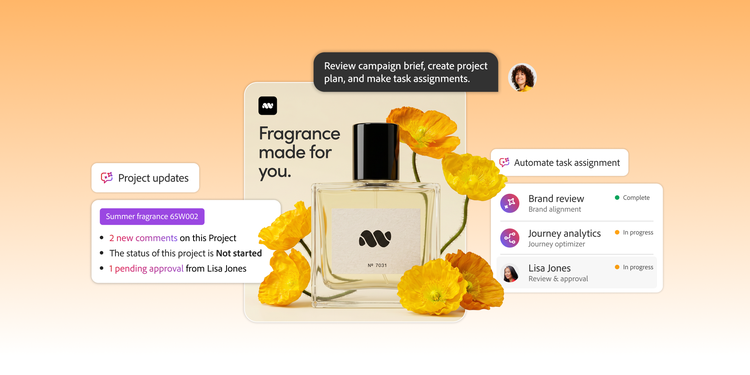
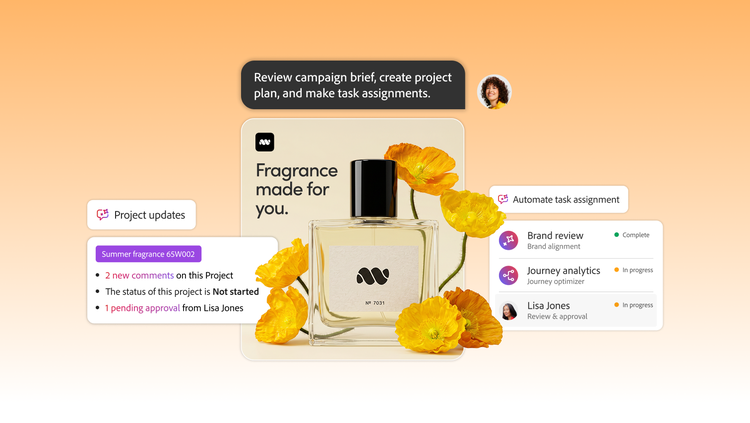
Thats’s exactly what Adobe Workfront delivers. Most agent deployments today ask enterprises to piece context and governance together on their own. Workfront already has both built in, so agents can be trusted with real work from day one. Combined with AI Collaborators, the leap to a human-agent model can be as simple as assigning tasks to agents your team already trusts, Adobe-built or otherwise. Those agents draw on the same knowledge of the business that any person on the team would, reaching across Adobe and third-party systems to get the job done, with the right people checking in exactly where it matters. The result is a workflow that's fully connected and governed, from the first task to the final decision.

Enterprise context, unified visibility, and end-to-end governance helps agents move from being brilliant strangers to productivity-boosting teammates.

SOURCES

  1. Boston Consulting Group, Applied AI at Its Most Impactful with Agentic Enterprise Operations (Executive Perspectives), June 2026. The 3x productivity / 80% cycle-time figures are BCG's, drawn from its 2025 report "The Widening AI Value Gap."
  2. Gartner, Ontologies Are Crucial to Improve AI Accuracy and Reduce Costs, 13 May 2026, ID G00853677.
  3. Gerry Murray, The State of Agentic Marketing in Large Enterprises (IDC Survey), IDC, February 2026. Based on IDC's Agent-Based Marketing Operations Survey, October 2025 (n = 81).

https://business.adobe.com/fragments/resources/cards/thank-you-collections/workfront