Retail has always been about connection — understanding customers, anticipating their needs, and earning their loyalty over time. Few brands have done that as consistently as Macy’s.
But in today’s retail environment, connection is more complex than ever. Customers move fluidly across digital and physical channels, and expectations for relevance, convenience, and personalization continue to rise.
As Macy’s embarked on its Bold New Chapter — an organization-wide strategy to become more curated, connected, and customer-led — the company faced a familiar challenge for modern retailers. It needed to move beyond siloed channels and mass messaging to deliver truly personalized experiences at scale.
Together, Macy’s and Adobe have built a partnership focused on solving exactly that challenge — combining human creativity with AI-powered, real-time decisioning to create seamless, data-driven customer journeys.
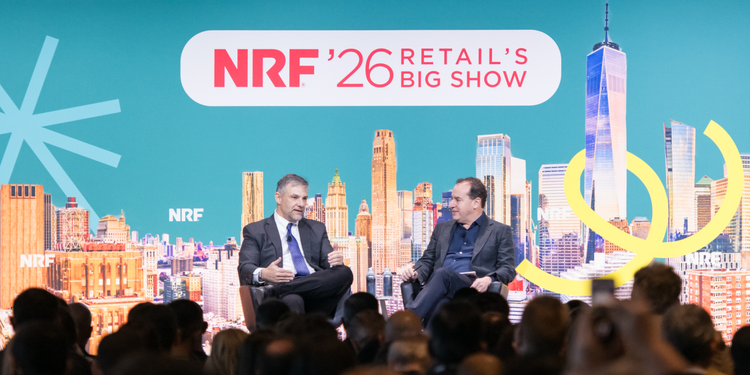
I recently sat down with Max Magni, chief customer and digital officer at Macy’s, to discuss how Macy’s is modernizing retail experiences, why loyalty starts with trust, and how AI is reshaping the way brands build lasting customer relationships.
Macy’s Bold New Chapter is based on three big pillars.
The first is strengthening and reimagining Macy’s — upgrading our assortment, optimizing our fleet, and creating better customer experiences. The second is accelerating luxury and enabling Bloomingdale’s and Bluemercury to win across markets, brands, and channels. The third is streamlining and modernizing our end-to-end operations. We want to use automation where it makes sense, unlock capital, and increase profitability.
When customers come to Macy’s, we want them to feel understood and that we know what they want. We’re trying to create something fundamentally different — a more customer-led model where every decision starts with understanding individual customer needs, preferences, and behaviors.
When you joined Macy’s, what did you see as the biggest opportunity to rethink how the brand showed up for customers?
It was about two and a half years ago. Back then, the online shopping experience was going to macys.com and seeing a purely transactional website.
Like many retailers, we were still navigating the complexity of connecting data, channels, and customer interactions in a truly unified way. We had strong capabilities, but delivering personalization consistently across touchpoints — digital and physical — was a significant opportunity.
The major focus became building a more unified understanding of our customers — connecting signals, behaviors, and preferences across channels so interactions could feel consistent rather than fragmented.
And today, the experience is different. Customers see storytelling. They see collections catered to their interests and offerings that feel more tailored. The homepage evolves based on who you are and what you care about.
That shift — from transaction to relationship — is fundamental. We need to understand our customers, anticipate their needs, inspire them, and make them want to come back because they trust us.
Personalization at Macy’s now operates at scale. How does AI help you make that possible?
AI helps us listen better.
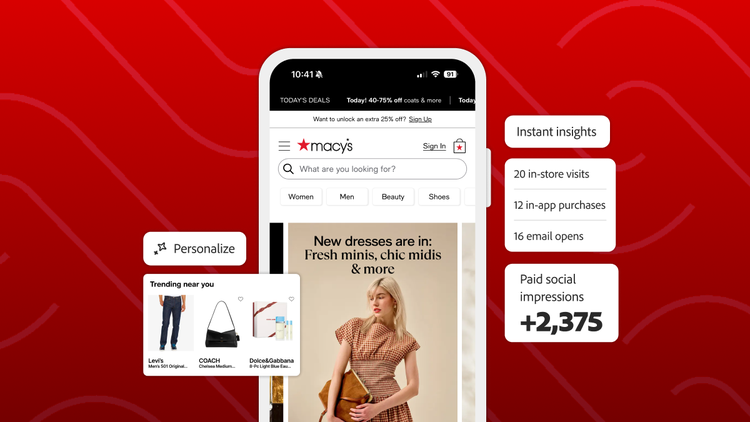
It allows us to interpret customer signals across channels, change course in response to those signals, personalize experiences in the moment, and deliver relevance at scale. Adobe’s real-time decisioning capabilities help us operationalize personalization — translating indicators into timely, relevant actions and experiences. We can move from broad campaigns designed for segments to dynamic journeys designed for individuals.
But it’s never AI for the sake of AI. It has to merge with creativity. You can’t automate taste, and you can’t automate inspiration. But you can use AI to amplify both.
The goal is to meet customers where they are. That’s where AI becomes incredibly powerful — helping reduce friction, remove guesswork, and create experiences that feel connected, intuitive, and helpful, no matter how customers engage with us.
When you think about long-term partnerships, what separates a vendor relationship from a true collaborator?
Transparency and shared accountability.
From day one, our partnership with Adobe has never been about buying a product. It’s been about solving problems together. Whenever I’ve brought an idea or a challenge to Adobe, the response has been, “How do we solve this together?” It’s never been, “Here’s what to buy.”
In fact, there have been moments when I proposed something and the Adobe team respectfully disagreed. And they were right — so we adjusted. That level of candor builds trust.
Every meeting starts with the same questions: Where are we adding value? Where are we not? How do we get better together?
That mindset — having Adobe not as a technology provider but as a strategic collaborator — has been essential as we scale AI-driven personalization across the organization. That’s why the relationship works.
Customer loyalty is crucial in retail. How do you think about earning it today?
Loyalty isn’t a program. It’s a mindset. And personalization plays a central role in that, because relevance is what shows customers you understand them.
Everything starts with the customer. Loyalty is such a big deal. We have cross-functional teams that are truly embracing it and all working together to gain customer trust. Internally and with partners like Adobe, we always talk about what it will take to win customers.
If there’s one big thing I’ve learned, it’s that every time you put a customer at the center, you achieve great things for them and for the company.
AI is moving quickly. How do you evaluate new technologies responsibly?
For us, AI only matters if it meaningfully improves the customer experience — reducing pain points, increasing relevance, and strengthening trust.
I’m a big believer in fail fast, then figure out why you failed. And it’s okay to fail. Step back and think through why you want to do something, whether it’s for improving efficiency, operations, and so on.
Keep in mind that you may scale a proof of concept, but there’s seasonality, new brands coming in, and geopolitical changes, so you’ve got to be careful. AI moves faster than organizational readiness. It’s important to take the time to do it right and do it with discipline — that means strong data foundations, clear use cases, and constant measurement of impact.
Think about the impact decisions have on customers. AI is going to change the world whether we like it or not. It’s here to stay.
You don’t have to be the first one to move, but you can’t stand still. You have to be ready to embrace AI and do things differently.
But don’t do it alone. Choose partners you trust, because this kind of transformation — scaling AI-driven, customer-centric experiences — requires deep collaboration and shared accountability, not just new tools.
Learn more about how to use Adobe AI technology to deliver relevant, compelling experiences across every channel.
Stephen Frieder is committed to helping Adobe define and deliver customers’ digital experiences. As chief revenue officer, he is responsible for Adobe’s global enterprise Digital Media, Digital Experience and Government businesses. He designs go-to-market strategies that leverage the expertise of the company’s technology, business, financial, and marketing teams.
Since joining Adobe in 2009, Stephen has worked with leaders in retail, restaurant, health care, technology, manufacturing, consumer packaged goods, and service industry. He has shown leadership teams from organizations across these sectors the capabilities and opportunities of digital transformation. At Adobe, Stephen has created high-performance teams that offer solutions for every type of customer — from emerging artists to global brands.