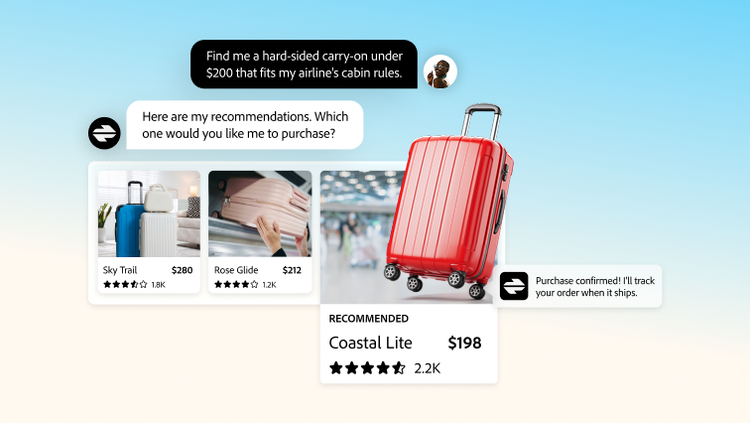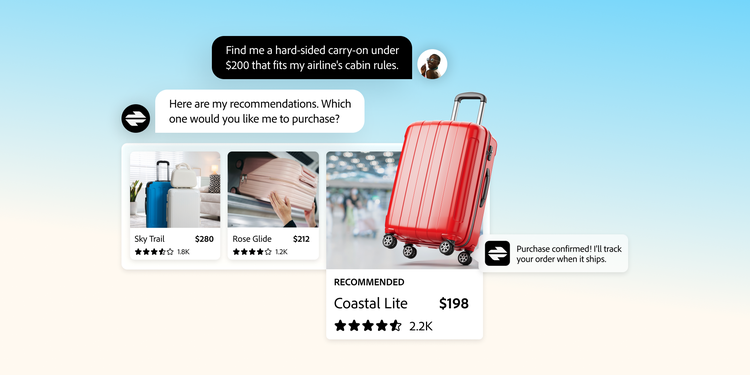
There's probably something you've been meaning to research and buy.
Say it's a carry-on for an upcoming trip. You have a budget, a few requirements, and zero interest in spending your evening comparing luggage across a dozen websites. So, you hand it off to your personal AI agent: “I need a hard-sided carry-on under $200 that fits my airline's cabin rules, is durable but light, has room for four days, and arrives before Friday.” Your agent researches, checks delivery dates, comes back with a shortlist, and with your approval, completes the transaction for you.
Now picture your website on the other side of that request. You might sell the exact suitcase. Whether the agent picks it depends on things most marketing teams haven’t had to think about.
If you lead marketing, digital, or website strategy, this post is for you. Your site now has a second audience. What wins that audience is different from what wins people, and the work to get ready builds on what your team already does.
Your website has a new audience.
For decades, we've built websites for a person who arrives, looks around, and decides. We obsess over what they notice first, how the brand makes them feel, whether the tone is right, and what nudges them to the next step.
That person hasn't gone away. They now have help. In June 2026, AI agent and crawler traffic surpassed human traffic for the first time. And according to Adobe Holiday Shopping Trends 2026, AI-driven traffic to retail sites grew 127% year over year in August 2026. That doesn't mean agents have replaced people. It means websites now serve two audiences, and one of them operates at enormous scale.
Personal agents are the part of that shift marketers can most easily relate to, because we're all customers too. Meta's Muse, OpenAI's Dot, Google's Gemini Spark, and others are being designed to feel personal. People use their names and swap stories about what they did for them. These agents can browse sites, fill out forms, help with purchases, and even recommend relevant follow-ups or reminders. And more agents are coming fast.
The point isn't which agent wins. It's that your customers are starting to delegate, and the work you’ve done to win people won’t be the same as the work needed to win their agents. A person responds to visuals, storytelling, and the feeling a brand creates. An agent is looking for information it can verify and a path it can complete. Both matter but they need different things from your site.
What an agent actually does with your site.
We tried it ourselves. The request: Find a three-day cruise in Ha Long Bay with kayaking for under $700. Muse searched with its own index, picked four options, and sent a browser helper to check each booking page for availability, room types, activities, and price. It came back with recommendations and asked for approval before paying.
The agent never saw a campaign or a brand story. It read the structure of each page and checked the facts. An appealing offer wasn't enough if the agent couldn't verify it or finish the booking, so the agent moved on to the next site. Each step maps to the work that marketers already know:
- Finding the right booking pages (SEO)
- Confirming the price for the right room depends on clear, readable page structure (Cumulative Layout Shift, web performance)
- Operating the date selector (accessibility)
- Finding the amenities list (content structure)
For a travel brand, that puts weight on details that might otherwise feel far removed from marketing strategy. The agent also wasn't acting alone. It was working from our request. Had we named a cruise line we loved, or one we'd had a bad experience with, the shortlist would have looked different. The agent works as an extension of the person, so their brand preferences travel with it. Brand still matters, but the agent also needs usable information and a workable path to act on it.
The problem is invisible and owned by marketers.
Personal agents introduce problems that look like this:
- A price that sits in an image instead of text — an accessibility and content structure failure
- A date picker an agent can't operate — another accessibility problem, usually involving keyboard and control labeling
- A page that shifts while it loads, which throws off agents working from screenshots — a performance problem, specifically layout shift
- A page the agent never finds or a bot defense that blocks the visit — an SEO issue
We already know that website friction affects conversion. What changes is where that friction happens, and whether you'll ever know about it.
When a person struggles with a booking form, you get an abandonment event. They might retry, call support, or tell you what went wrong. When their agent can't get through the same form, it quietly recommends another brand. No error, no bounce, no support ticket. Your team never learns a customer was interested, that your offer was a fit, or that one broken interaction stopped it.
That moves these issues out of the web team's backlog and into the metrics marketers own: consideration, conversion, and revenue.
The upside: Customer intent that finally turns into action.
Agents also introduce another opportunity. Our cruise test didn’t end with the recommendations. When we didn’t complete payment, Muse followed up a few days later. It wanted to know if we were ready to authorize it, or if we needed more options. The agent kept track of an unfinished task and offered to help move it forward.
Think about how often that doesn't happen. We get distracted, postpone the decision, wait for a sale or promotion, or forget to come back. Agents can carry that work forward and complete the task.
And the agent's job doesn't end at checkout. It remembers what it did for you. After one of our colleagues bought a LeBron James jersey, his agent reminded him when the next Philadelphia 76ers game was and offered to set a reminder for every game. After the cruise, an agent could ask about transportation to the port, check whether you’d do it again, and nudge you about your next getaway a few months later. Could agents foster a deeper relationship with a brand, not just complete one sale?
That creates a growth opportunity for brands. Customers could act on purchases or plans they would otherwise put off. Agents can then remember the action they took and recommend similar ones. This points to a market shift worth exploring, where agents help turn existing customer intent into action and ongoing relationships.
Two stages decide whether an agent chooses your brand.
Being chosen happens in two stages and requires different marketing efforts:
-
Before the visit: The agent decides which brands to consider, drawing on what it learned in training, what it finds through search, and how it expands a request into related queries. This is about how visible your brand is across AI search.
-
On your site: Once the agent opens a browser on a brand's site, the questions become:
- SEO and access: Can it get in and find your products and offers, or do your bot defenses block it?
- Content structure and page formats: Can it read your prices, availability, and policies accurately the first time?
- Accessibility and performance: Can it use your forms and controls without a person rescuing it?
- Accessibility and controls: Can it finish the task and recognize where the customer needs to approve?
From there, marketing teams will need to understand why the agent picked them, or another brand. Across an enterprise website, the answers may reveal issues that repeat through entire categories, templates, or booking flows. Making your site usable gets you onto the shortlist. Understanding what earns the recommendation is how you win it. Much of the work will feel familiar: clear product information, accessible controls, and reliable pages.
Marketers can start learning now. Give an agent a real customer task and follow it from discovery to comparison to checkout. Note which brands show up, where the agent gets stuck, and where the journey ends.
Where Adobe fits.
One website should work for both people and the agents acting on their behalf. As the examples above show, much of what agents need is SEO, accessibility, and performance work that already helps people. Adobe Experience Manager Sites Optimizer is built to find and fix issues at scale for people and agents alike. Adobe Brand Visibility covers the stage before the visit. Together, they help customers and their agents find, understand, and engage with your brand.
Here's how Experience Manager Sites Optimizer maps to the questions above:
- Can the agent get in and find us? Experience Manager Sites Optimizer improves how your pages show up in the searches personal agents run in their own browsers. It also supports agent-friendly page formats like Markdown and llms.txt so agents can find and read your content.
- Can it use the page? Many accessibility fixes help agents as well as people. For example, a correctly labeled date picker helps both a screen reader (software that reads a page aloud) and an agent operate the same control. Experience Manager Sites Optimizer includes accessibility checks for issues like this. Page stability matters too. Some agents work from screenshots, so a page that shifts while it loads can make them lose track of where to click. Experience Manager Sites Optimizer fixes this layout shift, one of the Core Web Vitals.
- Can it finish the task? WebMCP gives agents a direct, reliable way to take actions on your site.
Experience Manager Sites Optimizer does this across thousands of pages, prioritizes what matters, and applies approved fixes. Adobe is building toward helping marketers understand what makes agents choose and transact with their brands: which information matters, where journeys break down, and which changes improve the outcome. That includes applying Adobe’s testing, recommendations, and personalization to what an agent gets back.
And this can't be a one-time audit. Web optimization needs to be ongoing work as products, prices, pages, and agent capabilities keep changing. There’s also a math problem: People have finite time. Their agents don't. An agent can run endlessly, and one customer may have several working on their behalf. The volume of agent visits to your site could far outstrip the human traffic you plan around, and every one of those visits is a chance to be chosen or passed over. Brands need a way to keep improving at that pace without turning every issue into another manual project.
What to do next.
Personal agents can carry a customer's intent through work the customer used to do alone and potentially keep the relationship going afterward. For marketers, that's a growth opportunity and a visibility problem hiding in plain sight. The brands that serve agents well while still earning the preference of the people behind them will be the ones on the shortlist.
Is your website ready for a new audience? Adobe Experience Manager Sites Optimizer helps brands turn more customer intent into action, whether customers arrive themselves or send an AI agent ahead. Learn more about Adobe Experience Manager Sites Optimizer and how it helps teams prepare their websites for both humans and AI agents.
Recommended for you
https://business.adobe.com/fragments/resources/cards/thank-you-collections/experience-manager-sites