The future of productivity: How Adobe Workfront powers work management and workflow automation.
To gain a deeper understanding of what productivity in the workplace entails, we surveyed over 1,000 full-time US employees. The results show that while workers often struggle with juggling multiple tools and navigating outdated systems, they see a better path forward. Rather than losing time on low-value tasks, employees are looking for the right tools, clearer priorities, and more innovative ways to manage workflows to support their well-being.
Key findings.
Adobe for Business study reveals the current state of productivity for US workers.
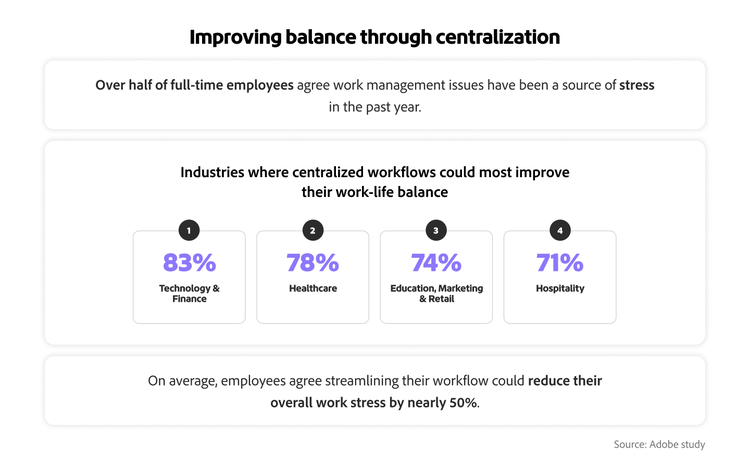
- More than half of the respondents say that work management issues have been a source of stress in the last year.
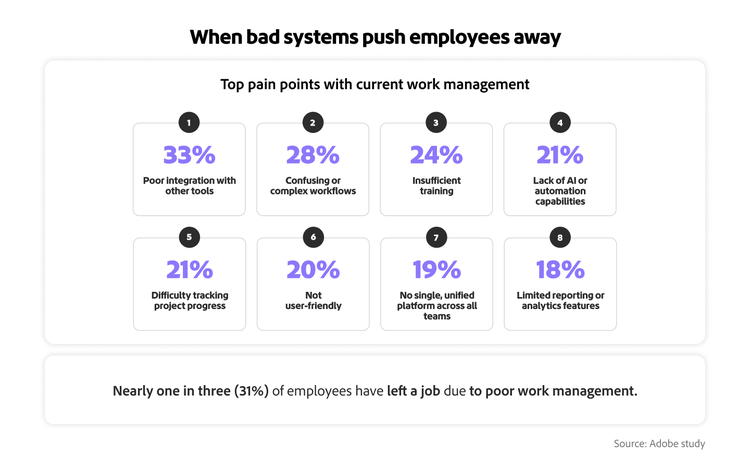
- Nearly one in three surveyed employees has left a job due to poor work management.
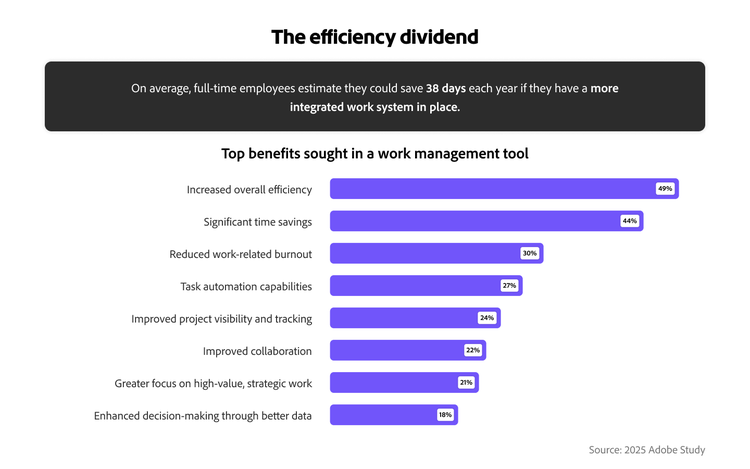
- The respondents believe that a unified workflow could give them 38 extra days of efficiency every year.
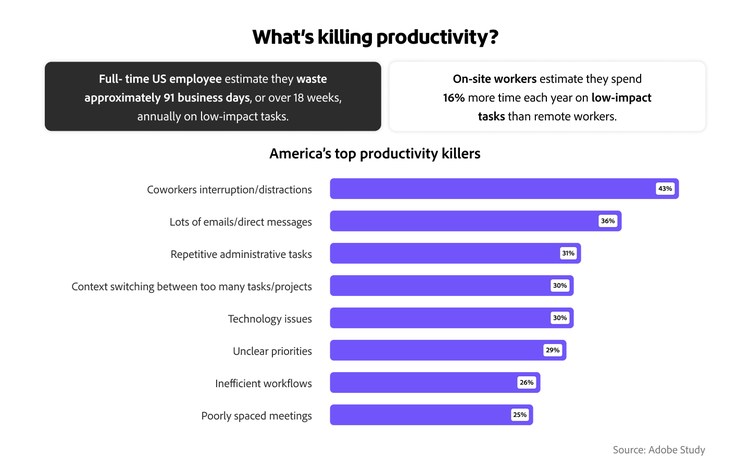
- Full-time US employees estimate they waste about 91 business days, or more than 18 weeks, annually on low-impact tasks.
- On-site workers surveyed spend 16% more time each year on these low-impact tasks.
- The number one reason for lost productivity is distractions from coworkers (43%).
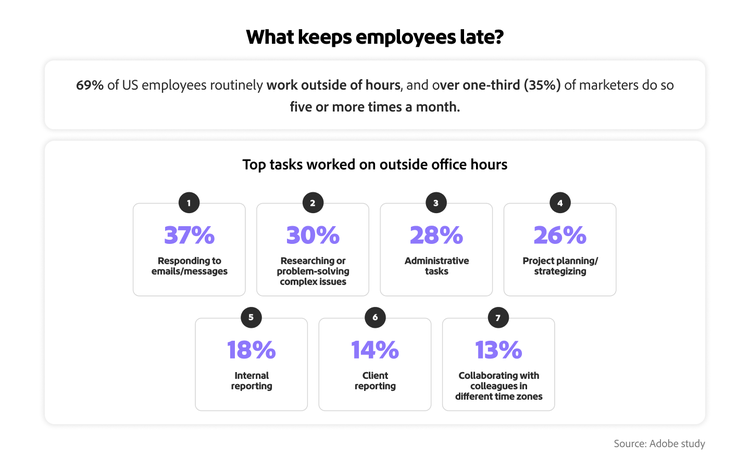
- Nearly 7 in 10 employees surveyed work during their off-hours.
- On average, employees automate 11% of their tasks, but believe that nearly a quarter could be automated, thereby reducing the time spent on low-impact work.
What’s draining workplace productivity?
The right work management product is essential for improved productivity, alignment, and well-being. By streamlining processes, organizations can help employees overcome constant interruptions, unclear priorities, and outdated processes that otherwise erode focus. Addressing time lost to low-impact work and hours spent after a workday ends allows teams to balance workloads and prioritize high-value tasks, making enterprise work management solutions more important than ever.
While employees surveyed face a range of productivity killers, from constant interruptions to inefficient workflows, there is a clear opportunity for improvement.
Fragmented tools and constant context switching prevent teams from having a single, collaborative system for planning, execution, and communication — creating productivity gaps that tools like Adobe Workfront can close.
Top causes of productivity loss by industry.
- Education: Too many emails/messages (48%)
- Finance: Coworker interruptions (48%)
- Healthcare: Coworker interruptions (48%)
- Hospitality: Coworker interruptions (43%)
- Marketing: Unclear priorities (38%)
- Retail: Coworker interruptions (51%)
- Technology: Poorly spaced meetings (35%)
On-site employees are 53% more likely than remote workers to cite coworker interruptions as their most significant barrier, and 82% more likely to struggle with collaboration. In addition, on-site employees spend 16% more time each year on low-value tasks than their remote counterparts.
Different job levels come with their productivity hurdles too. Senior leaders are 22% more likely than entry-level employees to face coworker interruptions, and entry-level staff are 50% more likely to report inefficient workflows.
To bridge these productivity gaps, teams need more than another standalone app — they need a unified system that eliminates friction. Adobe Workfront serves as the single source of truth for enterprise work. It reduces fragmented communication across email, chat, and meetings by centralizing collaboration, task management, and project tracking visibility. With digital reviews and automated approval workflows, teams can replace lengthy email chains and back-and-forth messages with streamlined content feedback and decision-making, cutting interruptions and reclaiming focus time.
Time lost on low-impact work by industry.
Hours spent on low-impact work, such as administrative tasks, data entry, meeting scheduling, and internal reporting, quickly add up, pulling time and attention away from core priorities. Wasted time is a constant challenge for the surveyed employees, with the average worker losing the equivalent of 91 business days each year on these low-impact tasks.
- Healthcare: 101 days/year
- Finance: 94 days/year
- Marketing: 91 days/year
- Technology: 85 days/year
- Education: 81 days/year
- Hospitality: 78 days/year
- Retail: 75 days/year
Instead of relying on disconnected team collaboration software and manual task handoffs, organizations are turning to platforms that can automate repetitive tasks and standardize processes. Workfront helps teams reclaim these lost hours by automating workflows, eliminating manual tasks, and connecting cross-functional functions within a single system.
Work outside regular hours.
Nearly 7 in 10 employees surveyed work beyond their scheduled hours. Tech employees lead the way, putting in an average of 72 days of extra time per year, compared with 55 days for marketers.
Across industries and roles, the data points to a common theme: fragmented tools and inefficient project workflows mean employees spend more time chasing information than completing strategic work.
This is where an enterprise work management platform can make a significant difference by not only tracking work but also connecting every task to larger outcomes. Workfront connects planning and execution, ensuring that every task is tied back to strategic goals, thereby reducing uncertainty and clarifying priorities. With built-in resource management capabilities, teams can forecast capacity, balance workloads, and track ROI.
Unlock work management AI and automation to boost productivity.
AI is only scratching the surface of what’s possible in today’s workplaces. While our study reveals that a small share of tasks are automated now, employees see clear opportunities for technology to take on more, and for smarter workflow automation and workflow management to remove the roadblocks holding teams back.
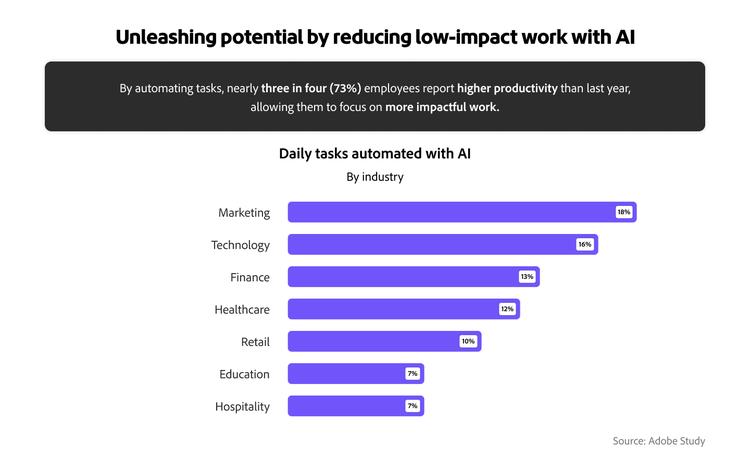
Employees see significant potential for AI automation to reduce the time spent on low-impact tasks, which is expected to allow them to focus on improving work quality and achieving better work-life balance. While AI automation remains limited, with only 11% of daily tasks automated, workers believe nearly a quarter could be. Those already using AI in work management are seeing the benefits, with nearly three in four (73%) reporting higher productivity compared with last year.
Realizing the value of AI automation requires a platform that puts these automations into everyday workflows, rather than treating AI as a separate tool. The AI-powered work management features in Workfront make automation practical and accessible. With auto-generated briefs that extract details from unstructured files (such as Word, PowerPoint, and PDFs), teams can skip the manual setup and jump straight into execution. The AI assistant delivers quick answers, deeper insights, and can instantly create tasks or projects, helping teams stay efficient and in sync.
Top three industries for AI automation.
- Marketing: 18%
- Technology: 16%
- Finance: 13%
A connected work management platform that incorporates automation is key to improving team performance and productivity. In fact, one in six employees surveyed who do not use work management products report a drop in productivity over the past year, and nearly one in three marketers surveyed (32%) has left their job due to poor work management, with women being 50% more likely than men to do so.
Top pain points with current work management.
- Poor integration with other tools: 33%
- Confusing or complex workflows: 28%
- Insufficient training: 24%
- Lack of AI or automation capabilities: 21%
- Difficulty tracking project progress: 21%
- Not user-friendly: 20%
- No single, unified platform across teams: 19%
- Limited reporting or analytics features: 18%
Teams are looking for a unified platform that can replace silos and grow with the business. Workfront unites teams, tools, and workflows with a single connected system. With automation, centralized collaboration, and real-time insights, organizations can streamline operations, reduce inefficiencies, and focus on the work that has the biggest impact.
How unified workflows drive efficiency and balance.
Unified work management keeps everything in one place, making processes smoother, collaboration easier, and freeing up more time for the work that matters most. This prevents slips and productivity drops that occur when work spreads across too many tools and systems.
Unified workflow management refers to the process of consolidating and optimizing all tasks and activities within an organization into a single, integrated system. This approach is aimed at streamlining operations, enhancing collaboration, and improving overall efficiency by integrating various business functions, including work management, customer relations, and accounting. By centralizing tasks and automating processes, unified workflow management and team productivity tools reduce inefficiencies, minimize errors, and allow teams to focus on core business objectives.
- Increased overall efficiency: 49%
- Significant time savings: 44%
- Reduced work-related stress/burnout: 30%
- Task automation capabilities: 27%
- Improved project visibility and tracking: 24%
- Improved collaboration: 22%
- Greater focus on high-value, strategic work: 21%
- Enhanced decision-making through better data: 18%
Addressing work management issues is vital for reducing employee stress — a feeling reported by more than half of the full-time employees surveyed, with finance employees (61%) most likely to experience it and healthcare employees least likely (40%).
How unified project workflows reduce stress.
Streamlining workflows could cut overall work stress by nearly 50%, according to respondents. Here’s how workers across US industries expect a unified workflow system to help reduce their stress levels:
- Marketing: 54%
- Finance: 53%
- Healthcare: 49%
- Retail: 49%
- Education: 48%
- Technology: 46%
- Hospitality: 45%
Workfront supports a healthier work-life balance by bringing clarity and focus to each person’s day. With its priorities feature, employees gain a single, focused view of their work, which helps them to eliminate clutter and efficiently manage and track daily tasks. With clear priorities and balanced workloads, teams can be more efficient, productive, and can focus on the most meaningful work, which will likely reduce stress and prevent burnout.
Unified project workflows and work-life balance.
The surveyed employees estimate they could save an average of 38 days a year with a more integrated work system.
Nearly three in four marketers surveyed agree that a unified workflow system would improve their work-life balance. Tech employees (83%) are the most likely to agree that a more unified workflow management system would improve their work-life balance, while hospitality employees are the least (71%).
For marketing teams, robust marketing work management capabilities ensure that campaigns progress smoothly, from concept to completion. Work management software can help coordinate complex, multi-team projects, thereby ensuring alignment and efficiency across an organization.
Visibility delivers the most impact when it scales across the entire marketing ecosystem, from intake and planning to reporting and optimization. Workfront Planning takes this further by unifying strategy and execution, linking planning and execution records across the marketing ecosystem so that every project aligns with broader business goals. Real-time dashboards and status reports provide leaders with visibility into progress, while data connections support deeper analysis in visualization tools like Tableau and Power BI. Together, these capabilities enhance visibility, improve decision-making, and strengthen strategic alignment across teams.
The future of enterprise starts with better work management.
Productivity thrives when organizations address challenges like hours lost on low-value tasks, automation that’s barely used, and scattered workflows that slow teams down.
Unlocking this potential isn’t about working harder or faster. It’s about providing people with the right balance of clarity, tools, and processes, so they can focus on the work that matters most.
Workfront brings everything into one place. It combines team productivity tools with streamlined project workflows, helping teams manage busy work, stay aligned, and keep projects moving. That means more time for high-impact work, less stress, and a healthier work-life balance.
Discover how Adobe Workfront can transform productivity and enhance work management for today’s dispersed and collaborative teams.
Research methodology.
This article is informed by proprietary research conducted by Adobe. The study surveyed 1,106 full-time employees across the US, providing a 95% confidence level with a ±3% margin of error. Respondents were asked about productivity in the workplace. As with all self-reported data, results may reflect personal perceptions and experiences that could differ from actual behavior.