We’ve all been there. You know the information exists somewhere. In a contract. A policy. A research report. Maybe a presentation someone shared six months ago. The challenge isn’t creating more information. It’s finding the right information, understanding it quickly, and putting it to work when you need it.
Now multiply that experience across an entire organization.
Companies have spent years accumulating knowledge in contracts, policies, reports, research, playbooks, and other business documents. These documents capture how an organization thinks, operates and makes decisions. Yet much of that intelligence remains difficult to access and use. IDC estimates that only half of an organization’s unstructured content is ever analyzed for value.
The impact shows up in two ways. In everyday work, employees spend more than three days a week reading, summarizing, and recreating documents that already contain the information they need, according to Adobe research. In higher-value business processes, critical information can be spread across hundreds or thousands of contracts, invoices, reports and other files that teams need to review and compare.
AI creates an opportunity to change that, but it also raises the stakes. Employees increasingly expect to be able to ask a question and get an answer quickly. TELUS Digital found that 57% of enterprise employees have copy-pasted sensitive company information into public AI tools to get an answer.
The challenge for enterprises, then, isn’t simply giving AI access to more information. It’s enabling AI to understand the documents where that information lives, while preserving the context, structure, sources and controls businesses rely on.
That requires a document layer.
Why enterprises need a document layer.
A document layer gives AI the ability to understand and preserve the structure, context, provenance and source of information within business documents. Without it, AI sees text. With it, AI sees meaning.
A contract includes clauses that depend on each other across pages. A financial report ties numbers to narrative, tables and footnotes.
A policy may include a single exception that changes the meaning of the rule.
AI that treats a document as plain text can miss the relationships that give the information its meaning. A document layer enables AI to reason over the information inside the documents while keeping it connected to the sources organizations already trust.
Evolving the standard for trusted document productivity.
This is the foundation Adobe has been building for more than three decades. Acrobat is where organizations already manage some of their most important business content: contracts, financial filings, HR records, regulatory submissions and other documents where precision is non-negotiable. The opportunity now is to extend it into AI without asking enterprises to compromise on security, governance or verification.
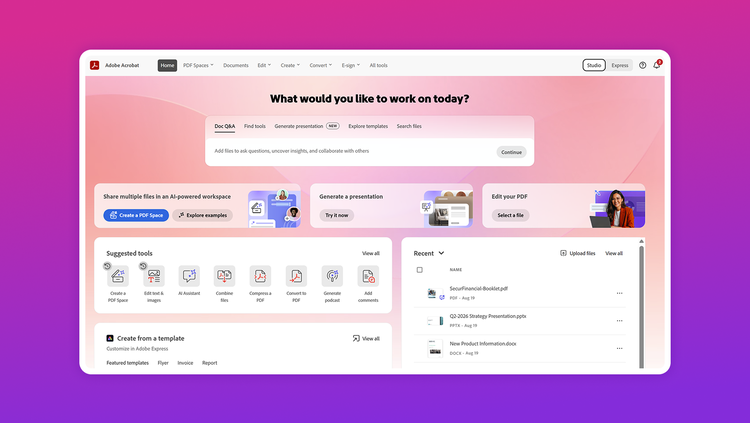
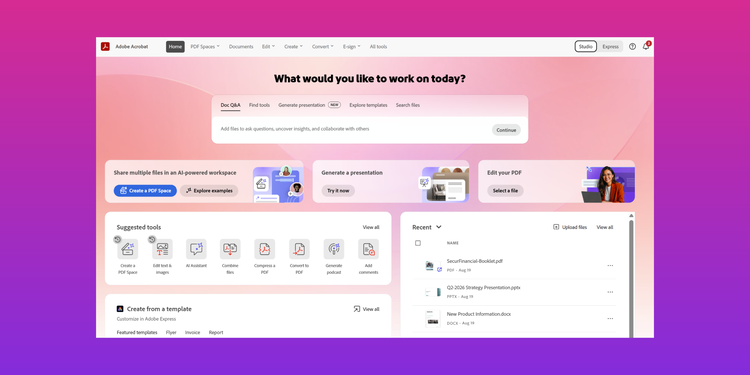
That evolution is already visible in how teams use Acrobat today. People can use AI grounded in trusted files to understand and act on documents faster, including reviewing, comparing, and summarizing information to creating polished, on-brand business deliverables with Adobe Express.
Acrobat is also expanding how people engage with information inside documents. New capabilities can transform dense files into interactive visual reports and summary slides, or make information easier to absorb through personal podcasts, audio summaries and read-aloud experiences.
Read more here.
These experiences make AI more useful in the flow of everyday document work. But the larger opportunity extends beyond helping one person understand or act on one document at a time. It is enabling organizations to put the knowledge across their document collections to work at scale.
That is the next step in Acrobat’s evolution, from a standard for trusted documents to the intelligence layer built on top of them.
Scaling intelligence with Knowledge Base and Analyzer.
The larger opportunity is no longer just one document at a time.
It's what becomes possible when organizations can reason across document collections that run the business, turning that information into knowledge employees can use and structured data businesses can act on.
New in Acrobat, Knowledge Base transforms curated document collections — policies, playbooks, product information, pricing guidance, research — into cited answers available from Slack, Microsoft Teams, Acrobat, and other places employees already work.
Instead of searching across files for the right information, employees can ask questions across that knowledge and get answers connected back to the source. Inside Adobe, we applied this approach to more than 6,000 research reports. In the first month, teams asked more than 1,000 questions, and research usage increased 46% year over year. Read more about Knowledge Base.
Analyzer addresses a different need: turning information across large sets of documents into structured, verifiable data. It can analyze thousands of contracts or invoices and identify critical information, such as renewal dates, revenue clauses, obligations, or exceptions, without requiring manual review or custom model training. That turns information once trapped in files into data that can inform finance, procurement, compliance, and the systems that support them. Read more about Analyzer.
Together, these capabilities change the role documents play in the enterprise. A policy becomes an answer an employee can verify in seconds. A body of research becomes institutional intelligence teams can use in product and customer decisions. A portfolio of vendor contracts becomes comparable data procurement can negotiate from, rather than a stack of files no one has time to fully review. The organizations that move first will not only work faster; they will make better-informed decisions with the knowledge they already have.
And as the role of AI in these decisions grows, so does the importance of trust. Leaders need to know where an answer came from, whether it can be verified, and how the underlying information is governed. Knowledge Base and Analyzer infrastructure is built on Acrobat Sign's foundation, operating under Adobe’s Common Controls Framework (CCF) for standardized security and compliance controls. Answers and extracted information remain connected to their sources, giving teams a way to validate the information before they act.
Read how Adobe is mining insights from our own data with Acrobat here.
Putting document intelligence to work.
For technology leaders, the mandate is clear: treat their organization's documents as a strategic asset. The next wave of AI advantage will not come only from new models or more copilots. It will come from connecting the information companies already trust to the decisions, workflows, and people that move the business forward.
The knowledge is already there. The advantage will belong to the organizations that can put it to work.
Learn more about Adobe Acrobat Studio.