Lately, I’ve been getting a lot of questions about node-based AI tools. The technology itself isn’t new. Node-based tools have been around for decades. What’s changed is the way creative teams work.
Getting from the first idea to the final output increasingly involves multiple AI models and creative applications. An image generated by one model may become the starting point for a video created in another, followed by editing and refinement in different apps. As workflows become more sophisticated, people need a better way to connect and manage each step.
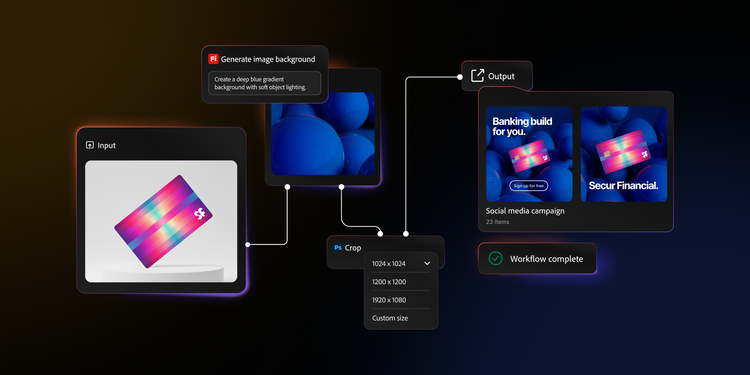
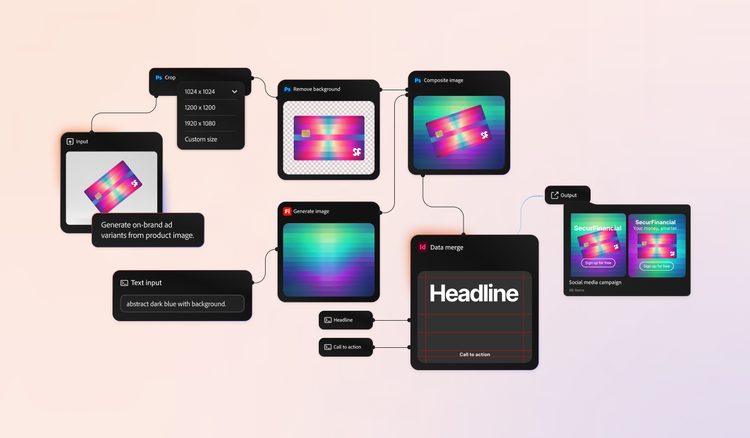
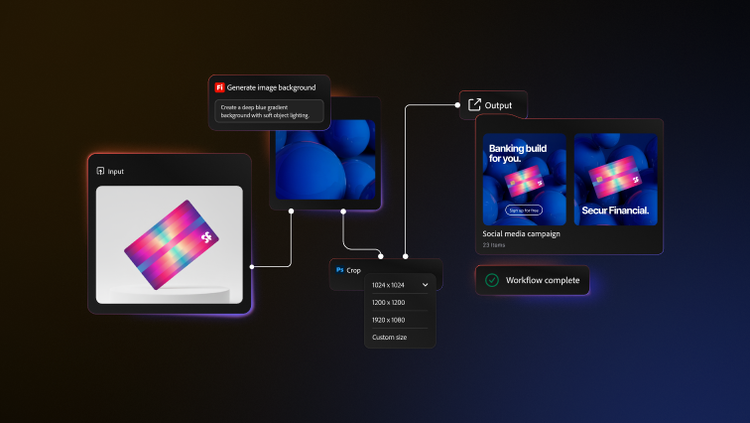
Node-based tools provide a visual way to represent these creative decisions and make them easy to reuse. Each node represents a part of the creative process, such as editing an image, prompting an AI model, or making an adjustment to a composition.
Like any creative process, you need a standard way of executing the work while still allowing room for important creative decisions. Connecting nodes determines what happens first, what follows, and how each decision affects the result. Once a workflow is built, it will execute the same steps in sequence for any input. After all, a great result is only valuable if you can repeat it.
More precision and control.
Node-based workflows give creators more precision and control. If someone changes an image, prompt, or other input, that change carries through the rest of the workflow. One decision can be adjusted without rebuilding everything that follows.
AI models and traditional capabilities can also be integrated into the same creative process. This reduces the need to move between disconnected interfaces and gives creators more flexibility in how they approach the work. Individual steps can be changed as new models become available or project needs evolve while the rest of the workflow stays intact.
Scaling what works.
For creators, node-based workflows offer more control over complex processes and less time spent repeating familiar steps. For enterprises, the value extends beyond creation.
A successful workflow captures the prompts, models, decisions, and techniques behind a strong result. That knowledge often stays in the mind of the person who developed the process. Node-based workflows make it possible to capture and share that knowledge in a form others can use.
This enables organizations to scale what works across teams and improve consistency. Rather than recreating each process from scratch, teams can start with an established workflow and adapt it for a new project. Over time, successful workflows become organizational assets.
Adobe Firefly Graph inside Adobe Creative Cloud.
Firefly Graph for enterprise is a new node-based visual canvas for building AI-powered workflows inside Creative Cloud. It combines Adobe’s creative applications, top AI models, and governance capabilities in a unified platform.
Because Firefly Graph works natively with Creative Cloud, workflows stay connected to the applications, assets, and people involved in the creative process. Creators can share workflows directly with teammates to reuse and build on proven approaches.
Inside a node-based workflow with Firefly Graph. Watch the on-demand webinar here.
Creative Cloud also provides enterprise-grade AI governance. Organizations can control model selection and access, while workflow management capabilities make it possible to centrally deploy and manage workflows. Built-in content credentials provide a verifiable record of how assets were created, and IP indemnification for Adobe Firefly and select partner model outputs supports responsible AI adoption.
Together, these layers of governance, controls, and protection help organizations scale AI-powered creativity with greater confidence and consistency.
More than a workflow.
A successful workflow captures more than just a result. It captures the decisions, techniques, and expertise that made that result possible.
As the pace of innovation continues to accelerate, node-based tools like Adobe Firefly Graph help organizations move from isolated capabilities to integrated workflows that incorporate both creativity and AI.
Looking ahead, that shift may prove just as important as the models themselves.
Learn more about node-based creative workflows and see a live workflow build in Firefly Graph at Adobe MAX. Register today.