State of Higher Education 2026: Australia and New Zealand
Australian universities face another step change in expectations of the digital student experience. Despite years of digital transformation, the definition of good is shifting as brand reputation, learning pathways, and student experience are reshaped by AI and seamless digital services.
Prospective students no longer discover universities through brochures, rankings, or open days. They are asking AI where to study, and which pathways lead to sustainable careers. For those enrolled, the value of degrees is being questioned amid cost-of-living pressures and the unknown impact of AI on career readiness and employability.
For institutions, the implications are operational as well as strategic. AI-enabled efficiency is moving from a back-office ambition to a core source of competitive advantage, and a necessity to keep pace with evolving student preferences.
The 2026 Adobe State of Higher Education report examines how universities across Australia and New Zealand are delivering digital student experiences today, and how prepared they are for an environment where AI increasingly influences discovery, student decision-making, and service delivery.
layout
1 | 3
style
Two up, xxl-spacing
Universities are navigating a bold new era
Tracking the shift from digital transformation to orchestration.
Australian universities have entered a defining new phase. Rising student expectations and the impact of artificial intelligence are reshaping how students learn and how institutions operate. What was once a digital transformation agenda led by universities is now a push from students and staff for modern experiences — and the pace of that shift is accelerating.
Discovery and learning pathways shift.
83% of students globally use AI in their studies on a regular basis¹.
Prospective students are no longer only discovering universities through brochures, rankings, open days, or websites. They increasingly ask AI assistants where to study, what to learn, and which pathways lead to career outcomes. Conversational AI tools now summarise and recommend institutions before a student reaches a university website, and the same tools are used during study to research, explain concepts, and support learning.
Pipelines remain under structural pressure.
Nearly two-thirds of university revenue comes from domestic and international enrolments².
Universities are operating in an uncertain environment for attracting students. Domestic demand growth is naturally constrained, migration policy continues to evolve, and students are scrutinising the return on investment of a degree. Potential students increasingly compare multiple pathways, including entering the workforce earlier, while assessing value and outcomes earlier in their decision-making process.
Competition for student attention is amplifying.
73% of learners believe they need qualifications beyond a bachelor's degree to improve career prospects³.
Competition for students’ attention now extends across the entire learning experience. AI tools, micro-credentials, and industry learning pathways are reshaping how students research, learn, problem-solve, and develop career skills. Students are engaging with a broader ecosystem of learning tools and providers alongside their degree. As a result, universities are tasked with demonstrating relevance and value continuously throughout the student journey.
Operational capability for the AI era is essential.
Only 32% of workers rate their AI proficiency as high⁴.
Delivering a modern student experience increasingly depends on how effectively universities mobilise AI across teaching, support, and administration. As expectations for speed, access to information, and personalised support rise, institutions are embedding AI into student services, learning environments, and staff workflows. Universities building connected digital capability now will be better positioned to respond at scale and keep pace with an increasingly AI-native student cohort.
The shift from digital transformation to AI orchestration marks a fundamental change in how universities are discovered, evaluated, and experienced. What once differentiated institutions at the margins now determines whether they are surfaced at all.
The challenge is not a lack of ambition, effort, or digital capability, but rather a problem of alignment. Universities have invested heavily in digital experience, marketing, platforms, and service improvement, yet the outcomes that matter remain uneven. The gap is not at the beginning of the journey where brand-building and reputation work hardest, but at the moments where intent peaks and decisions are made.
This is the current state of play. Universities perform more strongly when presenting information and establishing credibility, but even on these measures they have gone backwards from two years earlier. The struggles to sustain momentum then continues across the rest of the journey. Experiences fragment, context is lost, and responsibility shifts between systems and teams. In a more predictable environment, this friction was tolerable. In a world where AI is playing a more significant role, it can be exposed and amplified.
This reframes the problem for university leaders. The question moves from how to optimise individual channels, touchpoints, or technologies, to how to ensure the institution operates as a coherent system — one that holds together across discovery, decision, and delivery, regardless of where a student starts their journey or how they engage. AI readiness then becomes crucial precisely because it acts as a multiplier, strengthening connected capability or magnifying disconnection where it exists.
The leadership task then is orchestration — aligning experience design, personalisation, data, and service workflows into a single operating state. Universities that can make this shift will reduce friction, protect conversion, and scale support with confidence. Those that cannot adapt risk doing more and investing time and resources while achieving less where it counts most.
Scott King
Principal Strategist - Growth and Innovation Adobe
Framework for benchmarking and improving student experiences
This report combines benchmarking of the Digital Student Experience Index (DSX) with an assessment of personalisation capability and AI Readiness (AiR) across the Australian and New Zealand tertiary education sector. These interrelated measures indicate how well a university can deliver quality outcomes across the full student journey in a world where AI is reshaping discovery, decision cycles, and service expectations.
Why the three measures work together:
The Digital Student Experience Index (DSX) is the quality of the experience delivered today.
Personalisation shows how well that experience adapts to individual student needs and signals across journey stages.
AI Readiness determines how prepared a university is for AI-assisted discovery and interaction.
The three work together to deliver a cumulative impact. Personalisation influences the DSX Index, especially at high-stakes moments in the user journey. Strong personalisation capability with low AI Readiness may improve outcomes for users but will fail at the front door if the site can’t be reliably surfaced or represented by AI systems. And high AI Readiness scores without a quality DSX Index or adequate personalisation will lift visibility, but conversion and retention will still depend on the quality and relevance of the downstream experience.
While many universities deliver strong digital experiences once students reach their websites, how prospective and current students discover and interact with institutions is rapidly evolving. To provide a comprehensive understanding of current and future capabilities, Adobe’s framework evaluates the digital student experience from all three perspectives.
Adobe’s measurement framework
Digital Student Experience Index (DSX) is the quality of the experience delivered today.
Personalisation is how effectively journeys adapt to student needs and signals.
AI Readiness is how prepared platforms are for AI-assisted discovery and interaction.
Attract
Engage
Enrol
Retain
Student outcome
Be discovered and stand out
Help students explore learning pathways
Convert interest into enrolment
Support students and build loyalty
Digital Student Experience Index (DSX)
Clear identity and strong first impression
Students quickly understand the offering and value.
Metrics: Brand identity University information First impression ChatGPT engagement
Clear course and pathway exploration
Students can navigate courses and understand their study options.
Metrics: Information intelligence Learning pathways Demonstration of value
Simple application experience
Application processes are clear and easy to complete.
Metrics: Ease of application Guarantee of value
Positive ongoing relationship
Universities maintain satisfaction across the student lifecycle.
Metrics: Loyalty Customer satisfaction
Experience personalisation
Personalised discovery
Content reflects student interests and signals.
Metrics: Personalised site search User data for personalisation Homepage
Adaptive exploration journeys
Experiences respond to behaviour and location.
Metrics: User journey Geo-based personalisation
Tailored application journeys
Personalised prompts and communication support completion.
Content can be found and cited by AI tools used in students’ research.
Metrics: AI content and citation Generative LLMO AI channel and device
Interpretable course information
Content is structured so AI systems can understand and present it.
Metrics: AI technical context Generative LLMO
AI decision support
AI systems or agents can assist with application processes.
Metrics: Agentic interoperability AI technical context
AI-enabled student support
AI supports scalable student services.
Metrics: AI channel and device Agentic interoperability
Taking a holistic view of student experience delivery performance
The Digital Student Experience Index (DSX) assesses how effectively universities support students throughout their journey, from initial interaction through to enrolment, census, and ongoing engagement. As students’ expectations for ease of access, convenience, and digital support heighten, the quality of their experiences shapes their choices, ongoing commitment, and advocacy for their university.
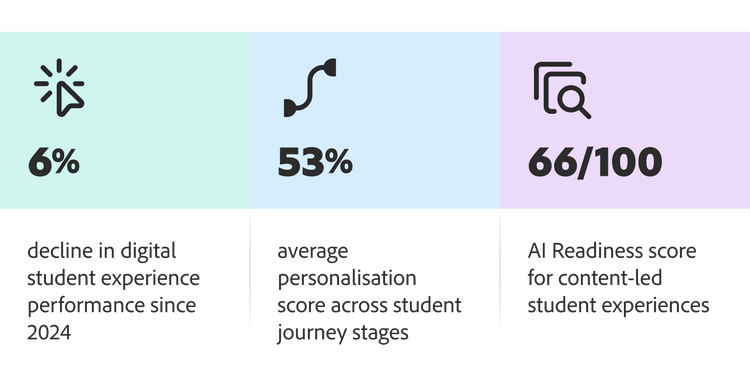
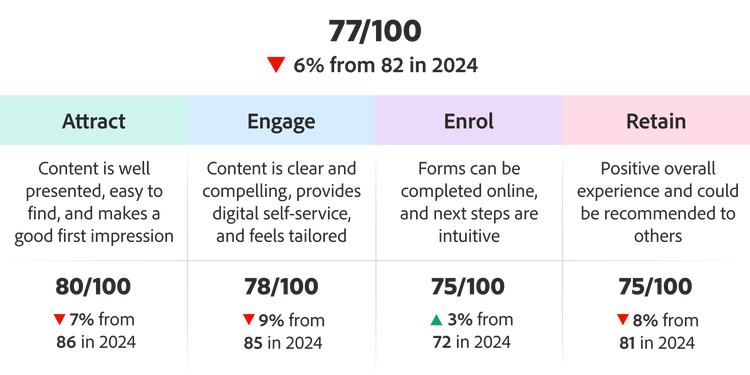
The DSX Index represents the industry average, based on user testing scores across 32 Australian and New Zealand university websites. The industry recorded an average overall index score of 77 out of 100, which declined almost 6% from the 2024 score of 82 out of 100.
However, looking at the student journey rather than the overall average provides a more useful perspective. A closer examination of key journey stages shows that performance is stronger early in the experience and moderately lower at the points that determine prospective student conversion and long-term outcomes. Yet even the higher-performing areas have seen a decline, whereas only the Enrol stage has improved.
Digital Student Experience Index (DSX)
DSX Index for Australia and New Zealand
Unpacking results across journey stages
Attract remains the strongest stage, reflecting maturity in first impressions and engagement in early stages of the student journey. This suggests many universities present a credible, navigable front door, but only once students arrive there. With AI tools increasingly summarising and comparing options before a website visit, this strength can become less differentiated and may also help explain a decline in this score since 2024.
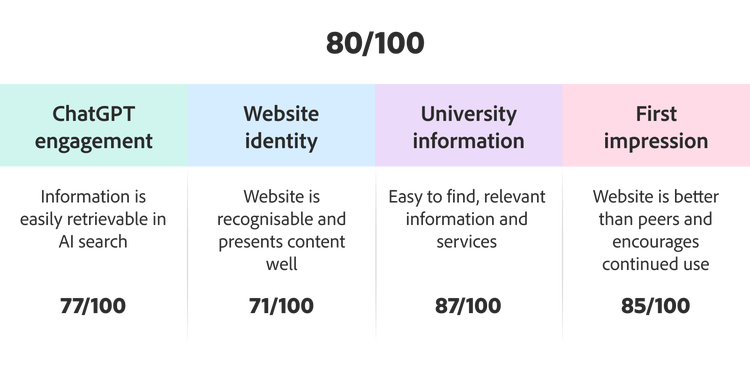
Attract sub-measures include ChatGPT engagement, website identity, university information, and first impression. While universities generally make a strong first impression and provide information clarity, credibility signals in AI contexts lag behind other measures, even as AI-assisted discovery is growing.
Attract
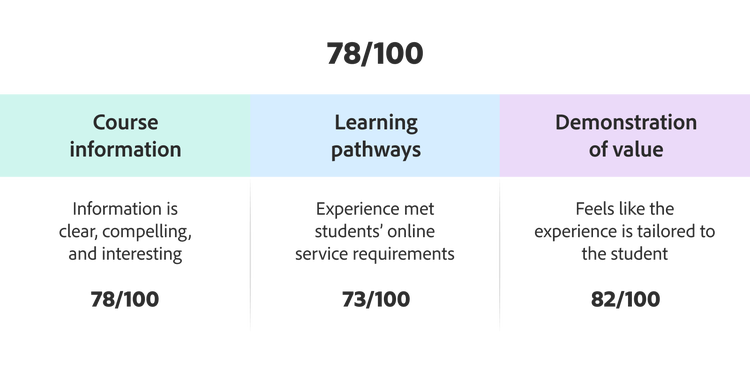
Engage is relatively strong, with clear content and a demonstration of value that supports consideration. But experiences vary in how tailored and relevant they feel. This is where students begin assessing best fit, exploring pathways, outcomes, and next steps. As expectations for personalised, AI-supported exploration rise, this stage has also seen a modest decline since 2024.
Engage includes course information, learning pathways, and demonstration of value. Results here show that students can find content, but face gaps in how the institution helps them interpret pathways and outcomes in a way that feels personal and enables confident decisions.
Engage
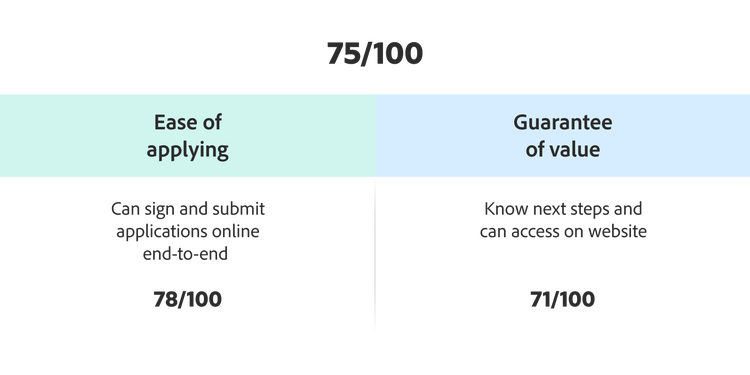
Enrol is where friction can become more visible. Substandard application and conversion pathways introduce drop-off risk. Earlier strength often declines at the application stage, where guidance, reassurance, and continuity are limited. This remains one of the clearest signals that maturity at the top of the funnel does not always guarantee consistent maturity through the journey. The modest improvement since 2024 may reflect increased focus on more intuitive forms and personalised experiences.
Enrolment is the conversion confidence zone, where students need continuity, reassurance, and fewer hand-offs. Experiences here must not only be easy but also offer value. This is an area many universities can improve, as indicated by one of the lowest sub-measure results in the study.
Enrol
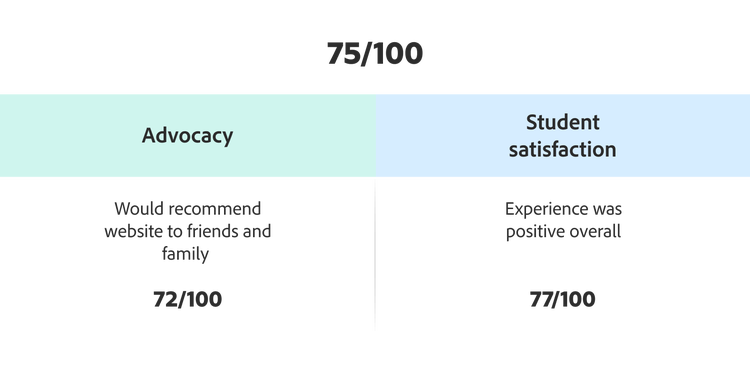
Retain shows a similar pattern to Enrol. Loyalty and advocacy depend on consistent post-enrolment experiences, but digital support becomes uneven once students move beyond the admission stage. In practice, this is where service expectations collide with operational constraints, and where scalable support becomes a differentiator. Higher expectations rather than depleted capabilities at this stage may help explain why scores have moved lower in recent years.
Advocacy and customer satisfaction are shaped less by one great web page and more by sustained, reliable digital support across services. The results indicate a significant opportunity for improvement.
Retain
The DSX Index results show that universities perform strongly when the task is to present information and build confidence early, while performance softens as students move towards commitment and long-term engagement. This can mean the experience becomes less responsive at the moments where student intent is highest, calling for a mechanism that converts strong early engagement into confident decisions and sustained support.
Illustrative student scenario Ang’s shortlist
(Student scenarios are composite examples created from common student behaviours and institutional practices. They are illustrative and do not represent real individuals.)
Student
Starting point
Optimal experience
Best practice capabilities
Ang Guangzhou, China
Ang asks a conversational AI tool to compare engineering pathways in Australia and recommend options based on outcomes.
Course and pathway information is structured, citation-ready, and easy for AI systems to interpret, so the university is surfaced accurately. When Ang clicks through, the experience recognises their intent quickly and helps them explore pathways, compare electives, and shortlist options. Relevant information for international students is surfaced early.
AI-discoverable content and interpretability
Pathway clarity
Decision support
Geo-based personalisation
Compare and shortlist experience
Strong first impression
style
xl-spacing
background
#E0F2FF
The impact of personalisation on student and university outcomes.
As students progress through the journey, their support and learning needs become more specific and their expectations for relevant guidance rise. Digital experiences that harness the power of connected data, recognise student intent, and adapt content accordingly improve relevance, convenience, and time savings.
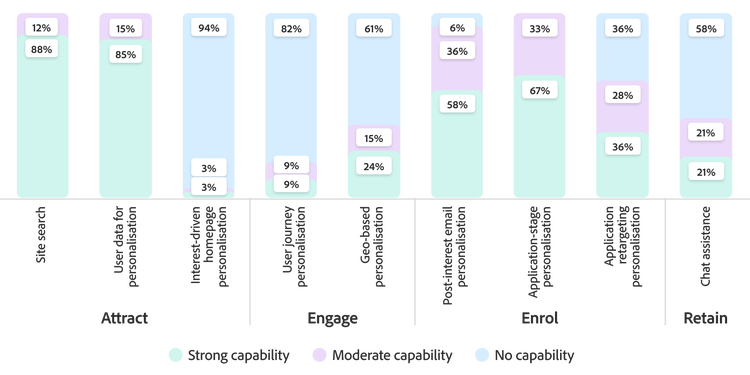
Personalisation performance across the student journey is the area where university scores varied the most widely. Overall, early discovery and engagement stages are more likely to be personalised, but interest-driven homepage personalisation and user journey personalisation are notably low. Put simply, universities are good at helping students find information but less mature when it comes to tailoring journeys once intent is expressed.
Presence of personalisation capabilities across the student journey (all universities)
The personalisation results show a pattern of concentration. Capability exists in a handful of moments, including site search, some email personalisation, and forms and applications. But it is not present across the entire journey. This can introduce friction in the latter Enrol and Retain stages, arguably where personalisation should have the most impact — reducing uncertainty, guiding next steps, and sustaining engagement.
The broader results show that the sector performs best where personalisation delivers utility as well as relevance. This is where it acts as the mechanism that converts strong engagement into confident decisions and sustained support, especially in the Enrol and Retain stages, where DSX Index performance has been shown to soften.
The personalisation results reveal a second, more structural constraint. Even where universities tailor journeys, that value is typically realised only after a student reaches the site and enters the pipeline. In an AI-assisted world, the front door is shifting — with summaries, comparisons, and recommendations occurring before or in place of a webpage visit. This is where AI determines whether personalisation and strong DSX even get a chance to deliver their intended impact.
(Student scenarios are composite examples created from common student behaviours and institutional practices. They are illustrative and do not represent real individuals.)
Student
Starting point
Optimal experience
Best practice capabilities
Mia Adelaide, Australia
Mia is considering Health Sciences with the option to progress to postgraduate study. They want to understand which specialisation keeps their options open, whether to study full- or part-time, and how the degree positions them for employment. They are also seeking clarity on entry criteria, prior learning credits, and study load flexibility.
The application journey builds confidence rather than simply capturing data. The experience recognises what Mia has already explored and guides them through study options in plain language. Entry requirements, credit eligibility, and workload expectations are surfaced proactively, and timely personalised reassurance helps them move forward with confidence.
Guided application flows
Continuity from exploration to enrolment
Personalised prompts and reassurance
AI-assisted eligibility and support
Scalable assistance integrated with service workflows
style
xl-spacing
background
#E0F2FF
RMIT’S holistic student engagement model
Scoring highest of all universities on the personalisation capability measure, RMIT tailors interactions across multiple stages of the student journey. This followed the implementation of a data platform which unified first-party data and enabled the creation of an AI-powered dashboard for student segmentation insights to track prospective journeys. This allows RMIT to intervene at key moments with relevant, interest-based communications and content.
“Our legacy systems and fragmented data made it difficult to deliver a connected, personalised student experience. We had to rethink how we interact with students from the very first touch. With our prospect journey dashboard accessible to all teams through an AI-powered interface, we now have a view of the entire funnel. It shows where students engage and where they drop off, giving us the clarity we’ve been missing.”
Darren Boyle Director of Digital and Experience, RMIT University
style
xl-spacing-top, xxl-spacing-bottom
background
#f8f8f8
Boosting preparedness for AI-led discovery and service.
Conversational AI interfaces such as ChatGPT, Gemini, and other large language models (LLMs) are increasingly shaping how prospective students research universities and make enrolment decisions.
As these systems generate answers and perform tasks, universities must consider how experiences perform for human audiences and how offerings, pathways, and value propositions are surfaced, interpreted, and ranked within AI-assisted environments. While this can have an outsized impact on the Attract stage, where research is at its most vigorous, it also extends to each part of the student journey where general-purpose and university-issued tools are increasingly becoming part of the student experience.
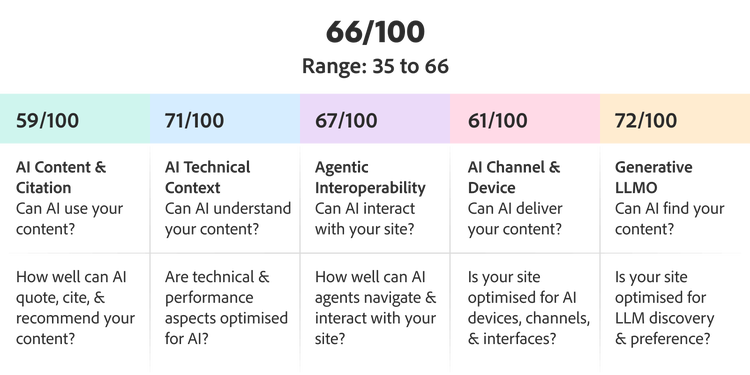
To determine the current maturity among universities and unearth tactics to improve AI performance, Adobe developed the AI Readiness score (AiR). Measuring five core criteria, AiR ranks the digital and operational foundations that influence how effectively a university is discovered, interpreted, and recommended by AI systems.
AI Readiness score (all universities in Australia and New Zealand)
The sector ranked highest on pillars that reflect foundational digital capabilities. The generative large language model optimisation (LLMO) pillar was scored at 72 out of 100 and AI Technical Context reached 71 out of 100, suggesting a positive impact from years of focusing on accessibility and site health. While still an emerging area, Agentic Interoperability, with 67 out of 100, is in the middle of the field, which may suggest a rising focus as universities seek to look ahead to a future where students more frequently use agents to seek information and complete enrolments.
The lowest scores among the AI Readiness pillars are AI Content and Citation and AI Channel and Device. Citation readiness assesses whether AI systems can accurately retrieve and provide information when queried by a student. Lower scores here raise the risk that answers are incomplete or inaccurate. Channel and device compatibility determines whether content and services perform consistently across AI-powered interfaces such as voice assistants and agentic systems. Again, lower scores here can mean variation or unintended information is conveyed as students move between modalities or devices.
The tactics universities are using to build AI readiness
Beyond the core pillars of AiR, Adobe analysed the tactics universities use to optimise their digital presence across AI search, AI systems, and emerging channels. These scores confirm better performance in more traditional areas of accessibility and search fundamentals, whereas newer areas such as generative engine optimisation (GEO) are low for all universities across the sector.
AI Readiness capabilities (all universities across Australia and New Zealand)
Traditional SEO
59/100 Range: 51-69
Accessibility
85/100 Range: 75-94
AEO
74/100 Range: 66-80
GEO
34/100 Range: 30-36
LLMO
70/100 Range: 63-81
AAIO
42/100 Range: 36-44
Omnichannel
66/100 Range: 60-80
Taken together, the sector’s AiR maturity profile shows strong digital foundations but weaker capability in areas that are fast emerging and more AI-native. As AI increasingly influences how students find and choose options, universities with higher scores will be more visible and more confident that they appear as intended, even when they aren’t in full control of the information being delivered.
background
style
grid-width-8
AiR as the multiplier
As the DSX Index results show, performance is strongest early on and gradually declines as the journey progresses towards conversion and beyond. The personalisation results help explain why capability is more prevalent at some journey stages than others. With that in mind, AI Readiness acts as the multiplier, boosting the impact of strong DSX Index and personalisation where they are connected, or magnifying gaps where friction and inconsistency already exist.
The next phase moves beyond incremental improvements in discrete journey interactions towards orchestration. That is, aligning content, data, journeys, and service workflows to ensure consistent performance, whether a student starts with a browser, chatbot, or AI agent.
Illustrative student scenario Priya's census choice
(Student scenarios are composite examples created from common student behaviours and institutional practices. They are illustrative and do not represent real individuals.)
Student
Starting point
Optimal experience
Best practice capabilities
Priya Sydney, Australia
Priya is already enrolled and balancing study with work. They are unsure whether to continue their current study load and have questions about support services, workload, and what happens if they change units.
Priya receives timely personalised nudges ahead of key milestones such as census and can access always-on conversational support that routes them to the right service pathway. Support is anchored in structured policy and support content that is consistent across channels and connected to real workflows, helping them resolve issues and move forward with confidence.
Proactive nudges before census
Lifecycle messaging continuity
AI-assisted support and service routing
Consistent policy and support content
Scalable always-on assistance integrated with service workflows
style
xl-spacing
background
#E0F2FF
The orchestration playbook
As universities strive to deliver better experiences to students and staff, differentiation is shifting away from isolated improvements towards connected capability. The DSX Index, personalisation, and AiR results suggest universities are being pushed towards connected, context-aware journeys at the same time as AI increasingly influences discovery, comparison, and trust.
In response, a clear industry direction is emerging. Leading universities are moving towards orchestration, treating experience, personalisation, and AiR as a single operating state rather than separate initiatives. That direction is showing up with three converging moves:
Building a digital nerve centre. Universities are consolidating the foundations that allow them to sense student intent and respond consistently by connecting data, journey design, and service workflows, so that experiences hold together across channels and stages.
Whole-of-institution AI enablement. AI is becoming an embedded layer shaping both discovery and operations. Universities are beginning to treat AI capability as an institutional competence, supported by governance, skills uplift, and platforms.
Readiness for the future of web. As AI systems increasingly summarise and recommend institutions, being discoverable now includes being interpretable and agent-friendly. Leaders in this arena structure course and pathway content, policy and support information, and key task flows so they work effectively for humans and machines.
From here, leading universities are adopting consistent tactics.
Effective nurturing becomes the battleground.
Institutions are focusing on enrolment and retention moments where uncertainty, hand-offs, and repetition cause drop-off, by using personalised self-service and assisted pathways to protect conversion and improve persistence.
Personalisation is moving from point capability to journey logic.
Leaders are extending beyond search and campaign personalisation towards connected, journey-based experiences that respond to intent signals and revolve around context across stages.
AI is being operationalised responsibly.
Governance, policies, skills, and platform capability are becoming differentiators, enabling sustainable impact rather than short-lived experimentation.
Service at scale is the payoff.
AI-enabled assistance that integrates with service workflows is becoming a lever to improve support quality and consistency without a proportional increase in workload.
Next steps
Arrange a session to explore your university’s results.
Adobe’s 2026 State of Higher Education evaluation deepens our understanding of how the sector is delivering digital services in Australia and New Zealand.
We work with universities to apply the framework and strengthen ownership of the digital experience across the student journey.
In a tailored session, we will:
Share your university’s Digital Student Experience Index, AI Readiness, and personalisation scores
Benchmark your performance against universities across Australia and New Zealand
Identify priority tactics to strengthen digital capability and improve AI Readiness
Contact Scott King, atscking@adobe.com, or your Adobe account representative, to arrange a session and review your university’s results.
Adobe’s Digital Strategy Group conducted the analysis of the higher education sector in 2026. It covered the official websites of the following universities:
Australian Catholic University, Adelaide University, Auckland University of Technology, Australian National University, Charles Sturt University, Curtin University, Deakin University, Federation University, Flinders University, Griffith University, International College of Management, La Trobe University, Lincoln University, Macquarie University, Massey University, Monash University, RMIT University, Swinburne University, The University of Adelaide, University of Auckland, University of Canberra, University of Canterbury, University of Melbourne, University of Otago, The University of Queensland, University of Sydney, University of Technology Sydney, University of Waikato, University of Wellington, The University of New South Wales, Victoria University, and Western Sydney University.
These universities were assessed based on their:
Digital Student Experience: User testing of 475 participants via script with citizens aged between 18 and 65, testing mobile and desktop user experience across 10 categories
Further analysis was undertaken to evaluate the following digital enablers with associated methods, including:
Personalisation capability: User testing covering services and updates, geo-based personalisation, site search, login experiences, registration, forms, frictionless enrolment experience, and chat assistance
AI Readiness: Assessment completed using Scanpire’s readiness evaluation for 32 university websites. Adobe analysis and custom dashboarding for the sector supported the analysis