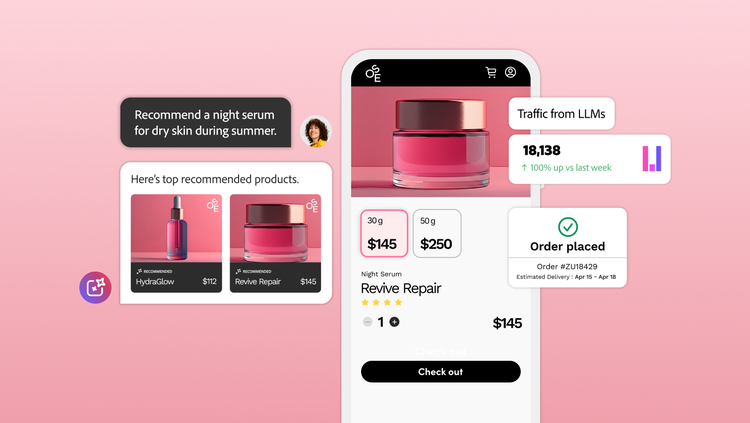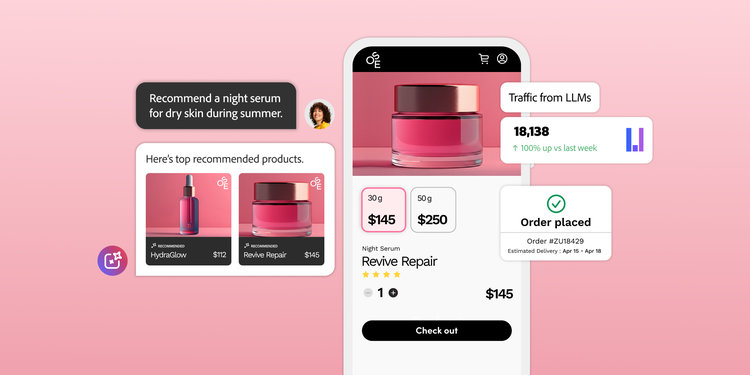
AI is redefining how commerce works, opening up powerful new opportunities for brands. Amongst them, two opportunities stand out:
- Product discovery is increasingly happening through AI-driven experiences.
- Owned digital storefronts are uniquely positioned to deliver engaging experiences that drive both conversion and loyalty.
In this blog, we’ll explore what these shifts mean for brands and highlight the Adobe Commerce innovations announced at Adobe Summit that are designed to help teams capitalize on them.
Product discovery is moving to AI assistants.
Shoppers today often begin their product discovery journeys within AI assistants like ChatGPT and Gemini. They are using these LLM-powered surfaces to research, compare, narrow their choices for purchase decisions.
Brands must ensure their products are visible, accurately represented, and contextually relevant in LLM environments to make the most of this shift.
How Adobe Commerce powers AI-driven commerce from discovery to transaction.
LLMs are contextual by nature — meaning the quality, structure, and richness of product data directly shape how products are understood and recommended.
To participate in AI-driven discovery, brands need accurate, relevant product data that LLMs can surface, understand, and act upon.
Powering product discovery on AI assistants.
At Summit, Adobe Commerce announced new native capabilities designed to increase product visibility across LLM-powered experiences. These innovations enable brands to:
- Automatically improve and enrich the quality and structure of their product data.
- Generate structured feeds ready for LLMs, search engines, marketplaces, and digital advertising channels to consume.
- Ensure product detail pages are AI-ready so LLMs can access all the product information without storefront changes.
By giving LLMs the context they need, Adobe Commerce helps your products get surfaced and recommended in the moments that matter.
Driving agent-to-agent readiness.
While optimizing content for LLMs improves how brands are discovered, the next step is enabling AI assistants to do more than just recommend products, and actually act on behalf of customers.
This requires commerce systems that can interact with AI assistants in real time and expose their core capabilities, so assistants can seamlessly embed functions like product search, transactions, order tracking, and returns directly within the user interface.
With a commitment to support emerging standards like Universal Commerce Protocol (UCP) and Agentic Commerce Protocol (ACP), Adobe Commerce enables this shift from visibility to execution, powering truly agent-ready experiences while allowing brands to maintain full control over their storefront, pricing, and fulfillment.
Adobe Commerce is also working with key partners to extend the agentic commerce ecosystem, helping brands reach and convert customers across a growing network of AI-powered and digital touchpoints.
Through our partnership with PayPal — we've transformed real-time product data feeds into frictionless checkout across marketplaces and ads, and are now bringing the same experience to LLM-driven experiences like Perplexity and Copilot. This experience will ensure merchant products are not only discoverable across a broad set of AI and digital surfaces, but also seamlessly purchasable wherever engagement occurs — all natively through Adobe Commerce and PayPal Store Sync.
In parallel, partnerships with Stripe and Adyen reinforce this foundation by supporting standard protocols like ACP and UCP, ensuring the transactions within in-chat and agent-driven interactions remain secure, flexible, and scalable.
Building custom agentic experiences with a commerce model context protocol (MCP).
While agentic protocols unlock transactions across third-party surfaces, the brands that truly differentiate will go further, building their own intelligent, agent-driven experiences.
At Summit, Adobe Commerce introduced a Commerce MCP server that gives developers secure, real-time access to core commerce data and capabilities, including catalog, cart, pricing, inventory, promotions, checkout, order management, and post-purchase flows. This enables merchants to create their own agentic commerce experiences or integrate with third-party solutions to create shopping assistants, voice shopping agents, upsell agents, and more.
Elevate owned experiences to increase conversion and drive loyalty.
Discovery may be shifting to AI, but conversion still happens on your storefront. To win, brands need high-performance, AI-powered commerce foundation that delivers personalized, engaging experiences to increase conversion and repeat purchases.
How Adobe is innovating to elevate owned experiences.
Last year, Adobe Commerce introduced two major innovations:
- Adobe Commerce as a Cloud Service: A cloud-native, full-stack commerce platform designed for scalability, performance, and rapid innovation.
- Adobe Commerce Optimizer: A SaaS-based optimization layer that integrates with existing commerce backends to enhance performance without requiring replatforming.
Brands are already leveraging Adobe Commerce as a Cloud Service and Adobe Commerce Optimizer to elevate their commerce experiences, boosting conversion rates, scaling seamlessly across markets and channels, and lowering total cost of ownership.
Accelerating the adoption of Adobe Commerce.
At Summit this year, Adobe Commerce unveiled the Commerce Developer Agent (coming soon), an AI-powered suite of developer tools that simplifies and accelerates the adoption of Adobe Commerce as a Cloud Service and Adobe Commerce Optimizer. By reducing complexity and development effort, it enables teams to deliver high-impact commerce experiences faster and more cost-effectively.
The Commerce Developer Agent starts by analyzing your existing implementation and mapping a clear, predictable path forward. This gives business and technology leaders a concrete roadmap to reducing discovery time and projecting risk. From there, it intelligently migrates legacy code and storefronts to modern, event-driven apps and storefront components, guided by Adobe’s best practices to ensure the end result is both functionally correct and built for long-term maintainability. Once you’re on the modern platform, teams can build new apps, storefront components, and content blocks faster, allowing them to iterate quickly as new trends emerge.
The result is reduced time-to-value, lower operational overhead, and lower cost of ownership from transformation all the way through ongoing development.
Turning conversations into transactions with Adobe Brand Concierge.
A high-performance storefront is the foundation, but brands can go further by bringing AI directly into the shopping experience. At Summit, we introduced Adobe Commerce integration with Brand Concierge, which brings conversational shopping experiences directly to your storefront, enabling customers to find the right products, faster.
With Brand Concierge, shoppers get access to real-time catalog data with accurate pricing and inventory, so they can confidently explore options and make purchase decisions.
AI-powered conversations understand shopper intent and guide them from questions to purchase, all within a single, continuous experience on your storefront. Merchants also gain direct visibility into what shoppers are searching for and how AI is responding, giving you the data to continuously improve shopper conversion.
B2B commerce built for complex buying journeys.
Merchants operating in B2B commerce have their own demands from complex pricing, multi-step approvals, and procurement workflows that add complexity to buying journeys. Adobe Commerce is addressing this very demand with a new set of B2B drop-in capabilities that makes it easier to manage, without compromising flexibility.
New drop-ins include company account management, negotiable quote management, requisition lists, and purchase order workflows. This gives buyers the self-service tools they need, and merchants the control to manage complex B2B relationships on a global scale.
Building for commerce, today and tomorrow.
Commerce is no longer a single channel, it’s every surface where a shopper or an AI agent can find, evaluate, and buy your products. The brands that win will be the ones who show up in AI discovery, convert on owned experiences, and evolve fast enough to keep pace.
With Adobe Commerce, you get the foundation to do all three.
Explore the latest Adobe Commerce innovations:
Learn more about new capabilities announced at Summit:
- Adobe Commerce Developer Agent (coming soon)
Connect with your Adobe account team or solutions partner to get started.
Nick Ben is a Product Marketing Lead for Adobe Commerce, focused on AI-powered commerce innovation, GTM strategy, and competitive positioning. With 11+ years spanning product development and product marketing, Nick has led go-to-market for AI-native platforms across consumer messaging and enterprise ecommerce. At Adobe, he drives commercialization of agentic commerce and next-generation storefront experiences. Nick holds a B.S. in Electrical and Computer Engineering from UC San Diego.