Agentic AI at work: New data on confidence, automation, and marketing teams.
Summary of key findings:
- Seventy-three percent of AI users report that having an AI agent has increased their confidence in overall job performance.
- Workers were asked who they’d be most comfortable turning to for an obvious question; 68% chose an AI agent — compared to just 4% who said their direct manager. Workers are 17 times more likely to ask an AI agent questions they’d hesitate to raise with leadership.
- Remote workers are 35% more likely than on-site workers to report reduced imposter syndrome and mental load due to agentic AI.
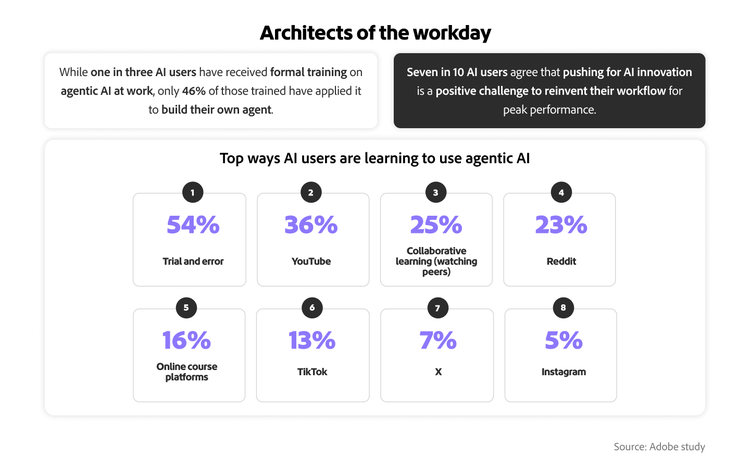
- While one in three users has received formal agentic AI training, fewer than half of those trained (46%) have gone on to build their own custom agent, pointing to a persistent gap between training and practical implementation.
- Seven in 10 AI users agree that pushing for AI innovation is a positive challenge to reinvent their daily workflows.
What the shift to agentic means for marketing teams.
Marketing teams have moved beyond experimenting with generative AI and are now exploring how agentic AI can fundamentally change how work gets done.
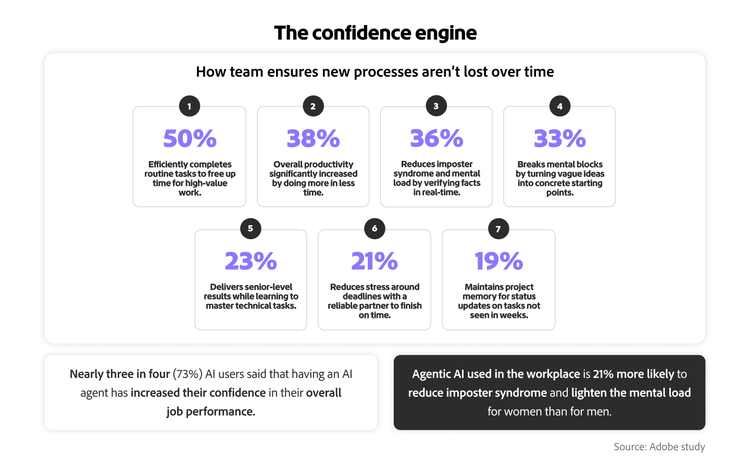
According to findings from our research on agentic AI at work, this shift is already well underway. We’re seeing the rise of an agentic advantage — where AI is no longer just a tool, but a collaborator embedded in daily workflows. And the impact is not just operational, but psychological. Nearly three in four AI users (73%) say working with an AI agent has increased their confidence in job performance.
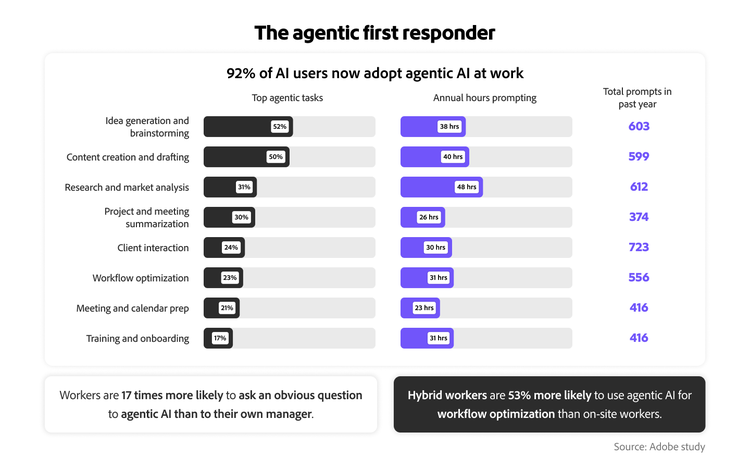
Modern marketing teams are under constant pressure to deliver personalized, high-quality work at scale. Agentic AI helps alleviate this strain, acting as a judgment-free resource that overcomes challenges posed by fragmented systems and tight timelines. Marketers can confidently turn to agentic AI for ideation, drafting, and validation. Moreover, workers are 17 times more likely to ask an AI agent a question than to ask their direct manager, highlighting how AI is reshaping not only workflows but also workplace dynamics.
To understand this shift, Adobe surveyed over 1,000 full-time U.S. workers who use AI weekly to uncover how agentic AI is shaping how teams collaborate, learn, and execute.
Most workers see the potential of AI, but many have yet to put it fully into practice. While one in three workers has received AI training, only 46% have built a custom agent. Without a clear view of how work actually flows across teams, it’s hard to know where AI can help most.
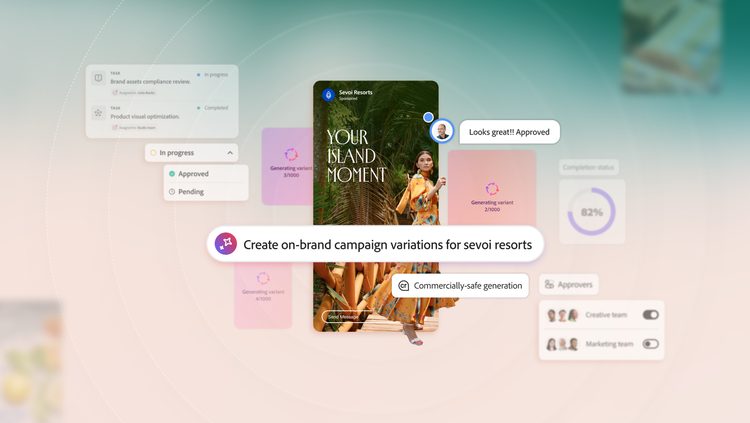
Tools like Adobe Workfront centralize work management and resources, while Agent Orchestrator activates that visibility by coordinating workflows with the right level of human oversight.
Nearly three in four workers who use AI agents say it has increased their confidence in their job performance. Teams see these significant advantages across a wide range of tasks and roles.
As marketing teams face more pressure to deliver personalized content at scale, they find AI agents particularly beneficial during the early stages of work. By handling tasks like research, ideation, and first drafts, AI agents give marketers more time to focus on strategy and creative direction.
Agentic AI is becoming a core part of how work gets done, but how people use it varies depending on their environment.
Teams commonly use AI for everyday tasks:
- Idea generation and brainstorming (52%)
- Content creation and drafting (50%)
- Research (31%)
These early-stage activities are where AI delivers immediate value, helping teams move faster without sacrificing quality.
The work environment also shapes how AI is used. Remote workers, for example, rely more on AI for quick clarifications — often replacing informal, over-the-shoulder conversations common in office settings.
- On-site workers are 14% less likely than remote workers to ask AI basic questions.
- Remote workers are 28% more likely to temperature-check a risky idea with a colleague rather than with AI.
- Remote workers are 35% more likely to report reduced mental load when using AI.
- Hybrid workers are 53% more likely to use AI for workflow optimization than on-site teams.
Additional insight from Adobe Workfront highlights how this plays out in practice. The most common tasks handled by AI agents reflect a shift toward streamlining coordination and reducing manual effort:
- Summarizing projects, programs, and portfolios (52%)
- Finding customer data using natural language (47%)
- Answering questions about documentation (41%)
- Checking project health (5%)
- Creating planning records (4%)
Together, these behaviors point to a broader evolution in workflow automation, one where AI supports both the execution of work and the systems that keep it moving.
AI as a judgment-free teammate.
One of the biggest shifts with agentic AI is how people choose where to go for help. In many everyday situations, workers say they’re more comfortable asking an AI agent than a manager or even a colleague. Whether it’s a basic question or a first draft, AI offers a quick, low-pressure way to get unstuck.
This dynamic is most evident in situations where hesitation is common:
- Asking obvious questions: 68% would turn to an AI agent, compared to just 4% who would ask their manager.
- Drafting a difficult or high-stakes response: 54% prefer AI, versus 23% for both managers and peers.
- Providing a first pass on a complex project summary: 62% choose AI, compared to 10% for managers.
- Recapping an important meeting: 62% turn to AI, versus 10% for managers.
- Walking through forgotten software workflows: 59% prefer AI, compared to 6% for managers.
These are the moments where uncertainty can slow down work. AI helps people move forward quickly without overthinking.
But there are still limits, and when the stakes are higher, people tend to rely on each other. For example, 43% of workers prefer to check a risky idea with a colleague, compared to 39% who would turn to AI. This reliance on human collaboration is particularly pronounced among younger workers. Gen Z, for example, is more likely to consult peers for complex or sensitive tasks, highlighting a preference towards social trust and confidence in early-stage careers.
For marketing teams, this balance doesn’t have to be a trade-off — it can be built directly into workflows. When AI-generated outputs move seamlessly into team workflows for review and refinement, speed and oversight stop competing with one another. The right work management tools can make handoffs more harmonized rather than disruptive.
That’s where purpose-built tools like Adobe Workfront can make a difference. Adobe Workfront connects AI-assisted tasks to project plans, resources, and approvals. Together with Agent Orchestrator managing how work moves between systems and teams, it becomes easier to keep automation and human judgment working together rather than at odds.
Why AI agent adoption is increasing workers’ confidence and reducing mental load.
AI not only speeds up work — it also helps people feel more confident. Much of the stress at work comes from tracking details and second-guessing decisions, both of which are areas where AI can help.
This is especially true for remote workers, who don’t always have someone nearby to easily check in with. AI can fill that gap by offering real-time support, helping people feel more assured in their work while keeping things moving.
That matters because work is already a major source of stress. Previous Adobe for Business research found that more than half of workers say work management challenges have contributed to stress over the past year, making that clarity and confidence all the more valuable.
The impact of agentic AI on confidence is clear. Nearly three in four users (73%) say it has improved their job performance, showing that AI isn’t just helping people work faster — it’s also helping them feel more confident in their work.
That boost to self-reported performance is even stronger in complex, high-stakes industries, where precision and speed matter most:
- Finance and banking: 87%
- Technology: 80%
- Retail and e-commerce: 78%
- Healthcare: 66%
- Education: 65%
In these environments, the ability to quickly verify information, generate accurate outputs, and reduce uncertainty has an outsized impact on both performance and peace of mind.
More broadly, the benefits of agentic AI extend beyond efficiency. Workers report freeing up time for higher-value work (50%), improving productivity (38%), and reducing imposter syndrome (36%). That last point is especially telling — AI is helping people validate their thinking in real time, reducing the need for second-guessing decisions or seeking reassurance.
Different workers experience these benefits to varying degrees. Remote employees are seeing some of the biggest gains — reporting 17% higher productivity and a 35% greater reduction in imposter syndrome compared to on-site workers. They’re also more likely to use AI for ongoing skill development, and men are more likely than women to use these tools for after-hours upskilling. At the same time, entry-level employees are the least likely to report increased confidence, suggesting there’s still an opportunity to improve support for workers who are early in their careers.
To make the most of these gains, teams need systems that support the full workflow. Work management software like Adobe Workfront brings everything into one place, from project planning to resource management and tracking, giving teams a clear view of what’s happening, helping them catch issues early, and keeping work moving forward.
AI features in Workfront also help build confidence. Automated risk detection can flag potential issues early, while AI-assisted asset review helps ensure content meets brand and compliance standards before it’s shared. For distributed teams, improved accessibility also makes it easier to find updates, files, and feedback.
With Agent Orchestrator, teams can take automation one step further by connecting systems and helping move work between them, reducing the need to search across multiple tools. Instead of digging for information, users can simply ask for what they need — like a project update or customer data — and get a clear answer.
Together, these tools make workflow automation easier to manage at scale, while helping teams stay aligned and confident in their work.
Formal agentic AI training exists, but it’s rarely where fluency begins. For most professionals, learning to work with AI is still a self-directed process — shaped by curiosity, peer collaboration, and a willingness to experiment.
How people learn to use AI reflects how early we are in the adoption curve. Most workers figure it out as they go rather than rely on formal training. The top ways workers learn how to use AI include:
- Trial and error (54%)
- YouTube (36%)
- Collaborative learning (25%)
- Reddit (23%)
The challenge for most workers is turning that knowledge into practical application. Even though one in three has received formal training, only 46% have gone on to build their own agent.
Adoption also looks different depending on who you ask. Younger workers are leading the way on informal learning — nearly one in four Gen Z professionals turns to TikTok to build AI knowledge, while men tend to gravitate toward Reddit and YouTube, and women are more likely to turn to TikTok. But learning habits are only part of the picture. Remote workers follow a similar pattern, logging higher rates of formal training than their on-site counterparts.
Some industries are further ahead than others, particularly those with more complex or regulated environments. The top industries by percentage that have received agentic AI training include:
- Finance and banking (51%)
- Technology (48%)
- Healthcare (31%)
- Retail and e-commerce (29%)
- Education (27%)
Even with a learning curve, people are starting to see AI differently. 7 in 10 workers see AI as a way to rethink how they work, not just as a tool to move faster. That aligns with previous Adobe research, which shows that marketers often use the time saved to improve the quality of their work (61%), build new skills (45%), and improve work-life balance (49%).
Tools like Adobe Workfront help teams put this into practice by bringing work planning, resource management, and workflow automation into one place. With features like low-code integrations and AI-assisted briefs, teams can turn early experiments into repeatable ways of working. Agent Orchestrator builds on that by helping teams connect systems and manage the flow of work between them. With tools like Agent Composer, teams can set up and adjust agents to fit their workflows without needing great technical skills.
Together, this helps teams move from learning to real-world use, with workflows that can scale over time.
Building the AI-ready marketing team: From work management to agent orchestration.
Agentic AI is becoming a go-to resource for many teams. It helps people fill knowledge gaps, stay on top of their work, and feel more confident in what they’re doing. The impact is especially clear for remote and distributed teams, as well as those working in complex or highly regulated environments.
There’s still a gap between what AI can do and how teams are actually using it, and training alone isn’t enough. Many workers haven’t applied what they’ve learned in a meaningful way, and making that shift requires tools that fit into everyday work, not just standalone AI features.
Work management software like Adobe Workfront gives teams a clear view of their workflows, resources, and priorities, helping them turn ideas into action. When paired with Adobe Agent Orchestrator, teams can also connect systems, automate tasks, and keep work moving while maintaining the right level of oversight.
The real opportunity is to make AI part of how work gets done. Teams that do this well will be able to move faster, stay organized, and deliver more personalized experiences at scale.
Ready to put AI into practice? Learn how Adobe Workfront and Adobe Agent Orchestrator can help you turn AI into scalable, real-world results.