What B2B customer segmentation really means.

Ask ten marketing teams what "customer segmentation" means and you'll get ten different answers. In B2B that gap between definitions is expensive, because the wrong definition quietly sends budget at the wrong people.

Part of the problem is the word itself. In B2B a "customer" is rarely one person deciding alone; it's a group of people inside a company, working under contracts and consent rules that a single-person view ignores. Segmentation that treats them as one tidy record tends to fall apart on contact.

So this piece reframes customer segmentation for how B2B actually works. It follows the data from raw source systems through to an engaged buying group, and along the way it shows you how to build segments that hold up in practice.

Why is B2B segmentation different?

Start with what the word "customer" stands for. In B2B it points to at least four distinct things at once: the person, the account they work for, the opportunity in play, and the buying group that will collectively decide. Collapse them into one record and your segments inherit that confusion, which is the most common reason B2B targeting underperforms.

Consumer segmentation can group individuals by shared traits and stop there. B2B segmentation has to hold people, accounts, and buying groups together, connecting attributes, relationships, and behaviors toward a stated marketing purpose. That added dimension is exactly why the work rewards more care up front.

It also explains why so many functions have a stake in the outcome. Demand-generation leaders want to reach the right accounts and roles, operations teams need workable audience criteria, data and MarTech architects own the sources and identity logic, and privacy stakeholders decide whether the data can be used at all. A good segment has to satisfy all of them, not just the marketer who defined it.

Underneath those stakeholders sit the questions segmentation actually answers. The first is a matter of eligibility: who can you responsibly include in an audience, given your data and your governance. The second is a matter of engagement: how should you reach the people tied to an account once they qualify. Keeping eligibility and engagement distinct is what keeps the rest of the work honest.

What are the segmentation units?

Precision starts with naming the entity every time it matters. A person is an individual, a businessperson is that individual in their work context, an account is the organization, an opportunity is a specific deal, and a buying group is the set of people who will decide on a purchase. Each term implies a different audience and a different next step.

Within a buying group, every member also holds a role, such as decision maker, champion, or practitioner. Treat that role as data, because it determines which message and channel actually fit the person in front of you.

The distinctions change what a segment can do. An audience of people at target accounts behaves nothing like an audience of accounts showing buying intent, even when the two overlap. IT directors at manufacturing companies with more than 1,000 employees is a person segment filtered by firmographics, while accounts with an open renewal and rising product interest is an account segment driven by opportunity and behavior, and each one points you toward a completely different play.

That is why B2B segmentation has to work at the account level and the buying-group level together, the organization and the individuals on its committee. A journey built for a buying group needs the role information that a flat person list simply never captures. If your team still runs off a single "customer" field, consolidating it is the first fix, and Adobe's overview of market segmentation types and its breakdown of firmographic segmentation can help you map which variables describe a company versus a person.

How does B2B segmentation work?

Picture segmentation as a flow rather than a filter. Governed source data becomes unified person and account context, that context feeds audience criteria, qualifying audiences get activated, activation opens into an account or buying-group journey, and measurement feeds the loop back to the start. Each handoff depends on the one before it, so the quality of the foundation decides the quality of everything downstream.

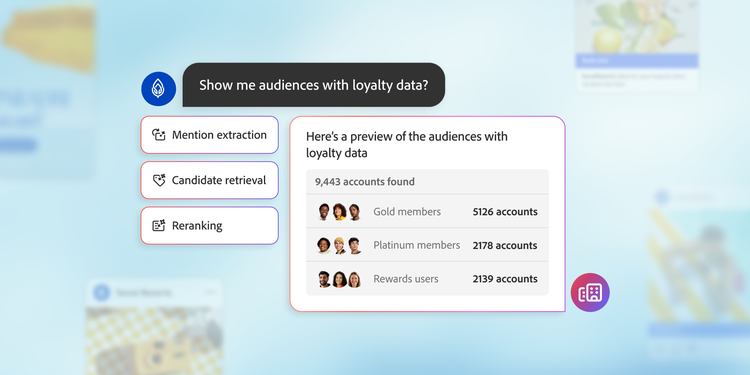
That foundation is unified data. Adobe Real-time Customer Data Platform and its B2B Edition can unify cross-source B2B data into person and account profiles, support person-to-account relationships and account hierarchies, and enable account-level audience evaluation and activation. In practice that means resolving "this lead, at this company, connected to this opportunity" into a single profile you can segment on, pulling together CRM records, marketing-automation activity, and third-party intent signals, then matching people to the accounts they belong to.

The hard part lives in that matching. The same person can appear in three systems under slightly different names, and the same account can surface as both a parent company and a subsidiary, so the logic that reconciles them decides whether your account audiences are trustworthy at all. This is where the richer B2B variables start to pay off: firmographics tell you what kind of company you're looking at, technographics tell you what they already run, and behavioral and intent signals tell you what they're researching right now. Layered together, those signals turn a flat list of accounts into a ranked, explainable view of who is worth engaging and why.

Be honest about the ceiling on all of this. An audience is only as good as its source data, its identity and account-matching logic, its definitions, and its governance, so unifying profiles supports better account context without guaranteeing complete or correct identity, buying-group membership, consent, or a business result. Weak inputs still produce weak segments, which is why many teams get their profiles right first, a step Adobe walks through in its guide to building customer profiles.

How do you govern audience data?

Governance belongs to the eligibility question, and it does a different job from audience logic. Audience logic decides who qualifies; governance decides whether the data behind that audience may be used for a given marketing action in the first place. You need both working together, with neither standing in for the other.

Data governance in Adobe Experience Platform classifies data with usage labels, defines policies that say which marketing actions are allowed on which labels, and enforces those policies against covered data operations. Because the controls are inherited from the platform, the labels and policies travel with the data as it moves through audience building, activation, and export, which Adobe details on its data governance and security page.

Enforcement does the real work at the moment of activation. If an audience or field would violate a policy, the platform blocks it from reaching the destination and surfaces the lineage that explains which policy applied and why, so a problem shows up before the data leaves rather than after.

That capability carries a limit worth stating plainly. The framework operationalizes the policies you define; it does not author your organization's legal, contractual, or ethical obligations, judge whether consent is valid, or guarantee regulatory compliance across every system you run. Confirm the enforcement scope and integration for the specific activation path you're building, and treat these controls as an instrument for your policy decisions rather than a replacement for them.

How do buying groups shape journeys?

Once a governed account audience exists, the eligibility question gives way to the engagement one: what happens next. A static account list is not engagement, and neither is a single email blast to everyone at the company. Coordinated, role-aware outreach across the buying group is what moves a deal.

Most B2B purchases move through a sequence of jobs the committee works through together, from identifying the problem and exploring solutions to building requirements, selecting a supplier, validating the choice, and reaching internal consensus. Different roles lead at different stages, so your segmentation has to support engaging several people at once rather than chasing one contact.

This is where orchestration takes over from audience building. Adobe Journey Optimizer B2B Edition can orchestrate account journeys using buying groups, supporting role templates and solution interests, engagement scoring at both the person and buying-group level, and journey progression that responds to account context. A buying-group completeness score then highlights which roles are still missing, so teams can focus where coverage is thin.

That completeness view matters because a gap in coverage is a gap in your pipeline. If the economic buyer for a deal has never been engaged, no amount of practitioner nurture will close it, a point Adobe's guide to B2B buying groups develops in more depth.

Hold the boundary here as well. Journey orchestration depends on usable account, contact, role, and engagement inputs and on journeys you have actually configured, so an inferred or configured buying group is not the same as a verified buying committee. Configuring a group does not prove every relevant buyer is known, which makes a completeness score a prompt to investigate rather than a guarantee of coverage.

How do you apply segmentation?

The fastest way to prove segmentation works is to start narrow. A pilot on a handful of named accounts will teach you more than an enterprise rollout that stalls on data quality, and it gives you something concrete to measure against. The sequence below keeps eligibility and engagement in the right order.

  1. Define the business problem and the segmented entity. State plainly whether you're segmenting people, accounts, or buying groups, and for what purpose: analysis, activation, or orchestration.
  2. Audit your source data and identity rules. Confirm which systems feed profiles, how person-to-account matching works, and where the gaps are.
  3. Set audience criteria against unified profiles, not raw system exports. This is where profile and account relationships earn their keep.
  4. Apply governance before activation. Label data, define usage policies, and verify the activation path respects them.
  5. Activate, then orchestrate. Push governed audiences to destinations, and where the goal is coordinated engagement, build role-aware buying-group journeys instead of a single blast.
  6. Measure against the baseline you set in step one, then refine.

Teams most often stumble at step two. They commit to a clever segment definition, activate it, and only then discover the account matching underneath was never reliable, which quietly undermines every downstream result. Validating against representative data and your real destinations tells you more than any demo, because it shows whether the segment can actually be built, respects the applicable policies, reaches the intended destinations, and produces the journey behavior you expected.

Decide how you'll measure success before you launch, whether that's influenced pipeline, account engagement, or buying-group coverage. A segment with no baseline can't be improved, since you have nothing to compare the result against. When you're ready to extend segments beyond owned channels, Adobe's write-up on scaling account-based advertising with Real-Time CDP shows how one governed audience can distribute across paid media, and its audience segmentation in Customer Journey Analytics page covers the measurement side.

What should teams remember?

B2B customer segmentation comes down to two linked decisions: who you can responsibly include in an audience, and how you engage the people behind an account once they qualify. Hold eligibility and engagement apart and the tooling choices line up behind them naturally.

Name the entity you're segmenting and its purpose whenever ambiguity creeps in, and keep governance controls, audience logic, and journey logic as separate layers that each do their own job. Unified profiles give you better account context, governed activation keeps that use honest, and buying-group orchestration turns a list into coordinated engagement, as long as you respect the limits of each. None of these tools decides your strategy, your consent basis, or your definition of a qualified account; those judgments stay with your team.

If you take one next step, make it a scoped pilot: one real business problem, a handful of accounts, clean data, explicit governance, and a measurement baseline. Get that loop working and then scale it, because segmentation that respects how B2B buyers actually buy will always outperform a bigger list.

Let’s talk about what Adobe can do for your business.

Get started