Data governance tools: What they are, what they do, and how to choose one.

Adobe for Business Team

08-31-2026

Ungoverned data costs organizations in fines, failed AI initiatives, and decisions made on figures nobody trusts. Data governance tools turn a policy document into an enforced, auditable system, and choosing the right one determines whether governance scales with your data or collapses under it.

In this article, we’ll cover:

What are data governance tools?

A data governance tool is software that enforces rules about who can access data, how it is defined, where it came from, and whether it meets quality standards. It translates written policy into automated controls. Without software enforcement, data governance exists only on paper, and paper policies do not stop a junior analyst from joining two datasets that should never be combined.

These tools are used daily by data stewards, compliance officers, analytics engineers, and chief data officers. Anyone responsible for ensuring that data used in reports, AI models, or customer-facing systems is accurate and authorized will encounter a governance tool at some point in their workflow. A compliance officer at a healthcare company, for example, needs to verify that patient identifiers are masked before data reaches a research analytics environment. A governance tool automates that check instead of relying on a manual review process that breaks down at scale.

Governance tools become relevant the moment an organization operates more than one data source, has regulatory obligations such as GDPR, CCPA, or HIPAA, or needs to share data across teams without losing control of how it is used. For a retailer pulling data from an e-commerce platform, a point-of-sale system, and a loyalty program, governance software is the layer that keeps definitions consistent and access appropriate across all three.

One distinction that readers frequently blur: a governance tool is not the same as a governance framework. The framework is the set of policies and roles an organization agrees on. The tool is what makes those policies operational, trackable, and auditable at scale. A framework might state that personally identifiable information must be restricted to authorized personnel. The tool is what actually blocks an unauthorized query against a PII field and logs the attempt.

What core capabilities do data governance tools provide?

Six capabilities form the functional baseline for any data governance software worth evaluating. Missing even one of these creates a gap that manual processes must fill, and manual processes are where governance programs fail.

  1. Data catalog and metadata management. Every governed asset, whether a database table, an API feed, or a marketing segment, is registered with a business definition, an owner, and a classification. A data catalog eliminates the scenario where two analysts use different definitions of "active customer" in the same quarterly dashboard and produce conflicting revenue figures. Without a catalog, teams duplicate work or, worse, make strategic decisions on metrics that mean different things to different people.
  2. Data lineage tracking. The tool records where each data point originated, how it was transformed, and where it flows downstream. When a revenue figure is questioned in a board meeting, lineage lets a data team trace the number's source in minutes rather than days. Data lineage tools are especially critical in environments where data passes through multiple transformation layers before reaching a report or model.
  3. Access control and policy enforcement. Role-based and attribute-based permissions are applied automatically, so a GDPR-restricted field cannot be exported to a marketing tool without triggering an alert. This reduces the manual audit burden on compliance teams. Consider a financial services firm where customer income data is permissible for credit decisioning but prohibited for marketing targeting. Policy enforcement ensures that the boundary is maintained without requiring a human gatekeeper for every data request.
  4. Data quality monitoring. Automated rules flag records that fall outside defined thresholds: duplicate customer IDs, null values in required fields, or address formats that fail validation. Data quality tools catch these issues before they propagate. Poor-quality data fed into AI models produces compounding errors downstream, a problem that grows more expensive the later it is detected.
  5. Workflow and stewardship automation. Certification requests, data issue tickets, and policy change approvals route to the correct owner automatically. Manual email chains are the primary reason governance programs stall in mid-sized organizations. When a data steward must chase approvals through Slack messages and shared spreadsheets, response times stretch from hours to weeks.
  6. Regulatory compliance reporting. Pre-built templates map governed assets to specific regulation articles, producing audit-ready evidence without manual spreadsheet compilation. This capability is considered non-negotiable for regulated industries, and for good reason: a company that cannot produce compliance evidence on demand faces both regulatory risk and reputational damage.

How do the main types of data governance tools compare?

Governance tools fall into four primary categories, each serving a different organizational profile. The right choice depends less on feature lists and more on where your governance risk is concentrated.

Integrated platforms combine data collection, identity resolution, and governance in one system. For organizations whose primary governance risk is customer data misuse, such as wrong audiences, consent violations, or cross-channel data leakage, this architecture eliminates the integration overhead of connecting a standalone catalog to an execution layer. Adobe Experience Platform is an example of this category, applying governance controls at the point where data is activated rather than in a separate system. This category fits marketing and customer experience teams managing first-party data across multiple channels.

Type
Key strength
Key limitation
Best organizational fit
Implementation complexity
Standalone catalog
Discovery and metadata
No native policy enforcement
Mid-market analytics teams
Low
Enterprise suite
End-to-end governance
Long implementation cycles
Regulated enterprises
High
Cloud-native layer
Cost-effective in-cloud coverage
Multi-cloud gaps
Single-cloud organizations
Medium
Integrated platform
Governance at the point of activation
Less deep on pure catalog features
CX and marketing teams
Medium
A comparison table of four data governance tool types, their strengths, limitations, best organizational fit, and implementation complexity.

A common mistake is selecting a tool based on the broadest feature set rather than the best fit for your primary governance risk. An enterprise suite is overkill for a marketing team that needs consent enforcement across three ad platforms, and a standalone catalog is insufficient for a bank preparing for a regulatory audit.

What factors determine which data governance tool is right for your organization?

Selecting a data governance platform requires evaluating your organization against several concrete criteria. Skipping this evaluation leads to the most common failure mode: buying a tool that solves the wrong problem.

  1. Regulatory exposure. If your organization processes health, financial, or EU personal data, prioritize tools with pre-built compliance frameworks and audit-ready reporting. A platform that requires custom rule-building for HIPAA or GDPR will delay your first compliance audit by months. Data compliance tools with pre-mapped regulatory templates eliminate that delay.
  2. Data volume and source diversity. Organizations managing data from dozens of sources, including CRMs, ad platforms, IoT devices, and cloud warehouses, need governance tools with broad native connectors and automated lineage. A tool that handles only structured warehouse data leaves unstructured and streaming sources ungoverned. Evaluate whether the tool connects natively to your existing data integration tools and data cleansing tools, or whether custom engineering is required.
  3. Team structure. If governance is owned by a central data office, an enterprise suite with stewardship workflows fits. If governance responsibility is distributed across domain teams, a federated catalog model with domain-level ownership permissions is more practical. Team structure is widely regarded as a primary selection variable, and for good reason: a centralized tool imposed on a decentralized organization creates friction that kills adoption.
  4. AI and analytics readiness. Organizations building machine learning models or AI-driven personalization need governance tools that can flag training data lineage, document model inputs, and enforce data usage policies before data reaches a model. This is a capability gap in older data catalog tools not designed for AI-era data stacks. If your data science team cannot trace which customer records trained a propensity model, you have a governance gap that will surface during the next audit or bias review.
  5. Integration with existing infrastructure. A governance tool that cannot connect to your existing warehouse, orchestration layer, and activation channels without custom engineering creates a maintenance burden that undermines long-term adoption. Ask vendors for a list of native connectors and compare it against your actual stack, not a hypothetical future state.
  6. Total cost of ownership beyond license. Implementation services, training, and ongoing stewardship labor are frequently two to three times the annual software cost for enterprise suites. Cloud-native and integrated platform options typically lower this ratio but may require capability trade-offs in areas like deep catalog functionality.

A simple decision framework can guide initial evaluation. If your primary risk is customer data compliance across marketing channels, evaluate integrated platforms with consent management. If your risk is enterprise-wide data quality and regulatory audit, evaluate enterprise suites. If your risk is data discovery at scale for an analytics team, evaluate standalone catalogs.

How does Adobe Experience Platform approach data governance?

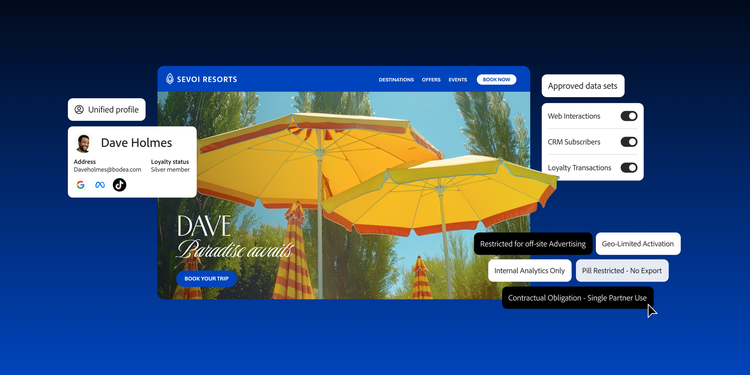
Adobe Experience Platform, Adobe CX Enterprise's single system of truth for unifying, analyzing, and activating customer data, includes a native data governance framework that applies usage labels, enforcement policies, and consent checks at the dataset and field level. When a marketer tries to activate a segment to a paid media channel, the platform automatically checks whether the underlying data is permitted for that use case before the activation executes. This is not a post-hoc audit. It is a real-time gate that prevents policy violations before they happen.

This architecture addresses the most common governance failure in customer experience organizations: data reaches an execution channel before anyone checks whether it should. The enforcement happens inside the same system where activation occurs, eliminating the manual handoff between a governance catalog and a marketing execution tool. For a retail brand running personalized campaigns across email, paid social, and on-site experiences, this means consent and usage policies are enforced consistently across every channel without requiring separate governance checks for each.

Adobe Experience Platform's data lineage capabilities trace how customer profile attributes are assembled from raw data collection events through identity stitching to final audience membership. Data stewards get a full audit trail without exporting data to a separate lineage tool. The platform's approach to data modeling tools is similarly integrated: schemas built using the Experience Data Model (XDM) carry governance labels from the moment data is ingested, so classification does not happen as an afterthought.

For organizations managing consent under GDPR or CCPA, the platform integrates consent signals directly into profile attributes. Opted-out users are automatically excluded from activations without requiring manual suppression list management. This is a meaningful operational improvement over workflows where a compliance team maintains a separate suppression list that must be synced across multiple systems daily.

Adobe Experience Platform fits the decision criteria for organizations whose governance risk is concentrated in customer data activation, particularly those already using Adobe Journey Optimizer, Adobe Real-Time Customer Data Platform, or Adobe Customer Journey Analytics, where governance controls can be shared across the same data foundation. Organizations with enterprise-wide governance needs spanning finance, operations, and HR data should evaluate whether an enterprise governance suite covers those domains alongside a customer data platform.

Start building your data governance foundation.

Identify your primary governance risk before evaluating tools: regulatory exposure, data quality in AI pipelines, customer data activation compliance, or enterprise-wide data discoverability each point to a different tool category. Choosing the wrong starting point is the single most common reason governance initiatives lose executive support in their first year.

Run a proof-of-concept on your highest-risk data domain first. Organizations that attempt to govern all data simultaneously typically stall within the first quarter. A focused first domain, such as customer PII used in marketing activation or financial data feeding board reports, produces early wins that build organizational buy-in and justify expanding governance to additional domains.

Explore how Adobe Experience Platform's built-in data governance capabilities apply to your customer data management and activation use cases.

Question? We have answers.

What is the difference between a data governance tool and a data governance framework?

A data governance framework is the set of policies, roles, and standards an organization agrees to follow. A data governance tool is the software that enforces those policies automatically, tracking lineage, flagging violations, routing approvals, and generating audit evidence so governance is operational rather than theoretical.

What features should a data governance tool include?

At minimum: a data catalog for asset registration, lineage tracking, access control and policy enforcement, data quality monitoring, and compliance reporting. Organizations managing customer data also need consent management and usage-label enforcement to prevent unauthorized data activation across marketing channels.

How do data governance tools support regulatory compliance?

They map data assets to specific regulation requirements, enforce field-level access restrictions automatically, and generate audit-ready reports showing which data was accessed, by whom, and for what purpose. This reduces manual compliance effort and shortens response time when regulators or auditors request evidence.

What is the difference between a data catalog and a data governance platform?

A data catalog focuses on organizing and making data discoverable by registering assets, definitions, and owners. A full governance platform adds policy enforcement, lineage, stewardship workflows, and compliance reporting on top of catalog functionality. Some tools do both; many organizations use a catalog as one component of a broader governance stack.

How long does it take to implement a data governance tool?

Implementation timelines range from weeks for cloud-native or integrated platforms scoped to a single data domain, to six to twelve months for enterprise governance suites deployed across an organization. Complexity is driven by the number of data sources, the depth of stewardship workflows required, and the size of the team managing onboarding.

https://business.adobe.com/fragments/resources/cards/thank-you-collections/rtcdp