What Is Data Hygiene? Definition, Benefits & Best Practices

What is data hygiene? Definition, benefits, and how to get started.

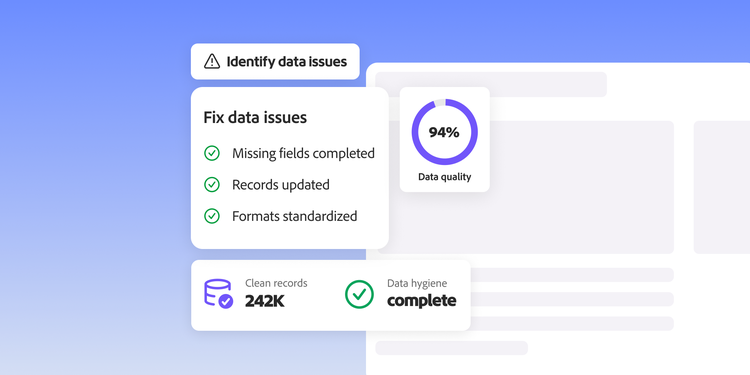
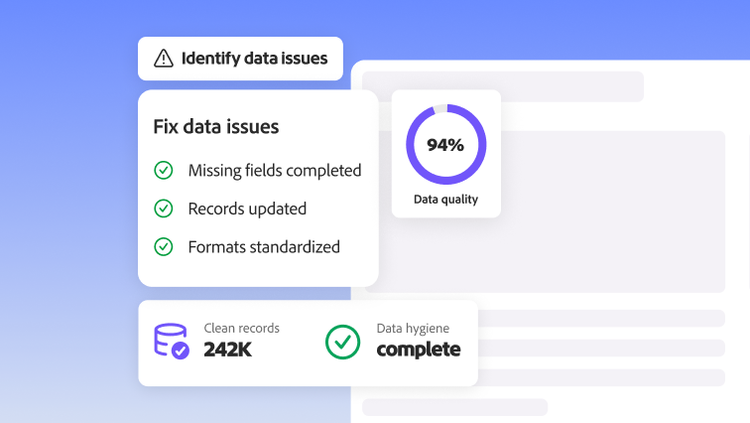
Dashboard visualization of data hygiene activities, including record updates and quality monitoring.

Every marketing decision, customer profile, and operational report is only as trustworthy as the data behind it, and most organizations are working with data that is partially incorrect, duplicated, or years out of date. Data hygiene is the discipline that helps close that gap before it costs an organization’s revenue.

In this article, you’ll learn:

What is data hygiene?

Data hygiene is the ongoing process of identifying and correcting errors, duplicates, outdated values, and incomplete records within a database or data system. It is routine maintenance, not a one-time project. Just as a warehouse requires regular inventory counts to stay accurate, a customer database requires regular inspection and correction to remain useful.

Three roles encounter data hygiene directly. Marketing operations teams manage contact lists and campaign segments, where a single duplicate record can trigger redundant sends and inflate cost-per-acquisition metrics. Data engineers maintain pipelines and schemas, and a format change in an upstream source can silently break downstream transformations. Analytics teams build models and dashboards whose outputs become unreliable when input data shifts without warning.

Data hygiene becomes urgent when an organization runs its first multichannel campaign and discovers that the same customer has four different email addresses across three systems. That moment, when personalization logic sends contradictory messages to the same person, makes the problem tangible and expensive.

The term "dirty data" describes records that are inaccurate, inconsistent, duplicated, or stale. Dirty data is the condition that data hygiene resolves. Two related concepts help frame the discipline. Data integrity covers the structural rules that keep data valid, such as enforcing that a date field always contains a date. Data accuracy measures whether the values stored actually match reality, such as whether a customer's current email address is the one on file. Both are necessary, and neither is sufficient on its own.

Data hygiene sits within the broader discipline of data quality management. It is the hands-on, operational layer that makes data quality policies real inside day-to-day systems. Policies define what "clean" means; hygiene is the work of getting there and staying there.

What types of data problems does poor hygiene create?

Dirty data is not a single problem. It manifests as four distinct types, each with a different root cause, detection method, and fix.

  • Duplicate records are the most common hygiene problem. A contact database with a 10 to 15 percent duplication rate inflates campaign costs, splits engagement history across multiple profiles, and makes personalization logic unpredictable. For example, if a loyalty program member exists as three separate records, their purchase history is fragmented, and a "top spender" segment may exclude them entirely. Deduplication, typically the first correction most teams apply, requires matching logic that accounts for variations in name spelling, email domains, and address formatting.
  • Incomplete records reduce the addressable audience for any segmentation rule that depends on a missing field. A blank job title field, for instance, removes a contact from every account-based marketing segment targeting a specific role. Placeholder values like "N/A" or "test" are equally damaging because they pass basic null checks but fail any logic that treats the value as meaningful. Detection requires profiling each field for completeness rates and flagging values that match known placeholder patterns.
  • Stale data decays naturally. B2B contact records degrade as people change jobs, companies restructure, and email domains expire. A list untouched for 18 months may be substantially unreliable, with bounce rates climbing and engagement metrics distorted by contacts who no longer match the profile attributes on file. Data freshness, the measure of how recently a record was verified or updated, is the metric that tracks this decay.
  • Inconsistent formatting prevents reliable joins across systems and breaks identity resolution. A phone number stored as "(800) 555-0100" in the CRM and "8005550100" in the marketing automation platform will not match during a merge, creating a false duplicate or an orphaned record. This directly undermines data consistency across platforms and makes cross-channel reporting unreliable. Fixing format inconsistency requires defining canonical formats and applying transformation rules before records are merged.

Each of these four problem types requires a different correction technique. Deduplication resolves duplicates. Field profiling and enrichment address incomplete records. Scheduled re-verification combats staleness. Schema-level normalization fixes formatting. A hygiene program that only addresses one type leaves the others to compound.

The downstream consequences are measurable. Campaigns reach the wrong audience. Analytics surface false trends because aggregated metrics include duplicate events. Machine learning models trained on dirty data produce unreliable predictions. Data accuracy and data reliability suffer at every layer when the source data is not clean.

What are the core benefits of maintaining data hygiene?

Improved campaign precision is the most immediate benefit. Clean, deduplicated contact lists mean paid media spend reaches real, non-duplicated people. An organization that eliminates a 12 percent duplication rate from a million-record database removes 120,000 wasted impressions per send, directly lowering cost-per-acquisition without changing creative or targeting strategy.

Accurate data supports better segmentation, which enables personalization that matches the right message to the right person. Consider a retail brand that standardized product interaction data across its web and mobile touchpoints. By resolving inconsistent product category labels, the brand reduced irrelevant email sends and saw measurable improvement in click-through rates, all without increasing send volume. The lift came from removing noise, not adding signals.

Regulatory compliance becomes easier when records are accurate and complete. CCPA and GDPR both require organizations to honor deletion and correction requests, and those requests are only actionable if records can be reliably located. A system with high duplication and inconsistent identifiers makes it difficult to confirm that every instance of a customer's data has been addressed, creating legal exposure.

Data-driven design decisions, from UX improvements to product roadmap prioritization, depend on behavioral data that accurately reflects user actions. When event data is duplicated or missing, design teams optimize for a distorted picture of user behavior. A product team that discovers its most used feature metric was inflated by duplicate event logging has to re-evaluate months of prioritization decisions.

Clean data also accelerates the onboarding of new tools. Organizations that attempt to implement a customer data platform or analytics platform on top of dirty data typically spend a disproportionate share of implementation time on remediation rather than configuration. Hygiene done upfront shortens that timeline significantly and reduces the risk of carrying legacy data problems into a new system.

Data reliability or the confidence that a report or model will produce the same result given the same inputs, is impossible to guarantee without an active hygiene process. Teams that trust their data make faster decisions with less verification overhead because they are not spending cycles re-checking numbers before every meeting.

How do leading organizations build a data hygiene process?

A repeatable data hygiene process has four sequential steps: audit, standardize, deduplicate, and enrich. Skipping the audit step and going straight to deduplication is the most common mistake because, without understanding the full scope of data problems, teams risk merging the wrong records or missing entire categories of errors.

The audit step involves profiling every field for completeness, running duplication detection logic, and flagging values that fall outside expected formats. The output is a prioritized list of problems, ranked by their downstream impact.

Standardization means defining a single canonical format for each field type and applying it across every source system before records are merged. Date formats, country codes, phone number structures, and job title taxonomies are the four fields most organizations standardize first because they are the most frequently joined across systems. A company that stores dates as "MM/DD/YYYY" in its CRM and "YYYY-MM-DD" in its analytics warehouse will produce join errors until one format is enforced universally.

Deduplication follows standardization because matching logic is far more accurate when records are already in a consistent format. Merge rules should define which record is the "surviving" record and how conflicting field values are resolved, such as keeping the most recently updated email address.

Enrichment fills gaps with internal or third-party data. A record missing a company size field, for example, can be enriched using data from a firmographic data provider, restoring it to segments that depend on that attribute.

Automation reduces the cost and latency of hygiene. Real-time validation rules at the point of data entry, such as rejecting malformed email addresses or phone numbers before they enter the database, preventing dirty data from accumulating. This is materially cheaper than retroactive cleansing.

Data quality monitoring closes the loop. Setting measurable thresholds for completeness rate, duplicate rate, and freshness lag, then alerting when a pipeline falls below those thresholds, turns hygiene from a periodic project into a continuous operational discipline. A data quality monitoring tool surfaces anomalies as they occur rather than weeks later in a campaign debrief.

Following documented data hygiene best practices, including record validation at ingestion, scheduled deduplication jobs, and ownership assignment for each data domain, gives teams a consistent framework rather than an ad hoc response to each new problem.

Assessing where your organization sits on a data maturity model helps prioritize hygiene investments. Teams at earlier maturity stages should focus on standardization and deduplication. More mature teams can invest in real-time monitoring and automated enrichment workflows that maintain database hygiene without manual intervention. Strong data governance at scale ensures that these hygiene standards are enforced consistently across every team and system.

How do you choose the right tools and approach for your organization?

The right approach depends on the complexity of your data landscape and the engineering resources available.

If your organization operates a single system of record with fewer than five data sources, lightweight ETL tooling and scheduled SQL-based deduplication jobs are sufficient. A small marketing team with one CRM and one email platform can maintain hygiene with well-written queries and a quarterly review cadence.

If you manage data across ten or more sources, including event streams, CRM, and offline files, a purpose-built data management platform with built-in identity resolution is the practical choice. At that scale, custom scripts become brittle, and the engineering time spent maintaining them exceeds the cost of a managed platform.

Teams with strong data engineering capacity can build and maintain custom hygiene pipelines. Teams without dedicated engineering resources need a platform that provides validation, deduplication, and monitoring as managed capabilities rather than code to maintain. The trade-off is flexibility versus maintenance burden: custom pipelines offer full control but require ongoing investment; managed platforms reduce overhead but may constrain how rules are configured.

Data normalization, the process of converting data from multiple source formats into a single consistent schema, is the technical mechanism that makes hygiene durable. Without normalization, every new data source reintroduces format inconsistency, and hygiene becomes a continuous manual effort rather than an automated process.

For enterprise organizations managing customer data across digital, offline, and partner channels, Adobe Experience Platform provides a unified data foundation with built-in data governance, real-time data ingestion with schema enforcement, and identity resolution that resolves duplicate profiles at scale. It functions as the layer where data hygiene, data integrity, and data consistency converge into a single operational system, reducing the engineering overhead of maintaining hygiene across disconnected tools.

Evaluation criteria for any hygiene tool or platform should include schema validation at ingestion, configurable deduplication rules, monitoring dashboards with alertable thresholds, API connectivity to existing source systems, and role-based access controls that enforce data governance policies. Run a proof of concept on a representative dirty dataset before committing to a platform. The real test is whether it handles your specific data problems, not whether it performs well on a vendor demo dataset.

Frequently asked questions.

If your organization is ready to move from ad hoc data cleanup to a sustained, automated hygiene practice, Adobe Experience Platform offers the schema enforcement, identity resolution, and data governance capabilities that enterprise teams need to keep customer data clean at scale. Learn more about Adobe Experience Platform.

Let’s talk about what Adobe can do for your business.

Get started


I'm the Adobe Assistant. How can I help you today?

1