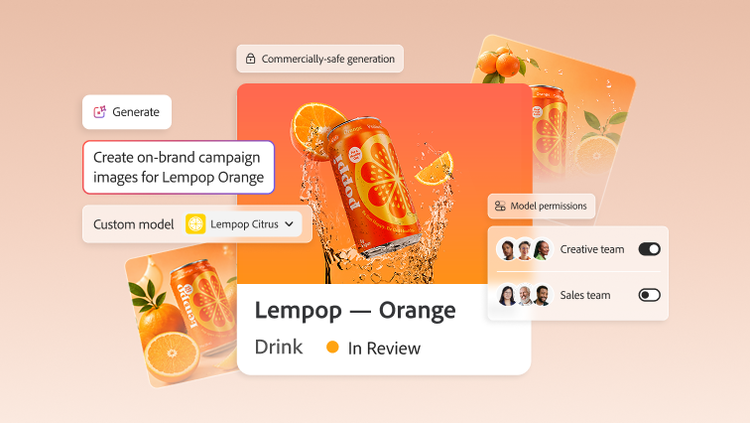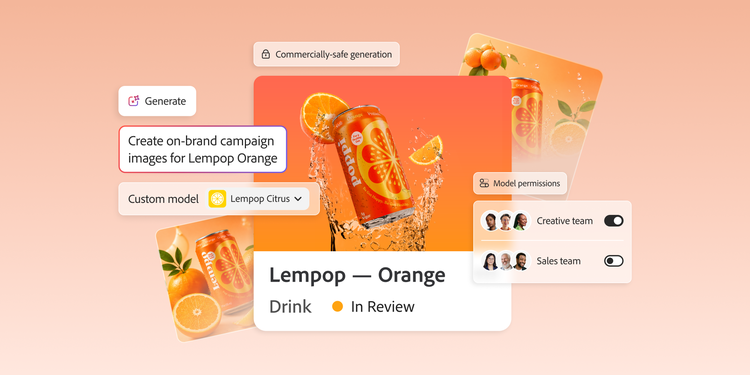
Enterprise brands now create visual content with generative AI across campaign production, content adaptation, and creative operations. As these workflows expand, organizations often discover that the same model does not fit every requirement. What helps one team move faster may not provide the level of control, visual consistency, or oversight required by another.
Model choice shapes how brands create, scale, and govern content. A team producing a variety of campaign imagery may have different needs than one working with proprietary brand images, established creative guidelines, or stricter review processes.
For marketing operations, creative experience, and digital advertising teams, it’s important to determine which level of model specificity the project requires. Adobe Firefly base image models, Adobe Firefly Custom Models, and Adobe Firefly Foundry each address distinct creative and operational needs. It is not about selecting the most advanced model. Rather, it is about understanding when a generic model is sufficient for your organization, when a custom model is needed to deliver brand-consistent content, and when deeply trained model development becomes necessary. This article explores how matching model capabilities to project needs helps organizations scale AI in ways that support their content, brand, and governance requirements.
Jump to section:
What is an AI maturity curve?
An AI maturity curve describes how organizations move from experimenting with AI to using it as part of everyday operations. As adoption expands, teams introduce processes, governance practices, and ways of working to support AI deployment at scale.
In creative operations, AI maturity often shows up in three areas: specificity, workflow integration, and brand governance. In the early stages of AI maturity, teams expect generative AI to create visuals quickly. However, as generative AI models become integrated into production workflows, teams want them to produce outputs that align with brand aesthetics, fit within existing review processes, and remain consistent across teams. These requirements often drive the need for different types of generative models.
Why AI maturity matters for enterprise creative asset development.
Teams start using custom models with a simple goal — to create on-brand imagery at speed and scale. These models are initially used to generate visual concepts, create production-ready image variations, and to reduce manual review cycles. With a custom model, teams focus on increasing creative output and working more efficiently, all while staying true to their brand.
As AI becomes a larger part of visual content and marketing operations, the requirements change. Teams need AI-generated assets to reflect the visual identities, campaign styles, product imagery, characters, and proprietary intellectual property (IP) that make their brand recognizable. They also need consistent outputs across campaigns, channels, and markets that fit within established review processes and governance standards. Organizations need custom models that can keep pace with these requirements. Choosing to use a model trained on brand assets helps teams scale creative production while maintaining brand control.
Spectrum of model customization.
Each enterprise team may require a different level of AI support. Selecting a model is an ongoing decision shaped by project goals, governance requirements, and production readiness. It’s not about adopting a more advanced model, but rather it is about matching the model to the organization's needs when it comes to managing brand imagery and protecting proprietary IP rights. A team generating campaign imagery with minimal governance requirements may need something very different from one managing global campaigns, regional adaptations, and established brand standards. As content operations become more complex, organizations often require greater model specificity to support them.
Let's look at the three stages of customization across Firefly:
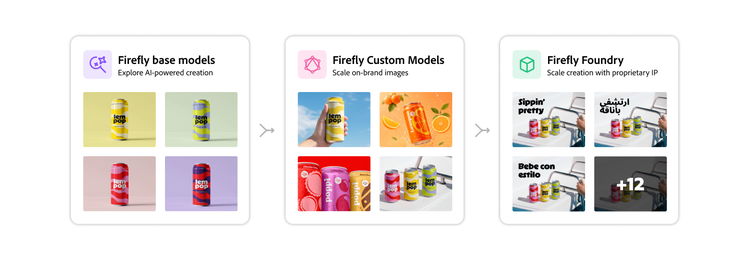
Stage 1: Adobe Firefly base models
Many organizations start using generative AI models for specific creative tasks rather than redesigning their content operations. Adobe Firefly base models provide a practical starting point for those teams by bringing AI into creative workflows. Teams can use them to develop concepts, build mood boards, explore campaign directions, create early content variations, and accelerate ideation.
At this stage, the priority is often to learn where AI fits within existing ways of working and to identify opportunities to create value. For example, Gatorade used Adobe Firefly for enterprise to power personalization experience through its signature bottles on its ecommerce platform. By generating hundreds of thousands of unique designs, the brand expanded creative possibilities for consumers while increasing engagement and strengthening brand loyalty. Experiences like this give teams hands-on knowledge of AI-assisted asset creation while building the skills and processes needed for broader adoption.
Governance at this stage starts with setting the right foundation. Organizations define usage guidelines, apply human review, document prompt best practices, and establish approved workflows for commercially safe experimentation. This equips teams to explore AI capabilities while preparing for broader adoption over time.
As content production scales, teams need more than generic AI-generated images. They want images that match their brand.
Stage 2: Adobe Firefly Custom Models
Brand consistency becomes more difficult to maintain as the volume of AI-generated content increases. Marketing and creative teams need their AI-generated images to visually reflect specific characters, illustration styles, campaign aesthetics, and photographic styles. Adobe Firefly Custom Models support these requirements by training on a small, curated set of approved brand assets, such as icons, character libraries, illustrations, and campaign assets.
Firefly Custom Models can be trained on dedicated assets for a specific campaign, such as a particular character or photoshoot style in a single model. By learning visual patterns, the models generate more consistent, on-brand output. They are great for teams that have small training sets — just 10 to 20 assets — and want to train and use the model quickly, accelerating content production. With Firefly Custom Models, teams can explore variations, accelerate production, and move from concept to final assets more efficiently.
For example, Amazon Fresh partnered with KINESSO to implement Adobe Firefly Custom Models trained on campaign assets. The team adapted creative assets from one seasonal campaign to another, producing high-quality holiday-themed visuals, and cut production time by 93%, all while maintaining brand consistency and commercial safety. Enterprises looking to localize on-brand visuals across audiences, markets, and channels can build a custom model and reduce time-consuming product reshoots.
Governance becomes more structured at this stage. Organizations train models on approved brand assets, control access to custom models, and validate outputs before scaling production. These practices maintain consistency while enabling creative teams to keep up with content demands.
Stage 3: Adobe Firefly Foundry
Leading brands and franchises rarely create content around a single product, character, or campaign. They manage portfolios of assets, experiences, and IP that span channels, formats, and customer touchpoints. At this stage, teams need custom models that can preserve relationships across those systems while supporting the creation of image, video, audio, vector, and 3D content.
Adobe Firefly Foundry is a managed enterprise model-development product for organizations with complex IP and multimodal production needs. Firefly Foundry employs large-scale training to teach the model multiple brand concepts across formats — images, audio, video, and more — and tie the relationships between them. Organizations can build private models trained on proprietary assets and retain ownership of both the training data and model outputs. The aim is to combine creative speed with creative precision to support production-ready AI at an enterprise scale.
With this approach, the model aligns with broader brand and franchise systems across content workflows. For example, Disney uses Firefly Foundry to help Imagineers quickly generate consistent visual iterations across the characters, stories, and attractions that audiences connect with and love. As Disney expands across parks, hotels, cruises, and other experiences, proprietary models help its teams meet growing design demands while staying true to the brand’s IP.
Governance requirements also expand at this stage. Organizations are required to manage proprietary IP, make model deployment decisions, integrate models into production workflows, establish stakeholder oversight, and implement enterprise-level controls for production use. They also need AI usage guidelines for employees, vendor evaluation processes, and governance practices that evolve along with AI adoption.
When is your organization ready for the next stage of the model?
Marketing and creative teams need to decide whether their current approach still supports the way content is created, reviewed, and scaled. For example, a team using Adobe Firefly base models may need to consider Firefly Custom Models if designers spend more time correcting AI-generated outputs for brand consistency than refining creative ideas. Also, an enterprise that uses custom models may eventually want a model trained on a repository of content.
The following signals can help evaluate whether the current model approach meets your requirements or if it is time to move to a new model:
Scaling enterprise AI for on-brand creative asset development.
The most effective generative AI strategy reflects the realities of the business, brand, and content being produced. As these requirements evolve, organizations may need to expand beyond generic creative asset generation to more customized, proprietary AI solutions that provide greater design control and consistency. This approach can help organizations expand AI across creative operations while developing larger volumes of on-brand content.
Explore how Adobe Firefly Enterprise Solutions can help your organization scale the creation of commercially safe, on-brand imagery with Firefly Custom Models and Firefly Foundry.
Recommended for you
https://business.adobe.com/fragments/resources/cards/thank-you-collections/firefly