How MLB and Adobe drove record fan engagement: When a technology partner becomes your closer.
Adobe Support and Success Team
10-13-2026
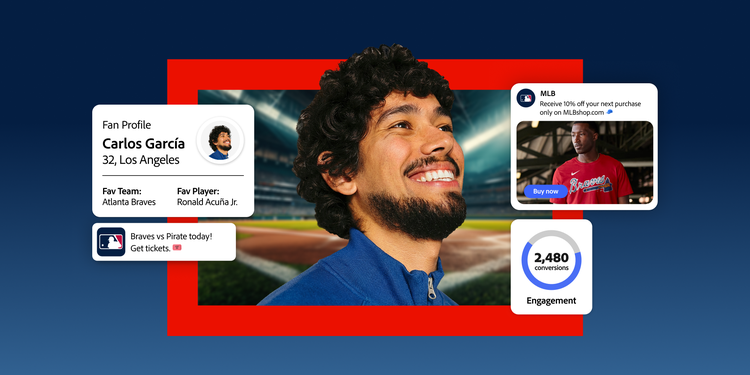
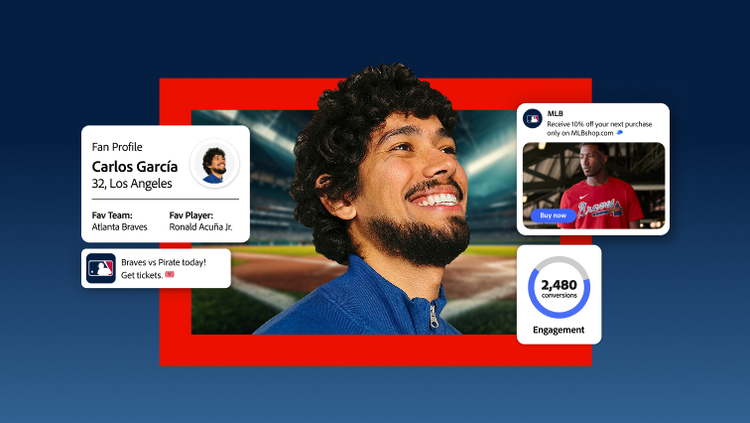
At a time when marketers wonder whether AI and automation can keep brand experiences human, Major League Baseball (MLB) and Adobe are proving that sports organizations can innovate at pace while delivering more joy, excitement, and passion to their fans than ever before.
MLB joined forces with Adobe Support and Services five years ago to enhance fan experiences with data-driven insight and automation. Adobe solutions now power the league’s personalized communications before, during, and after each game, from seasonal campaigns to real-time push notifications.
People’s love for baseball continues to grow. More than 150 years after the sport was established, MLB clubs welcome more than 70 million fans to their ballparks each year and generate tens of billions of views on social media. Through its partnership with Adobe, MLB continues to learn, evolve, and seek new ways to engage its fans. Here’s the framework the league follows.
Building a winning playbook for real-time fan engagement.
Divya Sandur, Senior Product Manager at MLB, attributes the league’s advances in real-time engagement to a structured framework. According to Sandur, understanding fans deeply and delivering the right message at the right time and in the right place requires MLB to connect three crucial pieces of its marketing ecosystem:
- Data. Marketers need relevant data and the ability to act on it quickly.
- Decision-making. Intelligent orchestration helps marketers deliver the right message to the right audience through the right channel at the right time.
- Coordination. The best outcomes happen when marketing, engineering, analytics, and product teams all work from the same playbook.
MLB has been developing each of these transformation pillars at scale. The league’s 30 clubs play nearly 2,500 regular-season and playoff games each year. To keep seats filled and fans engaged, MLB’s marketers must anticipate, execute, and excite them through every contest and in the downtime between matchups.
Real-time analytics, flexible workflows, and seamless collaboration form the foundation of MLB’s approach, but the winning play for its marketers is the ability to combine these elements in a meaningful way. Adobe Integrated Services supports this work as part of MLB’s broader engagement with Adobe Support and Services. Through the engagement, MLB teams gain strategic guidance, technical expertise, and deeper enablement — helping them align their work, turn insights into relevant fan experiences, and refine their strategies over time. Here are three lessons MLB learned along the way:
Lesson 1: Sunny days start with fan data.
The first pillar of MLB's framework is data — not just its volume, but how fast marketers can act on it. Working with Adobe, MLB draws on audience data signals to bring its new marketing plays to life. Adobe Experience Platform unifies hundreds of data sources, including ticketing, digital engagement, and location signals. Adobe Journey Optimizer translates those insights into real-time, personalized outreach.
In 2025, MLB piloted an initiative called Sunny and 75 to boost game-day attendance by using real-time weather data to identify timely ticket-sales opportunities. MLB worked with Adobe to create a workflow that combined real-time weather data with purchase histories and location data, enabling teams to target fans near their stadiums with last-minute ticket offers.
The Sunny and 75 pilot achieved 51% higher click-through rates than average for weather-based push notifications and generated a significant lift in incremental ticket sales. The results encouraged more MLB clubs to follow in the pilot club’s footsteps. Most importantly, it proved what’s possible when marketers think outside the box and have the right technologies and experts to support them.
Measurement was integral to the project. MLB also worked with Adobe to create club-specific measurement dashboards for Sunny and 75, informed by Adobe Customer Journey Analytics. This provided marketers with valuable insights into fan journeys and conversion drivers, helping them make push notifications timelier and more personalized.
Lesson 2: Strategic sprints drive projects home.
Fast decision-making requires a structure that can keep pace. That’s why MLB's marketers put such a premium on agility. Instead of the typical 12-month project cycles, MLB and Adobe teams work in six-week sprints. This approach is unique to Adobe Integrated Services and delivers valuable structure and speed. Teams work against a pre-planned roadmap to achieve their goals for the season, while gaining short-term agility to learn and adjust their strategies along the way, delivering the best experiences for all 30 league clubs and their fans.
This flexible, hands-on approach also helps MLB to put its marketing technologies into practice with confidence so clubs can make faster, better-informed marketing decisions. The ability to deliver timelier and more relevant experiences across every channel has helped the league grow closer to its fans and realize new value from its technology investments each day.
“Our partnership with Adobe has given MLB marketers greater focus and more flexibility to adapt to fans’ evolving needs without having to rescope every time they adjust,” says Sandur. “We’ve developed a rhythm. And by working to that rhythm together, we’re building momentum.”
Lesson 3: Personalization is a loop, not a line.
None of this works without coordination. Marketing, engineering, analytics, and product teams must pull from the same playbook. Sunny and 75 revealed an important truth — the modern sports fan experience is a continuous, contextual cycle in which pre-game anticipation feeds in-venue immersion, which drives post-game momentum, in turn building heightened anticipation for future matchups.
MLB applies this insight, and others gained through its work with Adobe, directly to the league’s technology infrastructure.
This realization, and the many other learnings MLB has collected since joining forces with Adobe, are not just academic. They are integrated directly into the league’s technology infrastructure and accessible to all 30 MLB clubs via an internal microsite.
The shared MLB and Adobe playbook houses every use case, fan journey, audience insight, and campaign insight gained from marketing initiatives like Sunny and 75. Today, MLB clubs use the site as a centralized enablement platform to learn from others’ experiences and enhance their own marketing tactics.
Each club manages its own budgets, priorities, and fan expectations. Through the MLB and Adobe playbook, clubs can access all the resources they need to achieve their specific goals, from developing customized campaigns to creating workflow templates for greater brand and campaign consistency.
“Rather than treating successful campaigns as isolated wins, we’ve turned them into repeatable capabilities that every MLB club can build upon,” says Sandur. “Our fans watch their favorite clubs compete on the field for nine months each season, but behind the scenes, the entire league is working together to grow the game and make it more exciting.”
Baseball may be America’s pastime, but MLB never rests when it comes to fan experiences. Backed by faster data, smarter decision-making, and true collaboration across teams, all in partnership with Adobe Support and Services, the league’s marketers are rewriting the rules of fan engagement while supporting more ticket sales.
Discover how Adobe Support and Services can help your organization optimize and scale for the future.
For a deeper dive into MLB’s transformation, check out its session from Adobe Summit 2026 here.
Recommended for you
https://business.adobe.com/fragments/resources/cards/thank-you-collections/ajo