Launching a new product without historical performance data.

Launching a new product requires marketing teams to make important decisions: estimate projected demand, choose where to invest, and decide how to reach the right audiences, often without direct evidence of how customers will respond.

Predictive models give teams a stronger basis for those decisions. By analyzing relevant signals from comparable products, past campaigns, audience behavior, and market demand, they can help forecast outcomes, compare scenarios, and identify the best opportunities.

This post covers:

What is a historical data gap, and how does proxy data help?

New products have no performance history, which is why historical data gaps exist. Marketers have no prior campaign results, sales patterns, audience response, or customer behavior to indicate how the product may perform. They must make early decisions about demand, investment, targeting, and messaging. Additionally, certain launch decisions are more dependent on assumptions. Teams may overestimate demand, invest in the wrong channels, or prioritize audiences and messages that appear promising but have not yet been validated.

Proxy data helps marketers lower that uncertainty. It is relevant evidence drawn from sources such as comparable products, related campaigns, adjacent audiences, category trends, search demand, and early engagement signals.

While proxy data cannot predict an outcome with certainty, it can help teams form a more credible view of likely performance and surface the assumptions carrying the most risk. Marketers can then turn those assumptions into clear testing priorities once the launch begins.

Which proxy metrics help build a stronger launch strategy?

No single proxy metric tells the whole story. Some help identify similar audiences or customer behaviors, while others reveal useful patterns across products, campaigns, channels, and messaging.

Looking at multiple metrics together gives marketers a more complete picture of the launch and helps marketers make better decisions before product-specific marketing performance data becomes available.

Some of the most valuable proxy metrics include:

  • Audience and behavioral: Customer attributes, purchase behavior, engagement patterns, and product usage can support lookalike modeling and help identify audiences that may respond similarly to a new product.
  • Comparable product performance: Sales, conversion, adoption, and pricing response from similar products can help establish realistic benchmarks for demand and expected performance.
  • Campaign and channel response: Results from related campaigns can show which channels, formats, and tactics are most likely to perform well during the initial launch.
  • Market and demand indicators: Search interest, category growth, seasonality, and competitive activity can help marketers estimate demand and assess whether market conditions support the launch.
  • Messaging and offer response: Performance data from related messages, value propositions, prices, and promotions can help identify which positioning and offers are most likely to resonate.

How do predictive models forecast new product performance?

Predictive models forecast performance for new products by analyzing proxy data from comparable products, audiences, marketing campaigns, and market conditions. They turn those signals into structured estimates, such as demand forecasts, performance scores, confidence intervals, and launch scenarios, to help marketers make decisions more confidently.

A model can compare the current product launch with relevant evidence from previous products, campaigns, and market conditions to estimate likely outcomes. This gives marketers a stronger basis for decision-making than assumptions or experience alone.

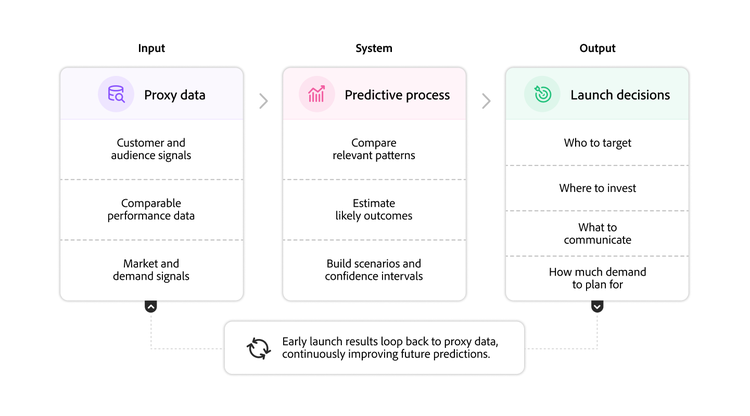
A diagram depicting predictive AI uses proxy data to guide launch decisions and uses the outcome to continuously improve predictions.

Consider a consumer electronics brand preparing to launch its smart-home device in a new market. The product has no local sales or campaign history, so the team leans on search demand, category growth, ecommerce behavior, audience response in comparable regions, and results from previous international launches. A predictive model combines those signals to estimate an initial demand range, identify the audiences most likely to respond, and compare likely channel performance. The team can use those forecasts to shape its product launch marketing plan.

Marketers have always used patterns from previous launches to make predictions about new ones. Predictive models make that process more structured by analyzing more signals at once and estimating the likelihood of different outcomes.

A 6-step predictive framework for a new product launch strategy.

Forecasting demand is only useful if it leads to better launch decisions. Predictive models can turn proxy data into estimates, but marketers still need a clear process for translating them into actionable insights for audience, investment, channel, and messaging decisions.

The following six-step framework shows how to move from product demand forecasting to a launch strategy, then refine that strategy as direct performance data becomes available.

1. Define the launch decision.

Key action: Specify the decision the forecast needs to support, such as estimating demand, prioritizing an audience, selecting a channel, or allocating budget.
Planning outcome: A focused business question and a clear purpose for the forecast.

2. Identify the missing data.

Key action: Identify what's still unknown, such as audience response, product demand, conversion rates, price sensitivity, message fit, or channel efficiency.
Planning outcome: A clear understanding of the information gaps to address.

3. Select the best proxy data.

Key action: Choose proxy data that best fills those gaps, from evidence such as comparable products, related campaigns, audience segments, search demand, market research, category benchmarks, or early engagement signals.
Planning outcome: Relevant evidence that supports more informed forecasts.

4. Build launch scenarios.

Key action: Create conservative, expected, and aggressive scenarios instead of relying on a single prediction. Evaluate trade-offs and risks.
Planning outcome: A range of outcomes to help make more informed launch decisions.

5. Prioritize by confidence level.

Key action: Rank forecasts based on confidence. Use high-confidence insights to support larger decisions and treat lower-confidence insights as opportunities to test and learn.
Planning outcome: A clearer view of where to act and where to continue testing.

6. Launch, measure, and update.

Key action: Compare real performance data with original assumptions, refine the forecast, and adjust the strategy as new data becomes available.
Planning outcome: A continuously improving forecast that becomes more accurate over time.

A single forecast should not be treated as a guaranteed outcome. Every new product launch carries uncertainty, so marketers should build multiple scenarios to understand how different assumptions could affect performance.

Why are predictive model confidence intervals important for product launches?

Predictive models for product launches should use confidence intervals because new products have limited direct performance data. By showing a range of plausible outcomes rather than one fixed prediction, confidence intervals help marketers understand how much uncertainty surrounds a forecast.

Scenario planning helps explain what could produce different outcomes within that range. Upside, expected, and downside scenarios vary key assumptions to show what might improve or hurt performance.

  • Upside scenario: Represents the higher end of the confidence interval. It assumes more favorable conditions, such as stronger demand, better campaign response, or greater channel efficiency.
  • Expected scenario: Represents the most likely outcome within the confidence interval. It assumes the outcome aligns with the prediction.
  • Downside scenario: Represents the lower end of the confidence interval. It assumes less favorable conditions, such as weaker demand, lower campaign response, or lower channel efficiency.

Defining confidence intervals will help marketers compare scenarios, understand risk, and make decisions without focusing on just one forecast. Teams can use confidence intervals to judge how much reliance to place on each forecast and scenario to understand what could impact performance.

Making the assumptions explicit and showing how changes in budget, launch timing, pricing, audience, and offer strength impact the result also helps identify which factors require closer monitoring or early testing.

Teams should treat product demand forecasting as a planning tool, not a promise. The goal is not to produce a perfect prediction before launch. It is to understand which factors could determine the outcomes and make stronger planning decisions.

How to validate predictions after launch and refine forecasts?

Once a campaign goes live, marketers can begin replacing proxy data with direct performance data. Early results should update the forecast, but they should not automatically override it. Initial data can be volatile because it often reflects small samples, launch-period effects, or incomplete customer journeys.

So, the first step is to compare and validate actual performance with the assumptions behind the forecast. This helps teams see where the model is accurately estimating response, where it may be over- or underpredicting demand, and which parts of the launch strategy need to change.

Different metrics answer different questions:

  • Early response metrics: Impressions, CTR, engagement, and landing page actions show whether the campaign is reaching the intended audience and generating interest.
  • Conversion and demand metrics: Signups, add-to-cart actions, demo requests, trial starts, and sales velocity show whether that interest is turning into meaningful demand.
  • Customer quality metrics: Audience fit, customer acquisition cost, lead quality, retention, and repeat purchase reveal whether the launch is attracting valuable customers and not just generating volume.

Testing is just as important as controlled experiments and helps explain the reasons for performance. A/B tests, geo tests, holdouts, channel splits, and offer tests allow marketers to isolate specific variables and validate assumptions about audience, creative, channel, pricing, or offer strength.

When actual results differ from the forecast, the gap may reflect weak proxy data, changing market conditions, or execution factors the model did not fully capture.

Predictive models also have limitations, and testing helps marketers separate influences and understand what drives performance. That makes validation useful not only for improving the current launch but also for updating the model with stronger evidence and making future forecasts more reliable.

Launch new products and predict likely outcomes.

Launching a new product without historical performance data doesn’t mean relying on instinct alone. By combining predictive models with proxy data, such as predictive forecasts, comparable products, lookalike message data, and demand indicators, marketers can make more informed decisions before a product builds its own track record.

The aim is not to predict one perfect outcome. It is to understand the range of likely outcomes, make the assumptions behind the strategy visible, and improve decisions as real performance data comes in.

Once those priorities are clear, enterprise marketers still need to translate them into coordinated campaign execution. Adobe GenStudio helps teams plan, create, activate, and optimize on-brand content across products, regions, and channels at scale.

Try GenStudio for Performance Marketing free for 28 days.

Let Adobe GenStudio support product launches today.

For enterprise teams managing complex launches across products, regions, and channels, Adobe GenStudio can help teams plan, create, activate, and optimize on-brand campaign content at scale.

Let’s talk about what Adobe can do for your business.

Get started

I'm the Adobe Assistant. How can I help you today?

1