Retail App Retention: AI Features Customers Actually Want

Retail app retention: Why customers delete apps and the AI features that make them stay.

Summary and key findings.

Most retail apps don’t survive contact with the home screen. Nearly three in four customers say they’ve downloaded a brand or retail app for a one-time discount or purchase, only to delete it shortly afterward. This level of retail app churn signals a broader shift in customer expectations: discounts may drive installs, but they rarely drive long-term retail app retention on their own. For marketers, the opportunity is significant.

  • On average, customers report having 10 retail or brand apps on their device, five of which they’ve used in the past month, and three that they’ve never opened.
  • 72% of customers have downloaded a retail app for a one-time purchase or discount before deleting it.
  • The top reasons customers download retail apps are to join a loyalty or membership program (45%), receive a one-time discount or promotion (42%), and for an easier shopping experience (37%).
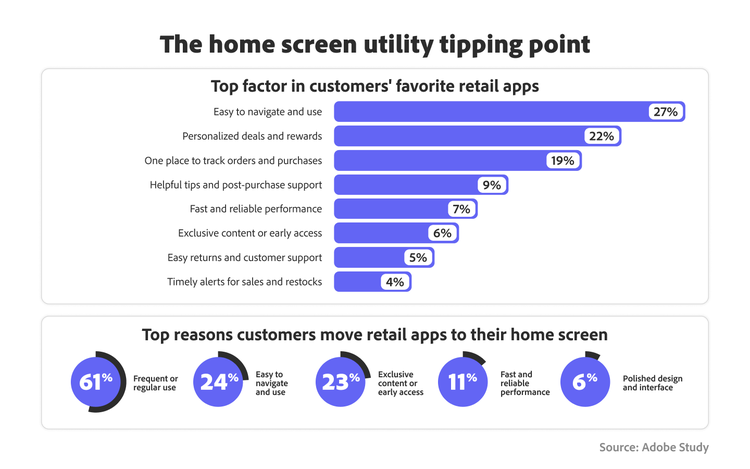
  • The top reasons customers move a retail or brand app to their home screen are frequent use (61%), ease of navigation (24%), and exclusive offers (23%).
  • The top notifications that drive retail app engagement are order status updates (39%), personalized discounts (37%), and price drops on saved items (33%).
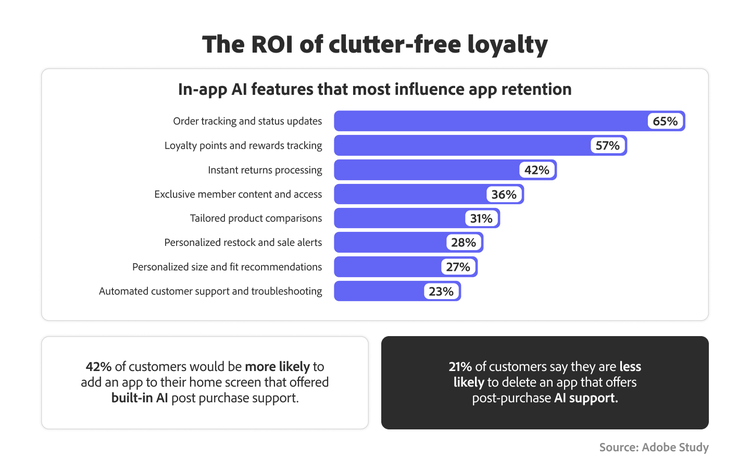
  • The top AI-powered features users want from brand and retail apps are order tracking and delivery status (65%), loyalty program management (57%), and instant return processing (42%).
  • One in three users say they would be more likely to keep a brand or retail app on their device if they could interact through voice or image search (33%).

What the data tells us.

Our key findings show that discounts reliably drive downloads, but they rarely foster lasting engagement. Customers report adding apps to their home screens based on utility, including repeated use, and they remain engaged when notifications feel personal and timely.

Post-purchase support presents a significant opportunity. Features such as order tracking, returns, and loyalty management are the AI-powered capabilities customers desire most. This indicates that brand apps can play a role that extends well beyond the initial purchase. Brands that successfully bridge this gap can transform one-time buyers into long-term app users.

3 in 4 customers delete retail apps after a one-time use or promotion.

Customers already know what they want from today’s mobile shopping experience: frictionless discovery, personalized rewards, relevant recommendations, and effortless post-purchase support. Brands that successfully combine all four are more likely to improve ecommerce app engagement, strengthen retail customer loyalty, and create the kind of repeat interaction that drives long-term customer retention.

To better understand what keeps apps on customers’ devices, Adobe surveyed 1,000 U.S. consumers about their retail app habits, download triggers, engagement behaviors, and the AI-powered features most likely to influence retention. The findings suggest that the next phase of ecommerce customer experience will be shaped less by one-time promotions and more by utility, personalization, and value across the entire customer journey.

This shift is also accelerating the rise of conversational commerce — an approach that allows customers to search, compare products, ask questions, and complete purchases through natural, conversational interactions instead of static navigation menus. Customers increasingly expect retail apps to function less like digital catalogs and more like responsive, AI-powered retail assistants that adapt to their intent in real time.

These technologies help brands create retail app experiences that keep customers engaged before, during, and after a purchase. Adobe Brand Concierge helps brands create conversational, AI-powered retail app experiences that keep customers engaged throughout the buying journey, while Product Support Agent extends that value after purchase through post-purchase support and issue resolution.

What makes customers keep retail apps on their home screen?

Before brands can earn a permanent place on customers’ devices, they need to understand why so many retail apps get ignored, abandoned, or deleted after download. The data below explores what drives retail app engagement, long-term retention, and lasting utility in today’s mobile shopping experience.
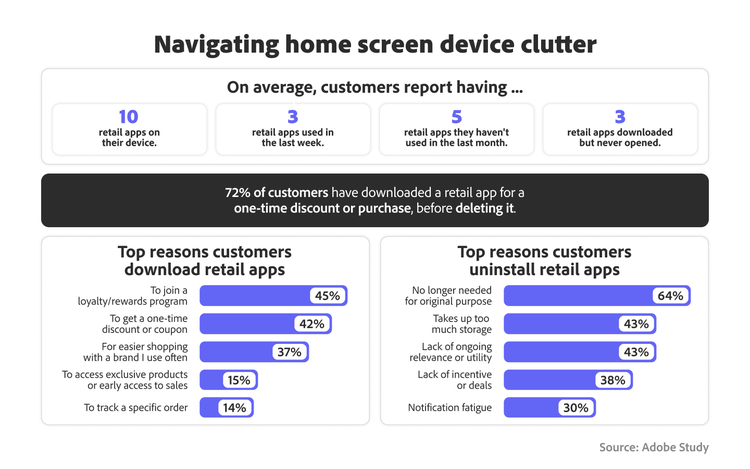
Infographic showing 72% delete apps after one use. Top uninstall reasons: no longer needed (64%) and takes up too much storage (43%).

Customers are downloading more retail apps than they regularly use. On average, consumers report having 10 retail or brand apps on their devices, but only five have been used in the past month, and three have never been opened at all. The research also found that 72% of customers have downloaded a retail app for a one-time discount or purchase and then deleted it, reinforcing how difficult long-term retail app retention has become. While loyalty programs and promotions remain strong acquisition tools, they are not enough on their own to sustain engagement. Customers say the primary reasons they download retail apps are to join loyalty or rewards programs (45%), access one-time discounts or promotions (42%), and enjoy an easier shopping experience (37%).

72% of customers have downloaded a retail app for a one-time discount or purchase before eventually deleting it.

Top reasons customers uninstall retail apps include:

  • No longer needed for the original purpose (64%)
  • Takes up too much storage (43%)
  • Lack of ongoing relevance or utility (43%)
  • Lack of incentives or deals (38%)
  • Notification fatigue (30%)

How agentic AI assistants power conversational commerce.

Most retail app churn is caused by brands failing to create lasting utility after the first interaction. Customers may install apps for discounts or loyalty perks, but they keep apps that continue to save time, simplify shopping, and deliver continued value throughout the customer journey.

This shift is helping drive the growth of conversational commerce — a retail experience model that allows customers to search, compare products, ask questions, and complete purchases through natural language interactions instead of static menus or traditional navigation flows. For brands, conversational commerce can reduce friction and create more personalized, responsive mobile shopping experiences.

Conversational commerce is the ability for customers to ask questions, discover products or services, and receive relevant suggestions from real-time interactions through natural conversations with an AI assistant or chat experience.

AI shopping assistants play a growing role in this by helping customers more intuitively navigate discovery, recommendations, support, and post-purchase interactions. AI-powered retail apps can continuously adapt to customer intent, preferences, and shopping behavior over time, instead of acting as static storefronts.

An AI shopping assistant is a customer-facing AI layer that powers conversational product discovery, recommendations, and guided buying experiences.

Customers increasingly expect retail apps to remain useful beyond the initial transaction. While discounts and loyalty programs may drive installs, long-term retail app retention depends more heavily on value, ease of use, and personalized engagement.

The research also highlights the growing importance of post-purchase utility in the ecommerce customer experience. “No longer needed” was the top uninstall trigger, while storage concerns and lack of relevance were also major drivers of app deletion, suggesting that many customers stop seeing value once the transaction is complete.

Product Support Agent addresses this challenge by extending the customer experience beyond checkout. As part of Adobe CX Enterprise, the AI-powered support layer helps customers manage orders, resolve issues, track purchases, and access ongoing support within the app experience. For brands, this creates more opportunities to improve customer retention strategies, strengthen retail customer loyalty, and turn one-time app downloads into long-term engagement.

Which AI features improve retail app retention?

Customers keep those retail apps on their home screen that consistently deliver value, convenience, and relevance. The data below explores the features and experiences that drive stronger retail app engagement and retention.

Chart on favorite retail app factors: easy navigation (27%) and personalized deals (22%). 61% move apps to the home screen for frequent use.

Customers are most likely to stay engaged with retail apps that make shopping feel easier, more personalized, and more useful after the purchase is complete. The research found that the top factors in customers’ favorite retail apps are ease of navigation and use (27%), personalized deals and rewards (22%), a single place to track orders and purchases (19%), and helpful tips or post-purchase support (9%). Frequent use was by far the leading reason customers moved an app to their home screen (61%), followed by ease of use (24%) and access to exclusive content or early promotions (23%). Together, these findings suggest that long-term retail app engagement is increasingly tied to utility and convenience rather than novelty alone.

Two in five customers (41%) also said they would be more likely to keep a retail or brand app on their home screen if it offered built-in AI-powered post-purchase support. This signals a growing shift in customer expectations, particularly as AI-powered retail apps become more common across the mobile shopping experience.

Customers’ favorite retail app categories include:

  • Grocery and food delivery (39%)
  • Apparel and accessories (25%)
  • Electronics (11%)
  • Beauty and personal care (7%)
  • Home goods and furniture (5%)

How retail app preferences differ by generation.

The most popular retail app categories look different depending on who you ask. Here are the app categories that each generation is more likely to identify as its favorite retail app category:

  • Gen Z: Electronics (14%) and beauty or personal care (8%)
  • Millennials: Apparel and accessories (27%)
  • Gen X: Grocery and food delivery (39%)
  • Baby Boomers: Home goods and furniture (6%)

How conversational commerce improves retail app engagement.

Customers increasingly favor retail apps that make the shopping experience feel smooth and easy to navigate. ‘Ease of navigation’ was the top feature associated with customers’ favorite apps, while ‘frequent use’ was the leading reason apps earned a permanent place on the home screen, highlighting a growing demand for experiences that simplify discovery, purchasing, and post-purchase support.

Conversational commerce allows customers to search, compare products, ask questions, and complete purchases through natural interactions rather than relying entirely on static menus or search bars. This creates opportunities for brands to improve the ecommerce customer experience while delivering more personalized and intent-driven engagement.

AI shopping assistants and AI agents are becoming a central part of that experience by helping customers navigate discovery, recommendations, order management, and post-purchase support within a single interface. Customers find greater value in retail apps that continue to provide usefulness beyond the purchase itself.

The findings also highlight a growing demand for centralized post-purchase experiences. Nearly one in five respondents said having a single place to track orders and purchases was among the most valuable retail app features, while 41% said AI-powered post-purchase support would make them more likely to keep an app on their home screen.

Product Support Agent helps address that demand by bringing order tracking, troubleshooting, returns, and support into a single AI-powered experience. As part of Adobe CX Enterprise, the solution helps brands extend engagement beyond checkout, turning post-purchase support into an important part of a long-term customer retention strategy and retail customer loyalty.

Why personalized notifications increase retail app opens.

Customers are far more likely to engage with notifications that feel timely and personalized and that directly connect to their shopping behavior. Alerts tied to customer intent and post-purchase utility consistently outperform generic promotional campaigns when it comes to driving retail app opens.

The top notifications that drive retail app opens are:

  • Order or delivery status updates (39%)
  • Personalized discounts or special offers (37%)
  • Price drops on saved or viewed items (33%)
  • Expiring rewards, points, or credits (30%)
  • Wishlist items back in stock (13%)

These behaviors reinforce the importance of relevance in the mobile shopping experience. Customers are most responsive to notifications that provide clear utility, reflect real-time intent, or help them take action on something they already care about.

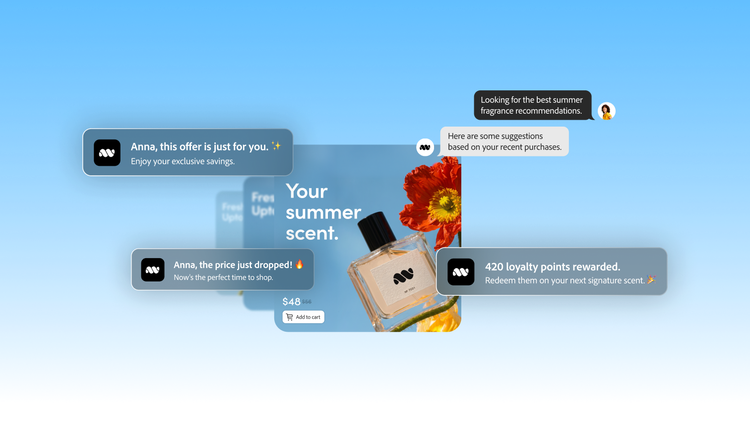
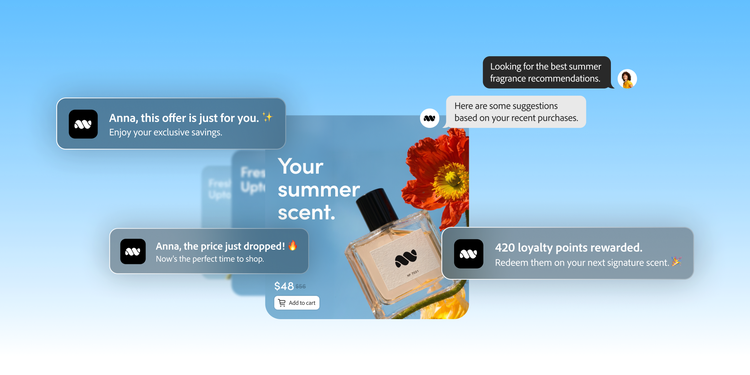
Adobe Brand Concierge supports this by helping brands better understand customer intent across searches, conversations, and browsing activity. Combined with Adobe CX Enterprise, brands can use those signals to deliver more personalized product recommendations, restock alerts, loyalty reminders, and price-drop notifications that feel useful instead of disruptive.

Order and delivery updates remain among the most effective ways to drive app engagement, as customers place a high value on timely communication and visibility after checkout, particularly when tracking purchases and staying informed throughout the delivery process.

Product Support Agent functions as an agentic AI assistant that helps brands keep customers informed after a purchase through order updates, support conversations, and issue resolution within the app itself. As part of Adobe CX Enterprise, it also gives brands more opportunities to stay connected with customers after checkout, helping them build trust and encourage ongoing app engagement over time.

Which AI features keep customers from deleting retail apps?

AI is becoming an increasingly important driver of retail app retention, particularly when it improves convenience, personalization, and post-purchase support. The data below explores the AI-powered features customers say would make them more likely to keep a retail app on their device over the long-term.

Chart showing AI features that influence retention: order tracking (65%) and loyalty tracking (57%). 42% more likely to add apps with AI support.

Customers are increasingly looking to AI-powered retail apps to improve convenience after the initial purchase, particularly when it comes to order management, loyalty tracking, and post-purchase support. The research found that the top in-app AI features customers say would increase retail app retention are order tracking and status updates (65%), loyalty points and rewards tracking (57%), instant returns processing (42%), tailored product comparisons (31%), personalized restock and sale alerts (28%), and automated customer support or troubleshooting (23%).

The findings suggest that customers no longer view AI as a novelty feature within the mobile shopping experience. Instead, they increasingly expect AI-powered support to reduce friction, simplify decision-making, and create more useful retail app experiences across the entire customer journey. Two in five customers (41%) said they would be more likely to add a retail app to their home screen if it offered built-in AI-powered post-purchase support, while 21% said those features would make them less likely to delete the app altogether.

Why AI matters in retail apps.

Customers are more likely to keep using retail apps when the experience continues to be useful after the initial purchase. Features like order tracking, returns support, loyalty tools, and personalized recommendations were among the most valued AI-powered capabilities, suggesting that convenience and ongoing relevance play a major role in long-term app engagement.

Customers increasingly want apps that can help them discover products, answer questions, and provide real-time support rather than forcing them to navigate menus or separate customer service channels.

Adobe Brand Concierge is designed to support this shift through conversational product discovery, personalized product recommendations, and intent-driven customer journeys. The research highlights the growing demand for AI-powered features such as tailored product comparisons, restock alerts, and loyalty tracking — all experiences that help customers move more confidently from discovery to purchase while improving engagement in ecommerce apps.

Post-purchase experiences have become incredibly important for retail app retention. Order tracking and delivery updates ranked as the most desired AI-powered features, while instant returns and automated support also ranked highly. Customers increasingly expect support experiences to be fast, proactive, and built directly into the app.

Product Support Agent helps brands deliver those experiences through AI-powered order management, returns handling, troubleshooting, and customer support within the retail app experience. As part of Adobe CX Enterprise, the solution helps brands extend engagement after checkout, turning post-purchase support into a meaningful customer retention strategy rather than a reactive service function.

Customers who receive ongoing utility through AI-powered support are more likely to keep retail apps on their home screen and less likely to delete them after the initial purchase. For enterprise brands, AI shopping assistants and enterprise AI chatbot experiences are becoming increasingly important for improving customer engagement and retention.

The AI-powered retail app experience.

The data shows a clear divide between the retail apps customers delete and the ones they keep returning to. Customers are not looking for more apps; they are raising the bar for the experiences worth keeping on their home screen, and increasingly, AI is becoming part of that expectation.

Features like order tracking, loyalty management, personalized product recommendations, and post-purchase support are quickly becoming standard parts of a strong mobile shopping experience. That creates an opportunity for brands to improve their app engagement strategy, retail app retention, repeat engagement, loyalty program performance, and the long-term value of every app install.

Brands also need to support the full customer journey, not just the transaction. Customers are more likely to stay engaged with retail apps that continue to provide value after checkout through personalized recommendations, order updates, loyalty perks, and accessible support.

Adobe Brand Concierge helps brands deliver conversational product discovery and personalized shopping experiences that improve ecommerce app engagement and mobile conversion. Product Support Agent,part of Adobe CX Enterprise,extends that experience after checkout through AI-powered order management, troubleshooting, returns, and support. Together, these tools help brands create connected customer experiences that strengthen retail customer loyalty long after the first purchase.

Methodology.

This article is informed by proprietary research conducted by Adobe. The study surveyed 1,000 consumers across the United States, providing a 95% confidence level with a ±3% margin of error. Respondents were asked about their retail app experiences, behaviors, and preferences. As with all self-reported data, the results may reflect personal perceptions and experiences rather than actual behaviors.

Learn how Adobe Brand Concierge helps brands improve retail app retention and loyalty.

FAQS

Let’s talk about what Adobe can do for your business.

Get started

I'm the Adobe Assistant. How can I help you today?

1