Scaling marketing campaigns by minimizing complexity.

Enterprise teams are expected to deliver exponentially more content across more channels with deeper personalization than ever before, yet budgets and resources often remain fixed. The solution requires changing how content moves from concept to customer.

As a result, marketing efficiency has become the defining metric for enterprise success. Enterprises that scale output share three key attributes: faster time-to-market, consistent experiences, and the agility to respond to market shifts in real time.

To deliver these outcomes, enterprise teams must move away from manual execution toward AI-powered orchestration. By modernizing the operational framework, you can multiply the impact of every team member and eliminate the friction that can limit growth.

This article explores:

Shifting from campaign execution to content orchestration.

Traditional marketing automation focuses on rule-based workflows for emails and lead handoffs. These systems are vital for journey execution. However, rule-based workflows were not designed to produce a lot of content that’s required for omnichannel personalization.

Content orchestration helps solve the hardest problem: how to consistently generate and adapt content at scale. Instead of manually creating every asset, an integrated system enables:

  • AI-assisted content creation: Generating copy, imagery, and video variations guided by specific brand rules and human oversight
  • Template-based design: Assembling experiences quickly using approved components rather than starting from scratch
  • Variant generation: Adapting a core concept for different audiences, markets, and channels instantly

Reducing reliance on manual processes can give teams time back for higher-value work. Rather than spending time on coordination and data transfers, marketers can focus on long-term growth while technology handles content at scale. To achieve this, marketing teams need a unified content lifecycle system that brings together every step from planning to launch.

Building a connected content lifecycle.

A content supply chain has become essential for understanding how content flows from planning to delivery. Just as manufacturing supply chains connect raw materials to finished products, content supply chains connect strategy to customer experience through content.

Most organizations struggle with disconnected content workflows. Creative teams work with one tool while campaign managers work with another, creating operational friction that stretches the production cycle. Content gets stuck in approval queues, assets are lost in scattered locations, and teams duplicate effort. These manual handoffs create friction that stalls your speed to market and erodes team morale.

This is where an integrated platform becomes essential. Adobe GenStudio addresses this by providing a unified environment that connects planning, creation, governance, and activation into a unified workflow. It enables the following:

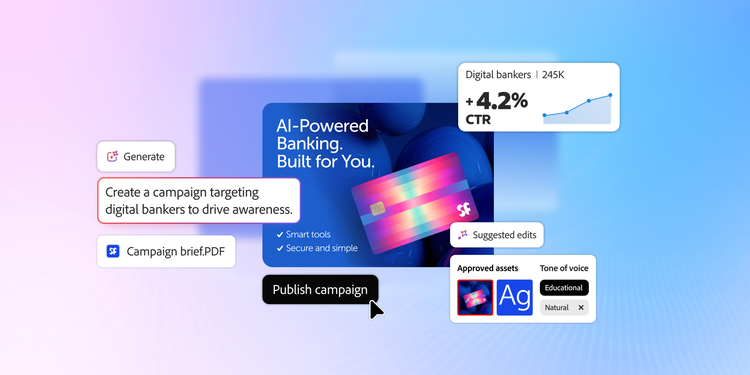
  • Efficiency gains: GenStudio connects campaign briefs, brand guidelines, and content production in one workspace. This means requirements feed directly into AI-assisted content creation, cutting out unnecessary handoffs and administrative work.
  • Quality and agility: Approved assets in GenStudio allow for usage rights, brand rules, and guardrails to be included in the creation process. Content can move from a designer’s concept or an AI-generated variation to a customer-facing channel quickly, allowing the brand to respond to market dynamics in real time without sacrificing quality or compliance.

With a connected content lifecycle, the next step is to put a practical framework around it so campaigns can scale consistently, not just occasionally.

How to build a scalable campaign framework in five steps.

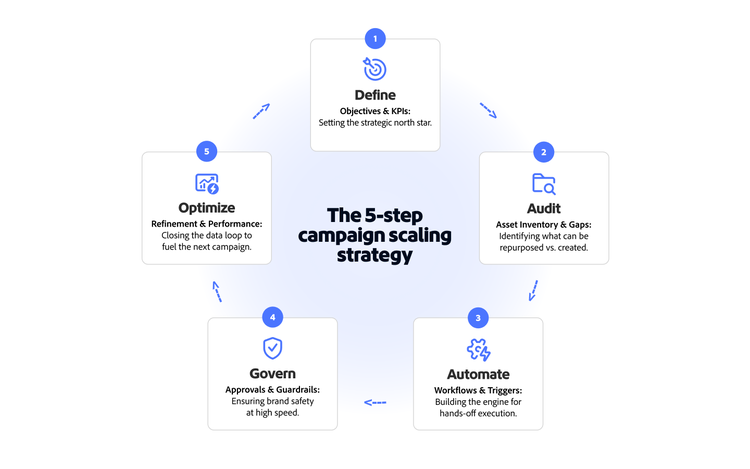
Scaling campaigns successfully means building processes that maintain quality as volume increases. The roadmap below shows enterprise teams how to achieve this.

Diagram illustrating the five-step framework for scaling marketing campaigns effectively.

1. Define campaign objectives and key performance indicators (KPIs).

Every scalable campaign starts with clear objectives tied to measurable outcomes. Vague goals like “increase awareness” make it impossible to prioritize efforts or evaluate success. Instead, specify targets such as “generate 500 marketing qualified leads (MQLs) from the financial services segment within 60 days.” This clarity guides every subsequent decision and enables meaningful optimization.

2. Establish content requirements and asset inventory.

Before creating new content, audit what already exists. Many organizations discover they have usable assets scattered across systems that could be repurposed or adapted. By mapping these existing resources against your campaign requirements, you can pinpoint specific content gaps, eliminating redundant production and significantly accelerating your time to launch.

3. Design AI-driven workflows.

Move beyond manual-first operations by designing workflows where AI does the repetitive work. Start with standardized briefs that flow into AI-assisted content creation tools, which can generate or adapt assets to match your brand standards. Establish tiered approval paths to keep quality high while preventing bottlenecks.

4. Implement governance and approval processes.

Scale requires structure. Establish clear approval workflows that maintain quality without creating bottlenecks. Define who must review which types of content and set service-level agreements (SLAs) for turnaround times. Consider tiered approval processes where minor variations follow expedited paths while significant changes require full review.

5. Configure optimization loops.

True scale requires measurement built in from the beginning. Start by tagging assets for attribution and setting up dashboards that show actionable insights, not just vanity metrics. When performance data is accessible to marketing, sales, and product teams, everyone shifts from “set-and-forget” thinking to continuous refinement. Balancing efficiency metrics with effectiveness outcomes ensures teams are launching content that works. Together, these five steps create a foundation for scalable campaigns, but the real impact comes when they’re supported by connected workflows.

Why connected workflows are the future of marketing scale.

Marketing teams are expected to deliver more relevant, personalized content across more channels without increasing costs. To scale marketing campaigns, you need to unify all campaign workflows — from planning through execution — to achieve orchestration.

A unified content lifecycle delivers personalized experiences without adding complexity to the teams who execute them. Teams stop managing individual workflows and start creating from a single source of truth, using shared templates and centralized data. With brand guidelines integrated from the start, you cut through the bottlenecks of manual reviews and get to market faster.

Connected workflows have the following benefits:

  • End-to-end connection: Campaigns move through one project management solution, rather than multiple solutions across stakeholders.
  • Operational efficiency with enterprise-grade guardrails: Role-based access, audit trails, approvals, and policy enforcement are built in, ensuring scale never comes at the cost of brand control or regulatory compliance.
  • Scale through orchestration, not just automation: Automation handles repetitive tasks, but orchestration coordinates people, content, data, and channels. This can help teams replicate successful marketing campaigns across regions, brands, and segments.

Connected workflows and content orchestration allow marketing leaders to do more with the teams they have. Each of the above benefits can be driven by connected workflows rather than disconnected platforms across marketing stakeholders.

Explore Adobe GenStudio and watch the overview video to discover how AI-powered orchestration can scale your marketing campaigns.

Let’s talk about what Adobe can do for your business.

Get started