The way marketing, creative, and IT teams work with AI to execute customer experience workflows is undergoing a fundamental shift, not an incremental one.
For the past few years, most AI interactions in enterprise software have followed a familiar Q&A pattern: you ask a question; the system gives you an answer, and it can also be prompted to perform single, isolated tasks with simple reasoning. Very useful, certainly, especially when the answer required pulling data from a lot of sources. However, these first-generation "assistant" interfaces are essentially tools — atomic, good at what they do, but dependent on constant human direction to move forward.
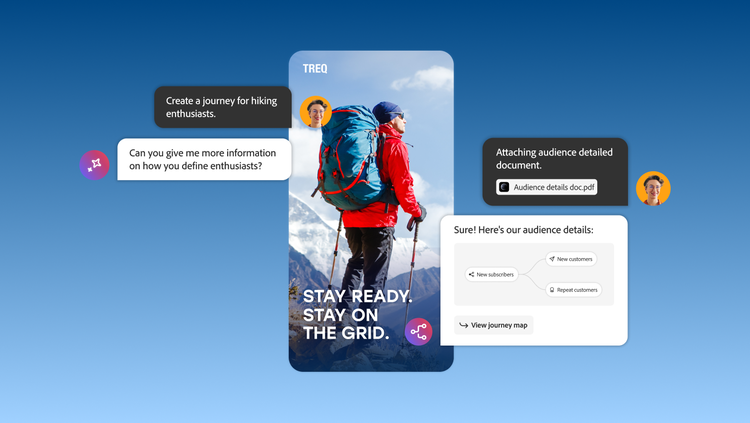
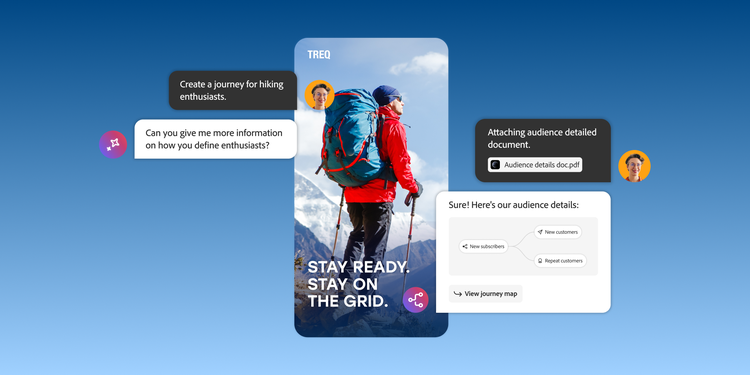
At Adobe Summit 2026, we announced how these early assistants are evolving to an AI coworker experience. Agents will soon no longer just respond, but reason, plan, execute, and iterate—making it possible to execute end-to-end workflows.
To enable this shift, Adobe is evolving its agentic architecture to support an open, scalable, and extensible agentic system that is interoperable with other agentic systems and tools. The technology enabling this shift has matured significantly, and the building blocks are now in place to soon support longer, more complex, real-world tasks across the enterprise.
This blog post offers a first look at how the latest AI industry trends and architecture are informing the evolution of Adobe’s AI technology framework for customer experience orchestration, why it matters, and what it means for enterprises leveraging Adobe CX Enterprise solutions.
The new building blocks of Adobe’s evolved agentic architecture for CX.
Three foundational components underpin this evolution to an open, extensible agentic system, and understanding them is key to understanding the big leap we are making.
1. More Capable LLMs. The large language models at the core of these systems have evolved substantially. A year ago, most LLMs were capable of answering questions or completing short tasks. Today, they're able to reason across multi-step workflows, recover from errors mid-task, and handle the kind of ambiguity that real business problems involve.
2. The Agent Harness. The harness is the architecture that wraps around the LLM and drives agentic behavior. The harness supports error recovery, maintains context across multiple tries, can delegate subtasks to other agents, and uses skill files to guide execution. It does this by operating in an iterative loop, starting with gaining context then moving to taking action, verifying the result, updating state, and repeating this process until the goal is reached.
This loop is what enables persistence — the ability to try things, learn what didn't work, and keep going until the task is done.
3. Skills (Markdown Files as Portable Context). Skills are how you tell agents how to behave. At the most basic level, skills are text files that provide guidance to the model — but in practice they are much more than that.
A skill is more accurately a folder of files (including scripts and structured guidance) that the agentic harness leverages to execute plans efficiently and understand how a task should be approached, what good output looks like, and how to validate results. Think of the PowerPoint skill, for example: it doesn't just tell the agent how to create a slide deck — it specifies design guidelines, acceptable colors, and a validation loop to check for font issues, overlapping elements, and other quality issues before the result is returned. Skills are treated as living code, expected to evolve as teams learn what works.
Together, these three components are the underpinnings of the agentic AI framework that Adobe has evolved to, moving from single-step AI interactions to sustained, goal-directed agent execution.
Benefits of the new agentic framework.
Together, these advancements don’t just enhance AI capabilities, they redefine how work gets done. The result is a new class of agentic systems that unlock meaningful benefits across customer experience workflows.
1. Deeper agentic reasoning
Agents can now handle longer, more complex end-to-end tasks autonomously, chaining actions, recovering from errors, and exploring options — without requiring constant human intervention. Under the new agentic framework, agents can dynamically load skills, run SQL queries against a knowledge graph, identify when a query returns incorrect results, self-correct, and continue until the task is complete — all without being re-instructed. Also rather than following rigid, predefined workflows, agents operate more dynamically in complex, real-world scenarios by exploring problems, building a plan, validating results, and trying alternatives.
For example, when met with an audience creation request, the appropriate agent can identify the task complexity, load the appropriate audience creation skills, run a parallel set of queries, catch a streaming configuration error, navigate structured and unstructured data regardless of how messy it is, switch to batch processing, confirm the audience schema, run an API call against the profile service to estimate reach, and present the result for human approval — all within a single, conversational thread.
2. Customizable skills
Adobe provides specialized Adobe Experience Platform Agents that work in context of CX Enterprise applications. This provides a starting point for customers to shorten time to value and start leveraging agentic AI natively in their CX workflows. While these pre-built capabilities will continue to exist, they will now be augmented with customizable skills to provide customers the ability to tailor agent behavior to their specific business needs.
The remarkable part is subject-matter experts can define how they want tasks like audience creation or journey activation to run without it feeling like a developer only experience. Skills are written in readable markdown, meaning they can be created, modified, and refined without code. The agentic system assembles them into structured definitions automatically.
This is a meaningful unlock for enterprise customers. No matter what industry they operate in, they can configure agents to reflect their own workflows, their own naming conventions, their own approval logic. The skills catalog acts as an enterprise-wide source of truth for AI capability — versioned, tested, and ready for deployment.
3. Contextual memory
A recurring frustration with current AI tools is having to re-explain your business every time you start a new session. What are your personas? What are your suppression rules? What does a good campaign look like for your brand? This rework erodes trust quickly.
Enterprises using CX Enterprise applications don’t have to start from scratch every time. The foundational business context — suppression rules already governing who should and shouldn't receive communications, data schemas, audience definitions built over months or years, campaign performance history, journey logic, consent records, and segmentation configurations — are already memorialized in these applications.
The new framework enhances this foundation even more by providing a hub for adding more contextual knowledge automatically, classifying it, and making it available to every agent in the system without requiring manual configuration each time.
When context changes — say, a persona definition is updated, or a new suppression rule is introduced — it doesn’t need to be hardcoded into a skill. Center of Excellence members can update it in one place, and every downstream agent inherits the new version instantly. The result is an agentic AI system that genuinely knows your business: one that doesn't need you to re-explain your brand rules, doesn’t misunderstand your ask, and gets more useful the longer it's been operating in your environment.
What's next
This is a first look at Adobe's evolved agentic framework for customer experience orchestration. The elements described here — the agentic harness, skills framework, and contextual memory layer — are early, and the rollout is underway.
There are many more details to unpack - how extensibility works across customer built and partner ecosystems, how the Center of Excellence manages governance and oversight at scale, and how the agent workflow builder enables deterministic multi-step orchestration with human-in-the-loop controls. Each of these deserves its own deep dive in subsequent blogs.
Taken together, these advancements mark a significant shift from AI as a reactive tool to AI as an active collaborator in customer experience workflows. Words only go so far so come see it for yourself at Adobe Summit 2026!
Horia Galatanu is a Senior Director of Product Management for Adobe Experience Platform, where he leads product strategy for artificial intelligence across Adobe's Experience Cloud portfolio. His current focus is on agentic AI — building the systems that allow AI to act autonomously on behalf of practitioners. Horia joined Adobe in 2007 and has shaped products across multiple generations of the platform, including Adobe Primetime, Adobe Campaign, and Adobe Journey Optimizer. He lives in the San Francisco Bay Area with his family and enjoys hiking, photography, and watching soccer.
Akintunde Ajayi is a Group product marketing manager for Adobe Experience Platform. He focuses on bringing innovative Customer Engagement and AI capabilities to market and driving awareness and adoption around Adobe’s Customer Experience Orchestration offerings. He has over 15 years of experience in consulting, systems integration, and product marketing. Akin joined Adobe in 2019 after obtaining his MBA from Kellogg School of Management at Northwestern University. Akin is a devoted husband, father of two, and an ardent fan of Liverpool FC soccer.