What is data governance? Frameworks, models, and how to implement it.
09-14-2026
Every organization collects data, but without a formal system for managing who owns it, who can access it, and how accurate it is, that data becomes a liability faster than it becomes an asset. Data governance is that system, and how well you design it determines whether your organization can trust the decisions it makes from data.
In this article:
- What is data governance?
- How does data governance differ from data management?
- What are the main data governance framework models?
- Who oversees data governance?
- How do you implement data governance?
- What are data governance best practices?
- What should data governance reporting cover?
- What should you look for in a data governance platform?
- Why do traditional data governance approaches fall short?
- How does Adobe Experience Platform approach data governance at scale?
- How do you connect data governance to business outcomes?
- Start building your data governance program
What is data governance?
Data governance is the set of policies, processes, roles, and standards that define how an organization manages its data assets. It covers quality, security, access, and accountability across the full data lifecycle from the moment a record is created or ingested to the point it is archived or deleted.
Three questions immediately anchor the concept:
- What data do we have?
- Who is responsible for it?
- How is its quality verified?
An organization that cannot answer all three is operating without governance.
A critical distinction: data governance is not software. It is a business discipline. Technology supports it, but a governance program lives in documented policies, assigned ownership, and enforced standards that persist regardless of which tools are in use. Buying a data catalog without defining who owns the data inside it does not constitute governance any more than buying a filing cabinet constitutes record-keeping.
The moment data governance becomes urgent is typically when something breaks. A compliance audit fails because no one can produce an access log. A marketing campaign runs on duplicate records and sends contradictory offers to the same customer. A regulator requests an audit trail that does not exist. Starting governance reactively after one of these events costs significantly more than starting it proactively, because the organization must simultaneously fix the immediate problem and build the program that should have prevented it.
Consider a concrete example: A retail organization discovers its customer records exist in three systems with three different definitions of ’active customer’. The loyalty platform counts anyone who made a purchase in the last 12 months. The CRM counts anyone with an open account. The email system counts anyone who clicked in the last 90 days. Governance resolves this by assigning a data owner for the customer domain, defining a single authoritative definition, and establishing a reconciliation process across systems so that every team works from the same trusted number.
How does data governance differ from data management?
Data management is the broad operational practice of collecting, storing, and processing data. Data governance is the authority layer on top of it: the rules, roles, and accountability structures that determine how data management is conducted.
A useful framing: Data management answers "how do we handle data?" while data governance answers "who decides, who is responsible, and what standards apply?" Governance without management produces policies no one can execute. Management without governance produces inconsistent, ungoverned outputs. The relationship between governance and data management functions is where policy meets pipelines, and organizations that treat them as a single concern tend to underinvest in one or the other.
For a mixed marketing and IT audience, the practical distinction works like this: A data engineer implements an ingestion pipeline (data management), but governance determines which data fields are classified as PII, who approved that classification, and what retention rule applies, both before and after the pipeline runs.
Data quality is a subset that sits within both governance and management. Governance defines the quality thresholds. Management implements the checks. The conflation of these three disciplines is a documented source of failed governance programs. Organizations invest in data management tooling while skipping the governance layer, then wonder why trust problems persist even after upgrading their infrastructure.
What are the main data governance framework models?
A data governance framework is the structural blueprint that defines how governance policies are organized, who holds authority, and how decisions are made across the organization. Choosing the wrong model for your organizational structure is one of the most common causes of governance programs stalling after launch, because the authority model conflicts with how the business actually operates.
Three widely adopted data governance models serve different organizational conditions:
Established reference frameworks provide the methodological foundation for any of these models:
- DAMA-DMBOK (Data Management Body of Knowledge) offers a body of knowledge covering all data management disciplines, including governance, and is the most widely referenced standard for defining governance scope.
- COBIT is an IT governance framework that addresses data as an enterprise asset, useful for organizations that need to align data governance with broader IT governance and risk management.
- Data mesh principles provide a sociotechnical approach that treats data as a distributed product, applicable when the decentralized model is the target.
None of these is a software purchase. Each is a methodology requiring organizational commitment.
When selecting a model, map your organizational conditions to the model's strengths: regulated industry with a single data team points to centralized; global enterprise with independent business units points to federated; technology-first company with distributed engineering points to decentralized.
Who oversees data governance?
Effective governance requires defined human accountability at three levels: strategic, operational, and technical. Without named owners at each level, policies remain documents rather than practices.
- A chief data officer or VP of data holds strategic accountability and program sponsorship. This role secures budget, sets governance priorities aligned with business strategy, and represents the program to executive leadership.
- A data governance council is a cross-functional committee of domain leads who ratify standards, resolve disputes between domains, and approve policy changes. The council should include both business and IT representatives to prevent governance from becoming a purely technical exercise.
- Data stewards are business-side owners responsible for the accuracy and fitness of specific data domains. A steward for the customer domain, for example, defines what "good" customer data looks like, resolves quality issues, and approves changes to data definitions.
- Data custodians are IT or engineering roles responsible for technical implementation of access controls, storage rules, encryption standards, and backup procedures. Custodians execute the technical requirements that stewards and the council define.
A common failure mode: governance is assigned to the IT team alone. This removes business context from policy decisions and results in technically compliant but operationally useless standards. For example, an IT-only governance team might classify all customer data as "restricted" to minimize risk, inadvertently blocking the marketing team from using consented email addresses for campaign targeting. The council model, with business and IT co-ownership, consistently outperforms single-function ownership because it balances risk management with operational utility.
How do you implement data governance?
Data governance implementation follows a phased sequence. Starting with every data domain simultaneously is the most common cause of program failure. Deliberately narrowing scope in phase one is a feature, not a compromise.
- Phase 1: Take inventory and prioritize. Catalog existing data assets, identify which domains carry the highest compliance risk or business value, and document current ownership gaps. Customer data and financial records are typical starting points because they carry both regulatory exposure and direct revenue impact.
- Phase 2: Define policies and standards. Establish data definitions (the single authoritative meaning of each key business term), classification tiers (public, internal, confidential, regulated), retention schedules, and quality thresholds. Each policy must name a responsible owner before publication. A policy without an owner is a suggestion.
- Phase 3: Assign roles and communicate. Stand up the governance council, appoint domain stewards, and publish a RACI matrix so every team understands where decisions live. Role clarity before tooling is the sequencing discipline most programs skip, and skipping it means technology investments solve the wrong problems.
- Phase 4: Implement technology controls. Apply access governance rules, automate data quality checks, integrate lineage tracking, and configure audit logging. Technology at this phase enforces policies already defined in writing. It does not substitute for them. Adobe Experience Platform, for example, the single system of truth for unifying analyzing and activating customer data in Adobe CX Enterprise, allows organizations to apply usage labels and enforcement policies at the schema level during this phase, so governance rules travel with the data through every downstream application.
- Phase 5: Measure, report, and iterate. Define governance KPIs (data quality score by domain, policy exception rate, access request resolution time), establish a data governance reporting cadence, and schedule quarterly policy reviews. Governance is a continuous program, not a one-time project. Programs that skip this phase cannot demonstrate value to leadership and lose funding within 18 months.
What are data governance best practices?
- Start with business outcomes, not data catalogs. Define what decisions the organization needs to make confidently, such as a single view of customer lifetime value, then govern backward from the data required to support that decision. Catalog-first programs frequently produce inventories no one uses because the catalog was not connected to a business question.
- Make data quality measurable from day one. Assign a quality score to each governed domain covering completeness, accuracy, and timeliness, and publish it. Visibility creates accountability. Abstract quality commitments like "we will improve data quality" produce no behavioral change.
- Embed governance into existing workflows rather than creating parallel approval processes. Governance that adds friction without removing risk will be bypassed. Teams adopt standards that save them time or protect them from blame. Design for both. For example, integrating quality validation into an existing data ingestion pipeline is more effective than requiring a separate governance review step after ingestion.
- Treat data access governance as a continuous control, not a one-time permission grant. Access rights should be reviewed on a defined cadence, quarterly for sensitive domains, and any expansion of access should require documented business justification. Stale access permissions are one of the most common findings in compliance audits.
- Document lineage for every critical data asset. Knowing where a number came from, including source system, transformation logic, and time of last refresh, is the difference between a trusted report and an arguable one. Lineage is the audit trail that makes governance defensible under regulatory scrutiny.
- Align governance policy reviews with regulatory change cycles. GDPR (General Data Protection Regulation), CCPA (California Consumer Privacy Act), HIPAA (Health Insurance Portability and Accountability Act), and sector-specific regulations update. Governance programs that review policies only at launch will drift out of compliance without realizing it. Build regulatory monitoring into the governance council's quarterly review agenda.
What should data governance reporting cover?
Data governance reporting is the mechanism by which a governance program demonstrates its value to leadership and identifies where enforcement is failing. Without a reporting layer, governance exists on paper but cannot prove it is working.
Four categories of governance metrics form the foundation of effective reporting:
- Data quality metrics. Completeness, accuracy, and timeliness scores per domain, tracked over time to show trend direction rather than point-in-time snapshots.
- Compliance metrics. Policy adherence rate, number of policy exceptions granted, and audit finding resolution time.
- Access and security metrics. Number of access requests processed, average approval time, and percentage of access rights reviewed on schedule.
- Stewardship metrics. Percentage of data assets with a named owner, open data quality issues by domain owner, and steward response time to escalated issues.
Reporting cadence should match the governance maturity of the organization. Early-stage programs benefit from monthly reviews that surface quick wins and early failures. Mature programs shift to quarterly strategic reviews with monthly operational dashboards for stewards.
A governance dashboard visible to both IT and business stakeholders is more effective than separate technical and executive reports. Unified visibility removes the translation layer that typically causes business leaders to discount governance as an IT concern.
Consider this example: an organization tracking "percentage of customer records with a verified email address" as a quality KPI sees the score drop from 94% to 87% in Q2. The dashboard surfaces the owner, the domain, and the ingestion pipeline responsible. Resolution time drops from weeks to days because the path to accountability is explicit rather than buried in a spreadsheet.
What should you look for in a data governance platform?
A data governance platform operationalizes the policies, roles, and standards defined in the governance program. The right platform reduces manual enforcement overhead and makes compliance auditable without requiring human review of every access event.
Core capabilities to evaluate:
- Automated data discovery and classification that finds and categorizes data assets without manual inventory.
- Policy enforcement at the data layer, not just at the application layer. Data usage policies describe the kinds of marketing actions that you are allowed to, or restricted from, performing on data.
- Lineage tracking across source systems, transformations, and consumption points.
- Role-based access controls with time-bound permissions.
- Audit logging that produces regulator-ready reports without custom engineering.
For organizations managing experience data across marketing, analytics, and customer service channels, governance must span the full data lifecycle, from consent collection and identity resolution through segmentation and activation. A platform that governs storage but not activation creates a compliance gap precisely where customer data is most exposed.
Adobe Experience Platform provides data governance capabilities built into the platform architecture rather than bolted on after the fact. Usage labels, policy enforcement, and consent management apply at the schema level, meaning governance rules travel with the data regardless of which downstream application consumes it. This architectural distinction matters for regulated organizations operating at scale, because it eliminates the gap between where governance is defined and where data is actually used.
Evaluation criteria mapped to organizational conditions: a single-cloud, low-regulation environment may find catalog and lineage tooling sufficient. A multi-cloud, multi-region, regulated industry should look for enforcement at the data layer, automated lineage, and consent-aware activation. Experience-data-first organizations managing real-time customer profiles should prioritize platforms where governance is native to the data model, not a wrapper around it.
Why do traditional data governance approaches fall short?
Traditional governance programs were designed for structured, on-premise data environments where data volumes were manageable, sources were countable, and update cycles were slow. None of those conditions apply to modern organizations managing real-time event streams, third-party data integrations, and cloud-distributed infrastructure.
Three documented failure patterns recur across industries:
- Policy-only governance. Detailed standards documents with no technical enforcement, resulting in adherence that depends entirely on individual behavior. When a data engineer is under deadline pressure, a policy PDF does not prevent a shortcut.
- Retrospective governance. Quality checks and compliance reviews that run after data has already been used in decisions, discovering problems too late to prevent harm. A campaign sent to customers who revoked consent cannot be unsent.
- Siloed governance. Separate governance programs per system or department, producing contradictory standards and duplicate ownership claims that create more confusion than they resolve.
The compliance cost of ungoverned data is not theoretical. Organizations subject to GDPR or CCPA that cannot demonstrate consent-aware data usage face per-violation fines. More commonly, the cost shows up as campaign waste from sending to unsubscribed customers, or as analytics paralysis from teams refusing to trust reports built on ungoverned data.
The shift to modern governance requires moving enforcement from the policy layer to the data layer: rules that apply to a data record regardless of which system is reading it, who requested access, or which downstream tool is consuming it.
How does Adobe Experience Platform approach data governance at scale?
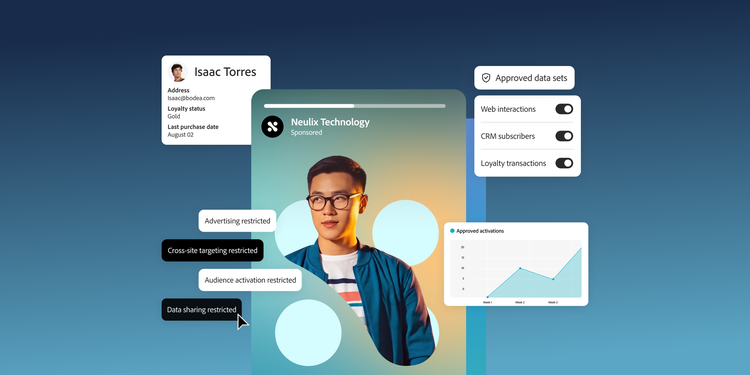
Adobe Experience Platform embeds data governance into the platform's core data model, including its underlying data lake, through a system of usage labels, data governance policies, and consent enforcement that apply at the schema and dataset level, not at the application level.
Usage labels classify data at ingestion. For example, a field with an out-of-the-box label "contains directly identifiable information" or a customer-label "restricted to a specific geography" carries those labels through every transformation, merge, and activation step. A data field labeled as consent-restricted cannot be activated to an advertising channel without a matching consent policy. The platform enforces this automatically through Adobe Privacy and Security Shield and Adobe Healthcare Shield.
For organizations managing customer journey data across Adobe Journey Optimizer, Adobe Customer Journey Analytics, and Adobe Real-Time CDP, governance rules defined in Adobe Experience Platform propagate across all connected applications without requiring separate policy configuration in each tool. This directly addresses the "siloed governance" failure mode: because governance lives in the data layer rather than the application layer, a policy change cascades to every downstream consumer simultaneously, reducing the policy drift that typically emerges when organizations govern applications individually.
- Use case, regulated financial services: A wealth management firm uses Adobe Experience Platform to manage client profiles across advisory, trading, and marketing touchpoints. Data access governance rules restrict marketing activation of trading-account data without explicit client consent. The enforcement is automatic. Compliance is auditable without manual review of each campaign.
- Use case, global retail: A multinational retailer uses geographic data usage labels in Adobe Experience Platform to prevent EU customer data from being processed in US-based analytics pipelines, satisfying data residency requirements under GDPR without engineering custom routing logic for each data flow.
How do you connect data governance to business outcomes?
Governance programs framed exclusively as compliance initiatives struggle to secure ongoing funding. Governance programs framed as business enablers, improving the accuracy of revenue forecasts, reducing campaign waste, accelerating regulatory approvals, attract sustained investment.
Three measurable business outcomes are directly attributable to effective governance:
- Faster time-to-insight. When data quality is trusted and lineage is documented, analysts spend less time validating source data and more time on analysis. Organizations that eliminate the "which number is right?" debate through governance consistently report shorter analytics cycle times.
- Reduced compliance cost. Automated policy enforcement replaces manual audit preparation, reducing the engineering and legal hours required per audit cycle. For organizations facing multiple audits per year, this reduction compounds.
- Improved customer trust. Consent-aware data activation and demonstrable data access governance reduce the risk of regulatory action and customer complaints related to unexpected data use.
Connecting governance to a customer data platform or journey orchestration tool creates a compounding return: every governed data asset becomes more usable for personalization, segmentation, and analytics, increasing the revenue contribution of data that was previously too risky to activate.
A decision framework helps prioritize governance investment based on primary risk. If the organization's primary risk is regulatory (GDPR, CCPA, HIPAA), prioritize access governance, consent management, and audit logging first. If the primary risk is data quality (analytics distrust, campaign waste), prioritize data quality scoring, stewardship roles, and lineage tracking. If the primary risk is speed (time-to-insight, self-service analytics blocked by governance bottlenecks), prioritize a federated governance model with automated quality gates rather than centralized approval workflows.
Frequently Asked Questions.
What is an example of data governance in practice?
What is the difference between a data governance framework and a data governance policy?
How long does it take to implement data governance?
What is the role of a data steward in a governance program?
How does data governance support regulatory compliance?
Start building your data governance program.
Use the implementation phases, model selection criteria, and best practices in this article to draft a one-page governance charter: named program sponsor, primary data domains in scope for phase one, target quality metrics, and first governance council meeting date. Organizations evaluating a data governance platform should map their top three governance risks (compliance, quality, or speed) to the capability checklist above before issuing an RFP, so vendor demonstrations do not define the evaluation criteria on the vendor's terms. Adobe Experience Platform is built for organizations that need governance to operate at the speed and scale of real-time customer data. Explore how its native governance architecture can reduce enforcement overhead and improve compliance confidence across your data ecosystem at Adobe Experience Platform.
Recommended for you
https://business.adobe.com/fragments/resources/cards/thank-you-collections/rtcdp