Today, people ask AI questions they might hesitate to type into a search box. They ask about difficult conversations, major decisions, and high-stakes purchases — and increasingly, they trust the answers they get. Consumers are doing the same thing when deciding whether to engage with a brand.
That means we have a new audience in the room, one that feels nothing but can absolutely influence whether your product is seen, surfaced, or considered.
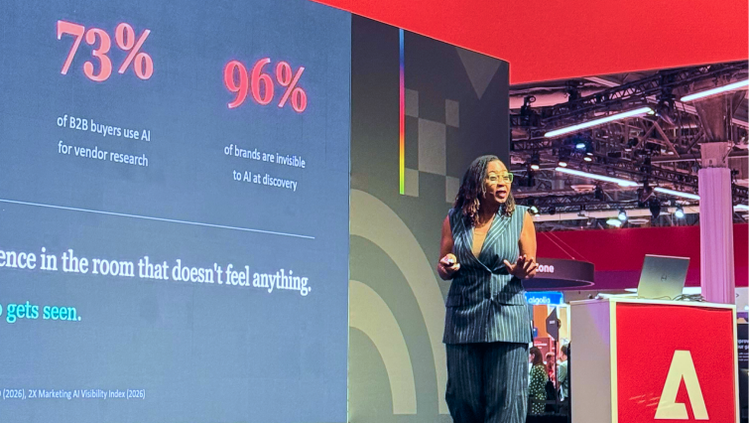
This year at Adobe Summit, conversations centered on how AI and agentic systems are reshaping decision-making — often before a human ever engages with a brand. In my session, I shared a few signals that make that shift impossible to ignore:
- 52% of consumers get answers from AI without clicking a link
- 73% of B2B buyers use AI for vendor research
- 96% of brands are effectively invisible to AI at discovery
* Sources: Position Digital (2025), Middle Georgia CEO (2026), 2X Marketing AI Invisibility Index (2026)
Together, these numbers point to a clear reality: Even the most thoughtfully crafted content may never enter the conversation if it isn’t surfaced by the systems shaping early decision-making.
That shift should change how marketers think about the journey. In my role leading marketing capabilities and development at Intuit, I’ve started asking a bigger question: What if this is not just a technology shift, but a fundamental craft shift? Across our teams, we’re rethinking how we create and scale content for both people and machines in a rapidly changing AI landscape.
Changing how the work gets done.
When marketers first encounter AI, the instinct is often to treat it as a tool. We consider which platform to adopt, which workflow to automate, or how quickly we can scale production. Those are all important factors, but they are not the most important ones.
What this moment really asks is whether our current ways of working still fit the journey ahead.
We cannot simply layer AI onto existing workflows and expect meaningful transformation. We can’t keep building and distributing content the same way when a new audience now sits at the center of the decision journey.
AI is reshaping the craft of connecting with customers. It forces us to rethink how work is orchestrated, how teams move from idea to execution, and how content is built for a more dynamic and nonlinear journey. The challenge is not just speed — it is alignment. We must make sure the way we create aligns with how decisions are now being shaped.
Breaking through to a new audience.
One of the most useful shifts for marketers is to stop thinking of AI as a black box and start thinking of it as an audience we need to reach. That starts by asking more practical questions: what is it evaluating, what is it validating, and how is it making decisions?
First, the machine wants to know whether it can verify the claim. Marketers commonly use strong language — like “industry leading,” “best in class,” or “trusted expert”— and while those phrases may still resonate with people, they mean little to a machine without proof behind them.
It’s also checking whether the broader internet agrees. Making a statement confidently on your own channel isn’t enough for a brand anymore. AI is seeking reinforcement from third-party sources, commentary, reviews, and other digital touchpoints.
And then there is the question of whether the machine can actually parse the data. Is the information structured clearly enough to be understood and used? This is the part I feel especially passionate about: What are customers saying about you on the channels you don’t control across Reddit, social platforms, forums, and reviews? Because AI is cross-referencing that data too.
That means the real test for marketers comes down to three things:
- Can the machine verify your claims?
- Does the broader internet reinforce them?
- Is your content structured clearly enough to be understood and trusted?
If the answer to any of these is unclear, that’s where the gap is.
The case for dual fluency.
None of this means storytelling is going away. Humans remember stories. They still respond to emotion, relevance, and trust.
The art of marketing remains essential because people still make decisions through feeling as much as logic. But machines are looking for something else: structure, consistency, and legibility.
That’s where dual fluency comes in. Dual fluency is the ability to create for humans and machines in the same breath. It’s understanding that stories are remembered, but structure is trusted. It is recognizing that resonance and rigor now have to work together.
For marketers, strategists, creatives, and agency partners, this is the real opportunity. Our work is not being replaced. It is being asked to do more. The bar is getting higher. Now, we have to account for how ideas travel across both human and machine interpretation. That is not a narrowing of the craft. It is an expansion of it.
What the next era demands.
Marketers still need the qualities that have always mattered — judgment, taste, strategic thinking, and a deep understanding of what matters to people. We still need to shape messages, build trust, and create work that resonates.
But now the job also asks for something more. It asks marketers to think more intentionally about structure, signals, systems, and how content holds up in environments they do not fully control.
That is a bigger job. But it is also a more interesting one.
The marketers who thrive in this next chapter will be the ones who can hold both realities at once — the human need for meaning and the machine need for clarity. The question is not whether the craft still matters. It does. The real question is whether we are willing to evolve it.
Explore more ideas from Adobe Summit on how AI is reshaping marketing, creativity, and customer experience.
Mos’ Okediji is a marketing transformation executive and director of marketing craft capabilities and development at Intuit, where she leads the craft strategies, AI-native workflows, and operating models that prepare marketing organizations for the future of work. With over 18 years spanning agency, CPG, and enterprise SaaS, she spends her time thinking deeply about how creative and GTM motions need to evolve to drive impact and velocity in an AI era.