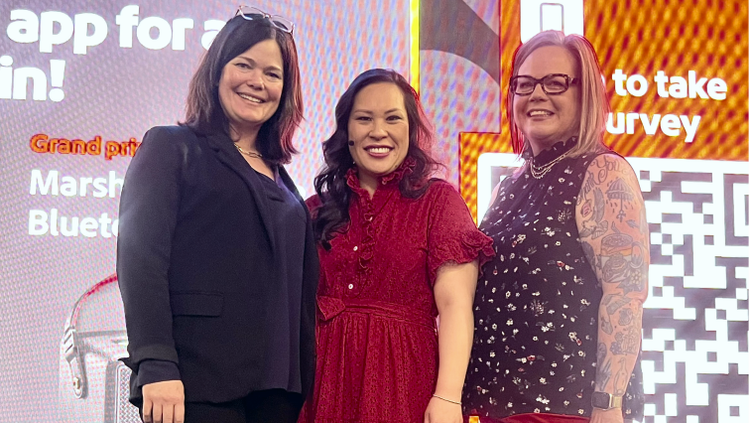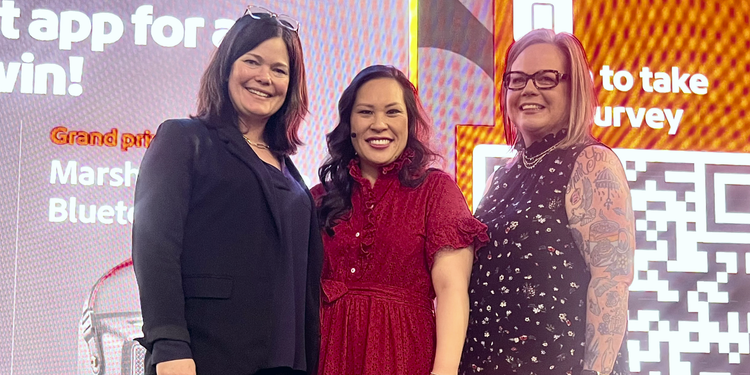
At my first Adobe Summit this year, I joined more than 14,000 marketers, creators, and technologists in Las Vegas. It's clear that marketing's biggest transformation is here — requiring a brand-new mindset and playbook for the agentic era.
As I shared on stage, in the era of agentic AI, we need to think of agents in three distinct ways. Agents as tools. Agents as teammates. And agents as a new target audience. This shift forces a complete reframe: How do we as marketers drive relevance with humans and agents? How do we drive both needed visibility with machines and meaning with humans?
Over two days of TED-style conversations, five accomplished leaders shared how they're navigating these shifts. I loved hearing the incredible potpourri of perspectives from leaders across industries, from tech to retail to sports and more. What stood out most wasn't just what they're building but how they're rethinking marketing strategy and operations itself.
Here's my take on what stood out most:
Ellie Taylor, Head of Marketing Integration and Creative Strategy, Best Buy
With more than 25 years in marketing, Ellie Taylor has seen constant evolution. But never this fast. "The past few years have been a crash course in change," she told the Summit audience, especially with AI models researching and comparing products, summarizing customer reviews, and making recommendations on what to buy for customers. "AI is now researching options, comparing products, and shaping the shortlist before a human even gets involved. And that changes everything."
Best Buy's response: Move faster without losing storytelling fundamentals. That starts with rethinking how work gets done (such as operating models, technology, and team workflows) to remove friction and accelerate execution.
But speed alone isn't enough. It requires sharper focus. As Ellie put it, teams need to be "diabolical" about prioritization, cutting through noise, narrowing messaging, and aligning around what actually moves the needle.
Crucially, the company doesn't just view AI as a tool to aid its efforts, but rather as a participant that can drive its transformation. "The question today isn't just how do we influence customers?" she said. "It's how do we influence the AI agents that influence them?"
In a rapidly shifting landscape, that means evolving creative to speak to both humans and algorithms, without losing what makes it resonate. Importantly for Ellie, this shift in mindset hasn't put creativity on the sidelines. "If anything, creativity is more important. We just have a new canvas and set of requirements to work with."
Takeaway: AI is no longer just part of the workflow; it's part of the decision-making process.
Action: Cut what doesn't move decisions forward and focus your messaging on what both customers and AI systems can clearly understand and act on.
Mos' Okediji, Marketing Director, Intuit
Mos' Okediji started with a simple truth: People are already trusting AI with decisions they wouldn't even Google.
And if that's how people are behaving, it raises a bigger question: What role is AI playing in how they discover and evaluate brands?
"There's a new audience in the room — one that feels nothing but has the power to decide whether your content is seen," Mos' told the Summit audience. That means even the most thoughtfully crafted campaign won't be part of the conversation if it isn't recognized, considered, and surfaced by AI agents.
For Mos', this is not just a technology problem. It's a craft problem. The requirement to speak to human audiences and AI agents has pushed Intuit to reconsider how work is orchestrated, how its teams move from ideas to execution, and how content is built to deliver more dynamic and relevant customer journeys. "The future of marketing calls for dual fluency," she said. "Stories are remembered, but structure is trusted." And in this new world, marketers need both.
Takeaway: In the AI era, storytelling and structure need to work together. Stories are remembered, but structure determines visibility and builds trust.
Action: Audit your content like a machine would. Is it structured, specific, and clear enough to be surfaced — or just compelling a human reader? It needs to be both.
Amit Khare, Director Marketing Technology, NFL
At the NFL, Amit Khare grounded the conversation around AI and brand relevance in something familiar: the fan experience.
Amit, recently awarded Adobe Experience Maker of the Year at Adobe Summit, walked through what happens behind a simple moment: a fan opening an app on game day and seeing exactly what they need to watch, where they are, and what matters to them.
Behind that moment is a massive volume of signals. AI helps interpret those signals, identifying where fans are, what they care about, and how they engage. But humans still decide what to do with the insights.
"We receive so many signals that they simply can't be managed by humans alone. We need AI to understand them," said Amit, whose team is leading the build of an AI-powered fan engagement platform that delivers these tailored experiences to NFL fans around the world, across every channel.
From audience building to content creation to delivery, AI drives scale and timing. But marketers shape the message and the emotional connection.
Takeaway: AI can help brands process signals and personalize experiences at scale, but human creativity and judgment remain essential to building emotional connection and trust.
Action: Use AI systems to interpret customer signals and orchestrate experiences more intelligently, while ensuring marketers remain intentional about the moments, stories, and connections they create.
Tracey Craft, VP of Content Marketing, SAP
According to Tracey Craft, AI agents are a new audience for marketers to connect with — but most brands aren't designing their content for them. And that's a mistake. AI doesn't scroll, click, or respond emotionally like a human, but it does decide what gets seen.
"By the time customers reach a brand, much of their decision has already been shaped by systems that gather, interpret, and summarize information on their behalf. That's what it means to influence upstream — AI's version of your content reaches your customer before yours does," Tracey explained.
That's why SAP is shifting from storytelling to "answer engineering," building content that signals credibility to AI systems and the agents increasingly surfacing information on behalf of customers. Strong patterns get surfaced. Weak ones get ignored.
According to Tracey, marketing is no longer just communication. It's the infrastructure for decision-making. "The best story will win humans over, and the best data will win machines over," she said. "To succeed in today's world, you need to win both."
Takeaway: It's no longer enough to persuade people — brands must also create content AI agents can interpret, trust, and surface confidently.
Action: Treat content as decision infrastructure. Build clear, structured, and trustworthy information that AI agents can surface confidently before customers ever reach your brand directly.
Jason Carmel, Global Lead for the Creative Technology Group, VML
Jason Carmel brought one of the most memorable moments of the sessions — drawing from his experience as a Dungeons & Dragons dungeon master.
His analogy was simple: There are two types of players. Those who care about the story. And those who care about the rules.
"It's a metaphor for how brands speak to the market today," he said. "Humans are emotionally driven. Agents are chaotically rational."
That tension is now the job.
Brands need to create work that resonates emotionally while also being structured enough for AI to interpret, validate, and act on. Story alone isn't enough. Structure alone isn't enough. It has to be both.
Jason pushed this further with a practical shift: Stop thinking in terms of one-off campaigns. Start building "Campaigns" with a capital C — connected systems of content that evolve over time and reinforce a single narrative.
Without that system, even strong ideas break down. "One thing is for sure," he cautioned. "Without an overarching storyline, you lose everyone."
Takeaway: If your content isn't built to be understood, it won't be surfaced — no matter how compelling the story is.
Action: Think in systems, not campaigns. Create connected content that reinforces a single narrative and can be interpreted consistently across channels and AI touchpoints.
The rules of brand visibility have changed.
What these leaders made clear is that the agentic era is not asking marketers to abandon what we know. It is asking us to expand how we think about audience, workflow, and trust.
At Adobe, we see agents emerging in three distinct ways: as tools, as teammates, and as a new target audience.
As tools, agents help marketers interpret signals, accelerate production, and orchestrate experiences at scale. As teammates, they change how work gets done across creative, content, data, and customer journey teams. And as a target audience, they require brands to build content and experiences that AI systems can understand, validate, and surface with confidence.
That is the strategic shift I heard across every conversation. The future of marketing will still depend on human creativity, emotion, and judgment. But it will also depend on whether our systems, stories, and data are structured clearly enough to earn trust in the moments before a customer ever reaches us directly.
There is no single playbook yet. But there is a clear starting point: stop treating AI as a separate workstream. Start asking where agents can help your teams work smarter, where they can collaborate inside existing workflows, and where your brand needs to become more discoverable, interpretable, and trusted.
The rules of brand visibility have changed. Learn how Adobe's acquisition of Semrush will help businesses build and expand their reach in an LLM-powered world.
Please also see customer bylined blogs on each of their sessions: Best Buy, Intuit, NFL, SAP, and VML.
As senior director of global enterprise marketing at Adobe, Ashley leads a global team of 100+ marketers, shaping narrative, content strategy, and operations for flagship campaigns, events, and experiences to help the world's most iconic brands thrive in the era of AI.
She's been called a storytelling wizard, insights queen, and the kind of magnetic leader whose energy doesn't just inspire — it delivers. With more than 15 years of experience across startups and global enterprises, including a decade at Google pioneering early AI launches, Ashley built a reputation for connecting people, turning complexity into clarity, and cultivating leaders and a culture the team is proud to be a part of.
Ashley began her career in storytelling at NBC, ABC, and The Coca-Cola Company, on-site during the 2008 Beijing Olympic Games. Passionate about building communities, she served as the global chair of the Asian Google Network and on The Coca-Cola Scholars Foundation Board, which has awarded more than $70 million in scholarships for deserving student leaders. She currently serves on the Board for Soles4Souls, a nonprofit that turns shoes into opportunities for millions of people around the world.