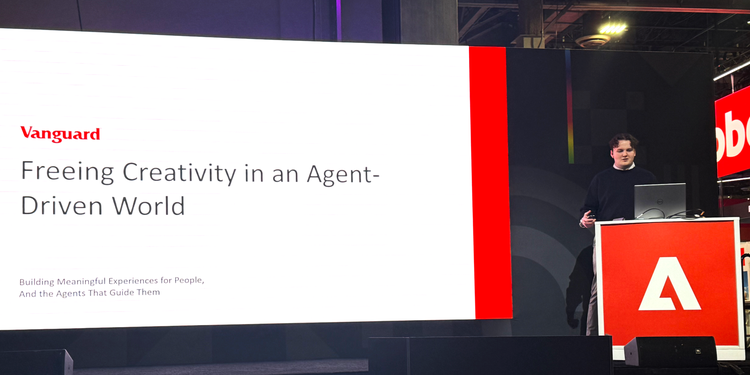
In my role leading creative technology at Vanguard, I spend a lot of time thinking about how discovery actually happens. And increasingly, it’s not happening the way brands expect.
People are no longer just searching. They’re asking AI agents to interpret, compare, summarize, and recommend options.
That changes the role of marketing entirely. Brands are no longer just persuading people. They’re influencing the systems helping people make decisions.
In this new world, brands don’t control discovery the way they once did. Customer-generated content like reviews, forums, conversations, and communities can carry more weight than what we publish ourselves. Winning brands won’t just persuade people — they’ll become trusted sources for the AI agents guiding their decisions. Expectations have shifted.
For years, marketing operated within a relatively stable system. We optimized for search engines, built backlinks, and created content designed to rank. Today, discovery happens across systems like Gemini, Claude, and ChatGPT, each pulling from different sources and interpreting information in different ways.
Brands no longer fully control the sources shaping discovery. AI systems increasingly surface information from Reddit, Quora, and other community platforms where people speak candidly and ask nuanced questions many enterprise brands were never built to answer directly.
And the questions themselves have changed. Instead of searching for “high yield savings account,” someone might ask, “I just graduated. I have a child on the way. I need access to my savings, but I also want it to grow. What should I do?”
That’s not a keyword. It’s a moment.
And increasingly, discovery depends on whether your brand can provide answers that match that level of nuance.
What still holds true.
For all this change, the fundamentals still matter. Three fundamentals continue to separate signal from noise:
- Customer experience still leads. When people trust your product, they talk about it. Those conversations are now part of how your brand is discovered.
- Trusted sources still win. Both humans and AI systems look for information that’s credible, consistent, and detailed enough to stand up to scrutiny.
- Clarity still converts. Structured, easy-to-understand content works better for both people and systems because it reduces friction.
The takeaway: Stop chasing algorithms. Start building answers worth finding, anywhere the question shows up.
Building for this new world.
So what are we doing at Vanguard to prepare? We’re connecting creativity, systems, and automation to do three things better: listen, respond, and stay human.
One way we’re doing that is by using AI systems to listen at scale. As we expanded into spaces like Reddit, we replaced assumptions with signals.
Using Adobe Workfront Fusion, we built an agent that pulls Reddit engagement data through APIs and compares those signals with strategy, creative direction, brand voice, and business priorities.
Within seconds, it generates content ideas grounded in real audience behavior and supported by cited reasoning. Strategists and creatives choose the direction, and AI helps optimize and create content based on what people have already shown they care about.
We’re also automating more business-as-usual work. My team’s goal is to automate what must exist so humans can focus on what matters most. By using Adobe’s generative AI capabilities and scaled production workflows, we can remove friction from the creation process, not to replace creativity, but to protect it.
Over the past year, we’ve achieved a 23% lift in capacity and a 20% reduction in production time. Looking ahead, our goal is to unlock another 40% efficiency gain. But this isn’t efficiency for its own sake. It’s time to return to humans so our creatives and strategists can think, connect, and create this new marketing reality.
Designing for memory and trust.
The impact shows up in the work.
When Vanguard made one of its largest fee cuts, we didn’t just publish an article or post on LinkedIn. We took over Union Station in Toronto and put that message directly in front of people during their morning commute.
That kind of work creates something that AI alone can’t do. It creates memory.
People talk about it. They share it. And those signals increasingly shape the environments AI systems learn from.
Another video campaign was recently recognized with a Webby nomination, reinforcing how memorable work generates signals that resonate across both human experiences and AI-mediated discovery environments.
The future of marketing isn’t humans versus machines. It’s systems designed for both — experiences that create emotional resonance for people while building trust with the systems shaping discovery.
The brands that succeed won’t just capture attention.
They’ll become the most trusted answer wherever the question gets asked.
Explore more ideas from Adobe Summit on how AI is reshaping discovery, trust, and marketing strategy in our full wrap-up blog.
Tyler Gage is a creative technology leader at Vanguard, where he leads AI-driven transformation of enterprise marketing technology. He focuses on designing marketing systems that balance human creativity with machine-readable, trusted intelligence across Adobe and enterprise martech platforms.