Improve geofencing marketing with AI-generated creative assets.

Geofencing marketing has transformed location-based advertising by helping brands reach the right audiences at the right places. As campaigns expand across cities, regions, and markets, however, the demand for location-specific creative assets is growing just as quickly. Marketing teams now face a new challenge — turning location intelligence into creative experiences that feel authentic and relevant to every market, store, venue, or neighborhood.

Generative AI helps marketers bridge this gap between precise audience targeting and scalable creative personalization. Instead of creating countless asset variations manually, teams can use AI to generate, adapt, and activate localized content faster while maintaining brand consistency. This article explores how organizations can combine geofencing marketing with AI-powered creative automation to make campaigns across markets and channels a success.

Jump to section:

What is geofencing marketing?

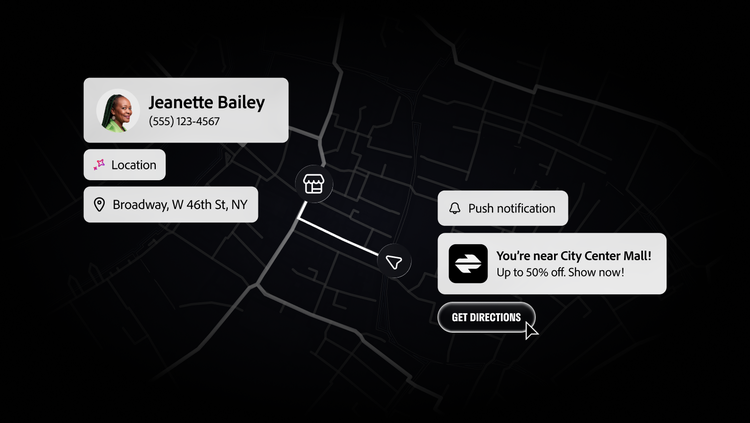
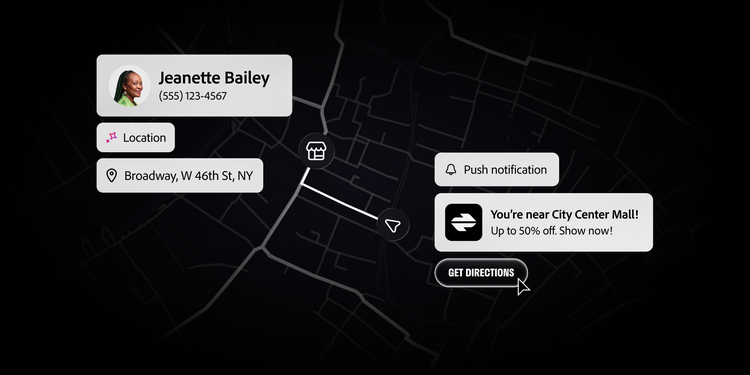
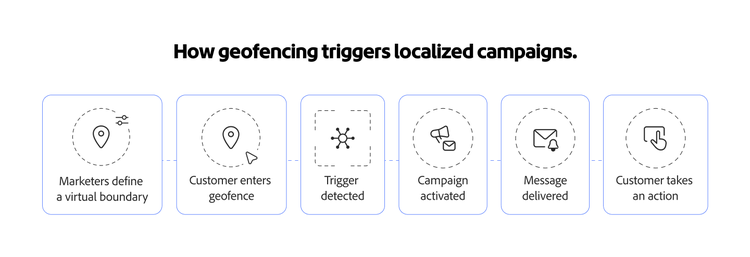
A flowchart showing how a virtual geofence triggers a campaign at the right time.

Geofencing marketing is a location-based marketing strategy that allows brands to trigger advertising, notifications, or other customer engagement actions when people enter or leave a defined area. To engage with this audience, brands create virtual boundaries around retail stores, event venues, restaurants, hotels, airports, and other points of interest. When customers enable location-sharing permissions on mobile devices and apps, technologies through GPS signals and Wi-Fi networks trigger geofencing ads.

Geofencing is often grouped with other location-based strategies. Each of them serves a different purpose:

Marketing approach
Action
Example
Geofencing
Triggers ads, notifications, or other marketing actions when a customer enters or exits a predefined location boundary.
A retailer sends a mobile offer when a shopper enters a mall or comes within a mile of a store.
Geo-targeting
Delivers content to audiences within a broader geographic area, such as a city, region, or ZIP code.
A restaurant shares a promotion with customers across a city or neighborhood.
Location-aware marketing
Uses location data and contextual signals to personalize experiences and messaging.
A hospitality brand sends custom-made regional promotions based on a traveler’s destination.

It’s important to note that organizations use these strategies in different ways depending on their goals. For example, an event organizer can use geofencing to activate sponsorship campaigns when attendees arrive at a venue. By connecting campaigns to a customer’s location and context, marketers can increase relevance and implement behavioral targeting.

Why traditional geofencing campaigns struggle to scale.

Creating location-specific campaigns at scale requires personalized creative assets to engage audience members. What begins as a single campaign can quickly turn into a complex network of market-specific messages, offers, and assets.

For example, a retailer running campaigns in multiple cities needs different offers, imagery, and messaging for each market. When promotions change or local events create new opportunities, teams must update creative assets, coordinate assets across paid media channels, and move content through multiple rounds of review and approval. Each update introduces additional production and operational work. When enterprises run campaigns at scale, this manual localization can delay execution significantly. Each new audience segment, location, or trigger adds another layer of creative requirements.

As these requirements grow, teams spend more time producing, reviewing, and managing assets. For many organizations, operational complexity is a bigger barrier to scaling geofencing campaigns than audience targeting. To scale creative production, marketers are using AI tools.

How generative AI changes location-based marketing.

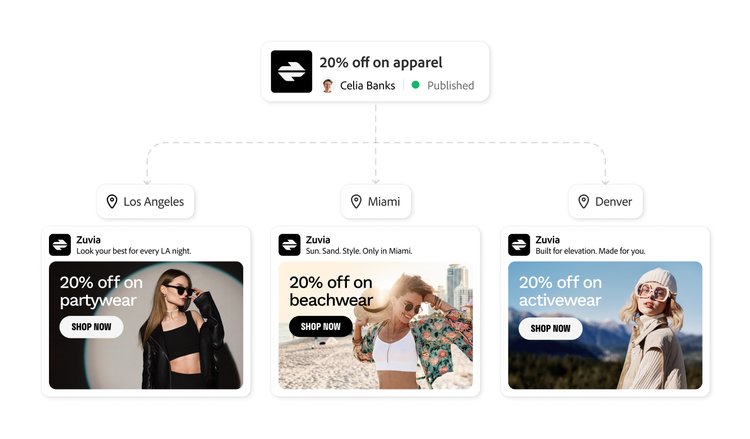
A visual showing how one campaign branches into customized ads to deliver location-specific content across cities.

Marketers no longer need to stick to one-size-fits-all campaigns. They can deliver dynamic, localized experiences. For generating ads across different locations, teams are using AI-generated content, including headlines, promotional messaging, CTAs, visual variations, and channel-specific formats. Instead of building every asset variation manually, marketers accelerate campaign execution with AI-powered content workflows. Generative AI helps create and adapt content based on audience context, geography, and campaign signals.

For example, a restaurant chain that runs ads across 30 locations could swap in each city's name and offer. Additionally, it could adjust imagery by region, such as patio shots for warmer markets, cozy indoor visuals for colder ones. They can also use AI creative automation to tailor messaging to local moments, like a late-night deal near a stadium on game day.

By automating these creative updates, teams can improve time to market, campaign responsiveness, content velocity, and personalization at scale.

Most importantly, generative AI does not replace marketing strategy. Marketers still define campaign goals, audiences, and positioning, while AI helps execute those decisions more efficiently at scale.

How geofencing and AI creative asset generation work together.

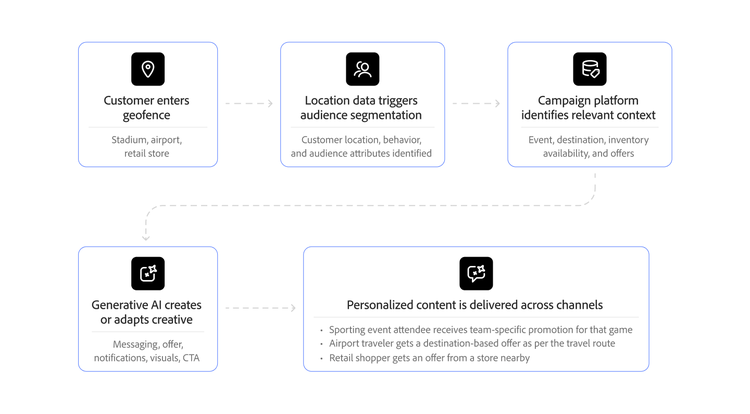
A flowchart showing how personalized content is created and delivered after a customer enters a geofence.

Geofencing marketing relies on a chain of signals — a customer enters a physical location, and the system decides how to respond. What's different now is what happens at the end of that chain. Instead of triggering a fixed ad, location signals can influence the creative direction for advertisements based on where the customer is and what's happening around them.

Relevance in creatives depends on three factors:

  • Audience proximity which tells you the customer is in range.
  • Behavioral context which tells you what's relevant to them at that moment.
  • Dynamic creative execution that includes turning a context into an asset the customer actually sees.

If you remove any one piece, the campaign can fall back to broad targeting with generic creative that reaches the wrong audience. Marketers can scale personalized campaign content faster with AI-assisted creative operations.

Building scalable geofencing marketing workflows.

To support geofencing campaigns across regions and channels, marketers need workflows that continuously connect audience data, content creation, and governance. Let’s look at the key components that help teams scale personalization while maintaining speed, efficiency, and brand consistency.

1. Connect audience and location data.

Effective geofencing campaigns start with audience intelligence. Marketers combine permission-based first-party customer data, behavioral insights, mobile engagement signals, and location data to understand not only where customers are but also how they engage with the brand. Real-time audience segmentation then helps teams organize customers into groups based on shared attributes, behaviors, or locations. For example, a customer visiting a retail district may receive different messaging than a customer entering a store location. By combining audience and location intelligence, teams can make targeting decisions with greater precision and deliver more relevant campaign experiences.

2. Automate creative production.

Once marketers identify audience segments, they need creatives to support them. AI creative automation helps teams generate campaign variations using modular creative systems, dynamic templates, AI-assisted copy generation, and automated asset resizing and formatting. It reduces manual production and makes it easier to scale campaigns across regions, channels, audience segments, and languages. Teams can adapt approved assets and messaging without rebuilding every variation from scratch.

3. Maintain brand consistency and governance.

As geofencing campaigns increase, marketers manage a growing volume of localized content. Brand guidelines, approved messaging, compliance reviews, and human approvals help teams maintain consistency across regions, channels, and audience segments. Automation speeds up production, but governance provides the structure needed to scale responsibly. Together, they allow teams to deliver personalized experiences while maintaining brand integrity.

4. Enterprise use cases for location-aware marketing.

From retail stores to event venues, organizations use geofencing advertising and generative creative to adapt campaigns to local context. The following use cases highlight common applications across industries.

Retail promotions: Retailers can trigger localized promotions when customers approach a store. Creatives can be adapted based on inventory availability, regional promotions, or seasonal events.

Event and venue marketing: Brands can personalize advertising for attendees at concerts, conferences, and sporting events. A stadium sponsor might promote team merchandise before a game, switch to food and beverage offers during the event, and update messaging as attendees move through the venue.

Hospitality and travel: Hospitality brands can adapt offers, imagery, and messaging based on traveler behavior and regional context. A hotel group might highlight beachfront experiences for travelers heading to Miami and ski packages for visitors traveling to Denver.

Restaurant and franchise marketing: Restaurant and franchise brands can customize offers by market, weather conditions, or local demand while maintaining brand consistency. For example, a quick-service restaurant might promote cold beverages during a heatwave and seasonal hot menu items in colder regions.

Dynamic out-of-home advertising: Marketers can update digital signage based on audience density, local events, time of day, weather conditions, or traffic patterns. A billboard near a stadium might promote pre-game offers before an event and switch to rideshare messaging as attendees leave.

This is how marketing teams are using AI-generated content and automation to localize campaigns without multiplying operational effort.

Governance and brand consistency in AI-generated advertising.

As organizations generate more AI-powered campaign variations, maintaining quality and consistency becomes important. Structured governance frameworks help teams enforce brand standards, manage compliance requirements, and maintain control across regions, channels, and audience segments.

Approval workflows: Teams route AI-generated assets through defined review and approval processes before publication. This helps stakeholders validate campaign accuracy and creative quality at scale.

Brand voice controls: Marketers establish approved messaging frameworks, tone-of-voice guidelines, and creative standard templates to keep content consistent across campaigns and markets.

Legal and compliance review: Legal and compliance teams review claims, offers, disclosures, and regulated content before campaigns go live, helping reduce risk across regions.

Regional content standards: Teams adapt creative to local market requirements, cultural expectations, and regional regulations while maintaining a consistent brand experience.

Version management: Marketers track creative updates, approved variations, and campaign changes across channels to maintain visibility and control.

Each of these guardrails helps reduce off-brand messaging, inconsistent creative, and compliance risk. As geofencing advertising scales across markets and audience segments, marketers need a balance of automation, governance, and human oversight to maintain brand integrity.

The future of location-aware marketing.

Customers receive hundreds of ads each day. The aim is to engage with them at the right time and place. This move from static geo-targeting to context-based customer experiences helps marketers use real-time decisioning to engage with customers where they are.

Rather than relying on predefined customer communication, teams now respond to live customer signals. Audience intelligence gives context behind those signals, creative orchestration aligns content with that context, and workflow automation helps scale those actions across channels.

As these capabilities mature, marketers are adapting the campaigns more quickly and delivering experiences that reflect customer intent even as it changes with time and location. The future of location-based marketing is not just targeting audiences based on where they are. It is dynamically adapting experiences based on context, intent, and behavior in real time.

From targeting location to creating intelligent customer experiences.
Reaching customers based on location with geofencing is now only one part of the marketing process. What teams do with that location signal increasingly determines the customer experience that follows. Audience context, scalable creative production with generative AI, campaign activation, and governance now need to work together as part of a connected workflow. Organizations that can connect these functions more effectively are now well-equipped to deliver relevant experiences across locations, channels, and customer segments.

For enterprise teams, this workflow requires connected systems for asset creation, review, activation, and measurement. A shared content supply chain can help marketers move from one-off asset production to governed, repeatable creation across regions and channels.

Adobe GenStudio helps marketing teams bring together AI-powered creative production, campaign variation generation, and workflow automation within a shared system. As location-aware marketing continues to transform, success will depend on an organization's ability to connect audience insights with scalable creative execution.

Let’s talk about what Adobe can do for your business.

Get started


I'm the Adobe Assistant. How can I help you today?

1