AEO vs. GEO: Differences and examples.

Adobe for Business Team

07-10-2026

The era of "10 blue links" is changing. Today, AI-generated responses appear prominently at the top of search results, delivering synthesized answers before users ever scroll to organic listings. As a result, brands must rethink how they become visible to potential customers.

For enterprises, this shift presents both challenges and opportunities. Visibility now depends on being cited in Google AI Overviews, Copilot Search in Bing, and platforms such as ChatGPT and Perplexity. Two nuanced strategies can help brands become visible in generative AI search engine features and AI search engines: answer engine optimization (AEO) and generative engine optimization (GEO). Understanding these strategies is essential for organizations seeking to maintain and grow their search presence.

This article will cover:

AEO vs. GEO: What's the difference?

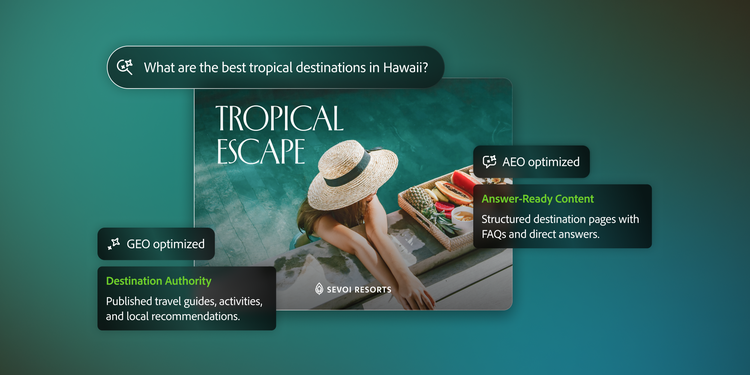
Answer engine optimization (AEO) is the practice of structuring content so search engines can extract and display it as a direct answer. Generative engine optimization (GEO) is the practice of creating content that large language models (LLMs) and AI search systems will reference, synthesize, and cite when generating responses. While both aim to increase visibility in AI-influenced search environments, they target different mechanisms and require distinct approaches.

AEO

AEO builds on traditional search engine optimization (SEO) principles. However, it prioritizes content formats that search engines can easily extract and display in answer-style search engine results page (SERP) features, such as featured snippets, People Also Ask (PAA) boxes, and AI overviews.

The goal of AEO is to ensure that a brand is cited in answers that appear without requiring a click. An effective AEO strategy relies on clear, structured answers prominently positioned within the content. Schema markup can help search engines better understand the content and context of a page, but the answer itself still needs to be clear, concise, and easy for crawlers to extract.

Success in AEO means your content is surfaced directly within search results. Users see your information, even if they never visit your site. For enterprises, this represents a significant opportunity to increase brand visibility during high-intent moments.

GEO

In AI-driven search experiences, responses are often synthesized from multiple sources rather than pulled from a single page. The goal is to create content that is clear, credible, and authoritative enough to be included in that synthesized response, sometimes with a citation to the source.

To succeed in GEO, your content must offer something distinctive enough to be referenced. This means providing original research, unique data, authoritative perspectives, and clearly stated claims supported by evidence. Content depth, context, and authority often matter more than brevity. Consistent brand and entity signals across owned and third-party sources can help AI search systems identify your organization as a distinct source connected to specific topics.

Success in GEO means being referenced or cited in AI-generated answers. Your brand becomes part of the synthesized response, positioned as a trusted authority on the topic.

AEO vs. GEO

Understanding AEO and GEO requires examining how each approach differs across critical dimensions.

Dimensions
AEO
GEO
Extraction vs. synthesis
Directly pulls and displays content.
Interprets and attributes content, along with other sources.
Search surface
Targets traditional SERP features, such as snippets and PAA boxes.
Targets AI-generated responses in AI search experiences and conversational interfaces.
Content structure
Uses short, structured, and answer-first formatting.
Uses long-form, insight-driven, and context-rich content.
Optimization approach
Relies on structure, formatting, concise answers, and relevant structured data.
Relies on authority, semantic depth, and originality.
Primary goal
Seeks visibility within search results.
Seeks inclusion in AI-generated answers.
Success metric
Measures snippet capture and zero-click visibility.
Measures citation frequency and share of voice in AI responses.

How AEO and GEO work together.

AEO and GEO do not negate each other. They work together as connected elements of an effective content strategy. While AEO ensures content is clear and structured enough to be extracted as a direct answer, GEO enables that content, or the broader ecosystem around it, to be credible, complete, and distinctive enough to be referenced in AI-generated responses.

The connection starts with structure. A page that is optimized for AEO provides search engines with a clear definition, a concise answer block, a descriptive heading, and supporting context. This structure makes the content easier to parse and understand. However, structure alone is not enough for GEO. To gain visibility in AI-generated responses, the content must also showcase signals of authority such as original research, an expert perspective, supporting evidence, depth of topical coverage, and consistent brand information.

For example, a page that defines AEO may capture visibility for a specific high-intent query if the definition is clear and easy to extract. The same page can also support GEO if it goes beyond the definition by explaining how AEO works, where it appears in search, how it differs from GEO, and why the brand is qualified to speak on the topic. AEO helps answer the immediate question, while GEO positions the brand as a trusted source for broader AI-generated explanations.

For enterprise teams, the opportunity is to build content that does both. Short, structured answer sections can support zero-click visibility, while deeper analysis, original insights, and strong entity signals can improve the chances of being referenced in AI-generated responses. Together, AEO and GEO help brands go from being found in search results to being understood, selected, and cited across different search experiences.

Examples: AEO, GEO, and hybrid approach.

Capturing a definition-focused query (AEO).

An enterprise martech vendor wants to improve visibility for the query "what is marketing automation." The company creates a dedicated page with a clear, concise definition positioned near the top of the page, immediately after the H1 (title). The definition uses simple language, answers the query directly, and is followed by supporting sections that explain how marketing automation works, common use cases, and related terms.

The page is structured with descriptive headings, a self-contained answer block, internal links to related resources, BreadcrumbList schema markup to allow users to navigate to previous sections of a site, and Article and FAQPage schema to give search engines additional context for the page.

Potential outcome: Search engines can more easily identify the page’s direct answer and supporting context, increasing its eligibility for answer-style SERP features such as featured snippets or PAA results. Thus, users searching for the query may see the company’s explanation prominently displayed, improving brand visibility even when the search does not lead to a click.

Earning AI citations (GEO).

A Fortune 500 analytics and insights enterprise wants to be recognized as a trusted source on e-commerce trends. Instead of publishing a general trends article that repeats information already available across the web, it creates a research-led report using proprietary data, expert analysis, and a clear methodology.

The report includes specific findings, context to help readers understand the data, and clear takeaways for enterprise marketing and commerce teams. Each claim is supported by evidence, making the content easier to evaluate, reference, and attribute.

Potential outcome: When AI-driven search experiences generate responses on e-commerce trends, the report is more likely to be cited as a supporting source because it offers original information and a clear point of view. The brand gains visibility not just by answering a query, but by contributing evidence that helps shape a detailed, synthesized response.

Hybrid optimization opportunity.

A global B2B software brand creates a comprehensive guide on data governance. The page opens with a concise definition of data governance that can stand alone as a direct answer. Below that, the guide expands into frameworks, implementation steps, expert commentary, common challenges, and examples tailored for enterprise teams.

The opening section supports AEO by making the core definition easy to extract. The deeper sections support GEO by providing more context, evidence, and an expert perspective to reference when answering complex questions about data governance strategy. This extra context and evidence improve the likelihood that a brand will be cited in AI-generated responses.

Potential outcome: The same asset can support different search behaviors. A user asking, "What is data governance?" may encounter the concise definition in an answer-style search result, while someone asking a more complex question about building a process to govern user data may encounter the brand within a broader AI-generated response. This approach enables the content to serve both immediate answer needs and more in-depth research journeys.

Why the E-E-A-T framework matters for AEO and GEO.

The Experience, Expertise, Authoritativeness, and Trustworthiness (E-E-A-T) framework helps search engines evaluate whether content is helpful, reliable, and created with users in mind. For AEO and GEO, these signals matter because both approaches depend on trust: search engines need confidence before surfacing a direct answer, and AI-generated responses are more likely to reference content that is clear, credible, and supported by evidence.

For AEO, E-E-A-T helps improve the quality of the extracted answer. A concise definition or answer block becomes more valuable when it appears on a page with clear authorship, accurate information, and relevant supporting context. For GEO, E-E-A-T helps establish why a brand should be referenced when AI-driven search experiences synthesize information from multiple sources.

The enterprise E-E-A-T checklist.

Use this E-E-A-T checklist to evaluate whether your content has the credibility signals needed to support direct answer visibility and AI-generated citations.

How to optimize existing content for AEO and GEO.

Once teams understand the difference between AEO and GEO, the next step is to evaluate whether existing content is built for both direct answer visibility and AI-generated citation opportunities. The goal is not to optimize every page in the same way, but to identify which pages should answer specific questions, which should build authority around broader topics, and which need stronger technical or entity signals.

Check whether the page can answer a direct question.

For AEO, start by identifying the primary question the page should answer. A strong page should include a clear, concise response near the top of the relevant section, supported by descriptive headings and surrounding context.

For example, a page targeting a "what is" query should provide a direct definition before expanding into use cases, benefits, examples, or related terms. The answer should be easy to understand on its own, while the rest of the page should help search engines understand the broader context.

Inspect whether the page adds value as a reference.

For GEO, evaluate whether the content adds something distinctive enough to be referenced in an AI-generated response. A page that only repeats common definitions may support AEO, but it is less likely to stand out as a source for broader, synthesized answers. Strengthen the page by adding original research, first-party data, expert commentary, clear methodology, examples, or a well-supported point of view.

Strengthen the technical foundation.

Both AEO and GEO approaches depend on content that can be easily found, crawled, rendered, and understood. Pages should load quickly by having a good Largest Contentful Paint score under 2.5 seconds. Pages should also use a clean HTML structure, include descriptive headings, and connect to related content through internal links.

Relevant structured data can also help clarify the content and context of a page, but it should enhance the page experience rather than replace clear writing. Focus on implementing accurate markup for Article, TechArticle, Organization, Product, or BreadcrumbList schema. Additionally, although FAQPage schema is no longer supported by Google, it is still valuable to include if a page has an FAQ section.

Reinforce topic and entity signals.

Visibility does not solely depend on the content of a page. Internal links, related resources, updated content, and consistent brand/entity information help strengthen the relationship between the page, the topic, and the organization behind it.

For AEO, these signals help search engines understand where a page fits within the broader site. For GEO, they help AI-driven search experiences recognize the brand as a credible source connected to the topic.

Adapting your search strategy for AEO and GEO.

As certain search experiences are answer-driven and AI-generated, enterprise visibility doesn’t depend solely on rankings. SEO still plays a critical role in helping content get discovered, but AEO and GEO determine whether that content is clear enough to be selected as an answer and credible enough to be referenced as a source.

Together, AEO and GEO provide teams with a practical way to adapt existing content strategies without having to start from scratch. The most effective approach is not to create separate workflows for each discipline, but to build a connected content process where direct answers, deeper expertise, technical clarity, and consistent entity signals reinforce one another.

For enterprise brands, this shift changes what it means to be visible. The goal is not only to earn a click, but to be seen, understood, and cited at the moments when customers are forming opinions and making decisions.

Turn search visibility into brand visibility with Adobe for Business by identifying where your brand appears and how to strengthen your presence across AI-generated answers.

https://business.adobe.com/fragments/resources/cards/thank-you-collections/generative-ai