How to scale content governance across enterprise production

How to scale content governance across enterprise production.

Enterprise content demand continues to grow as campaigns expand across channels, formats, markets, and languages. AI helps teams meet those demands, with 76% of 3,000 surveyed executives and practitioners reporting that generative AI has improved the volume and speed of content ideation and production. Faster production also expands the scope of what teams need to govern. As a result, what begins as a productivity gain can quickly become a bottleneck.

An increase in content output using generative and agentic AI translates into more systems and decisions involved in producing each asset. Moreover, enterprise content creation is also often spread across internal creative teams, regional stakeholders, agencies, and external partners. When assets move through multiple, disparate tools and workflows, maintaining consistent brand standards and accountability becomes increasingly difficult. This added complexity can strain the review and governance processes, slowing delivery.

Addressing these challenges calls for a scalable content governance model that embeds brand standards, controls, and accountability directly into high-volume production workflows. This article explores how enterprise teams can build such a model, evaluate its impact, and strengthen it over time.

JUMP TO SECTION:

What is content governance at scale?

Content governance is a framework of policies, processes, standards, permissions, and controls that governs how content is created, reviewed, approved, published, and maintained. When applied at scale, it helps enterprises maintain consistent oversight as content volumes grow, contributors increase, and production expands across markets. It turns governance principles into operational controls within the workflows, reducing late-stage corrections. As a result, instead of relying on reviewers to catch issues after content is produced, teams and systems can create high-quality, brand-aligned content from the start.

A scalable governance model can also increase production speed and capacity by clearly defining boundaries and standardizing approval pathways. When teams have clear accountability and a shared understanding of standard practices, they spend less time navigating handoffs or resolving ambiguity, and more time doing strategic work.

While such frameworks can extend seamlessly across the enterprise, human judgment continues to play an essential role. People remain responsible for setting policies, defining acceptable use, approving exceptions, and overseeing high-impact decisions.

Why traditional governance breaks down as content scales.

Traditional governance models are primarily designed for smaller, centralized operations, and often struggle to scale. They typically rely on manual coordination, institutional knowledge, and a small group of experienced reviewers. However, as content production becomes more distributed and complex, with new teams, markets, agencies, and AI tools joining the production process, these models can lead to:

  • Inconsistent application of standards. Teams may interpret the same guideline differently or work from outdated versions.
  • Unclear ownership and decision-making. A lack of clarity about who approves exceptions, such as a deviation from standard guidelines or an off-template layout, can stall decisions.
  • Review bottlenecks. Low-risk updates and high-impact deliverables often sit in the same review queue, whether it’s a minor banner resize or a promotional deck approval, diminishing the initial speed gains.
  • Duplicate or unauthorized source material. Teams or AI models may draw on outdated sources, unlicensed assets, or unapproved claims.
  • Limited visibility. Reviewers may lack insight into how a piece of content was produced, which inputs shaped it, or where AI played a role.

To put this into perspective, consider a retailer with a governance model built for a single store chain. The model includes an in-house review team, a spreadsheet of brand guidelines, and a few AI-assisted editing tools. It works because the team is small, reviewers understand the brand, and content volume remains manageable.

Now picture the same retailer operating five chains across a dozen markets, working with three agencies and a growing set of production tools. A model designed for one chain may not be effective in ensuring consistent brand standards across all stores. Adding more manual reviews rarely resolves these challenges, and applying the same level of oversight to every asset can create bottlenecks.

In this case, the retailer needs a governance model that can keep pace with content expansion across stores and markets. By embedding controls directly into the workflows, it ensures each asset adheres to the same standards for tone, visual identity, product descriptions, promotional terms, and regulatory compliance.

What are the core components of a scalable governance framework?

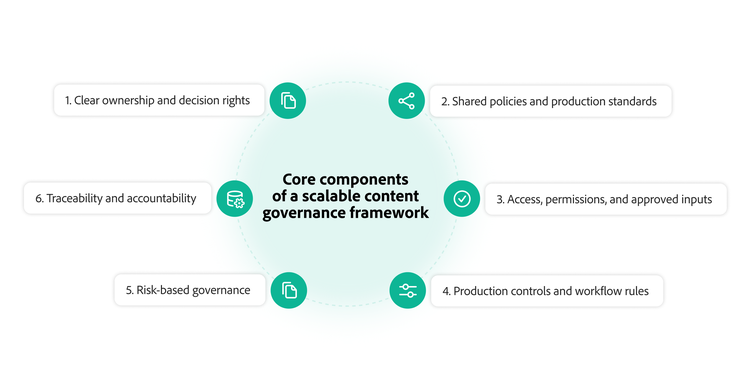
A scalable content governance framework defines clear accountability and applies controls consistently across production. Its six core components help establish who makes decisions, what standards apply, and how the system enforces those rules.

Six components of scalable content governance, including ownership, policies, access, production controls, risk-based governance, and traceability.

Clear ownership and decision rights.

Content ownership structures and decision rights help teams understand who owns policies, production standards, workflows, and exceptions. This requires distinguishing roles that are often grouped together, such as:

  • Content creators produce assets within defined standards.
  • Reviewers check work against those standards.
  • Subject-matter experts weigh in on specialized areas such as legal, medical, or financial claims.
  • Administrators manage tools, access, and system configuration.
  • Governance owners set the rules, maintain them, and are accountable for outcomes.

This clarity helps reduce delays often caused by uncertain approval pathways. Routine decisions stay with the teams closest to the work, while exceptions are routed to the people responsible for them. For example, a regional producer may independently select approved layouts, while a request to change a disclaimer goes to its designated owner in the legal department.

Shared policies and production standards.

Policies and standards translate various brand, legal, accessibility, security, and market requirements into practical guidance that teams can apply during production. While policies establish expectations, production standards define how those expectations should be implemented. For example, a policy may state that content should be accessible, while a production standard requires captions for every video and alt text for every image.

Clear production standards also reduce interpretation and rework. When requirements vary across content type, channel, market, audience, and use case, standards make those differences explicit for teams.

Access, permissions, and approved inputs.

Access and permissions determine who can use specific tools, assets, templates, data sources, models, and production environments. Approved inputs define which resources teams are permitted to use for a particular brand, market, channel, or task.

For example, an asset may be approved for one campaign or region but restricted in another because of licensing terms, expiration dates, or local requirements. Clearly defining these boundaries helps prevent governance issues, such as the use of expired assets, unapproved claims, or unauthorized data sources.

Controlled access and approved inputs also help minimize the number of issues that reviewers need to identify and correct later in the process. These guardrails become especially important in AI-assisted workflows, where teams and systems need stronger guidance.

Production controls and workflow rules.

Controls establish content requirements and specifications within the production environment, while workflow rules determine how content moves through each stage. They help teams apply governance consistently across the content lifecycle, and commonly include:

  • Required fields. Capture information such as ownership, usage rights, approval status, and expiration dates.
  • Locked templates. Protect approved brand elements while allowing teams to adapt designated content fields.
  • Routing conditions. Direct content to the appropriate workflow based on factors such as market, channel, or risk.
  • Validation checks. Confirm that required information is available and that production standards are met before content progresses.

These controls support enterprise-scale production by automatically enforcing routine standards, allowing reviewers to focus on decisions that require judgment. For example, a system can verify that a disclaimer is included or that an asset is tagged for the appropriate market. Human reviewers remain responsible for assessing whether a campaign concept aligns with business objectives and brand values.

Risk-based governance.

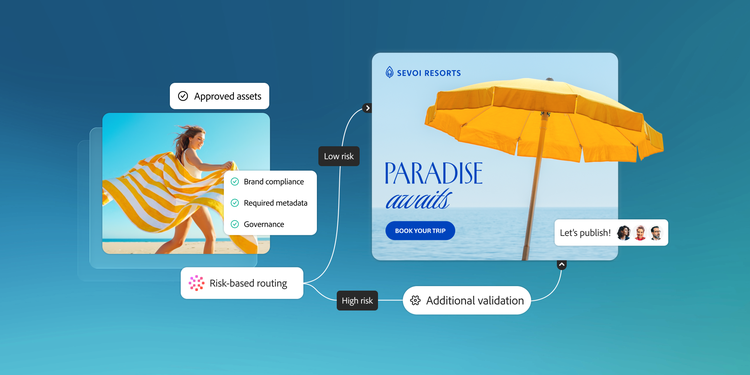
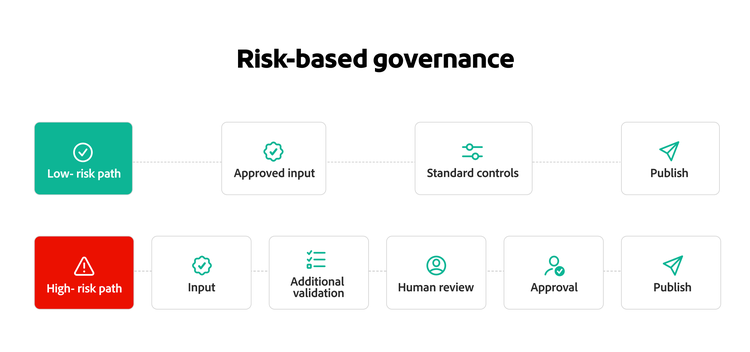
Risk-based governance applies oversight based on the characteristics and potential risk of each asset. Rather than treating all content equally, it aligns review requirements with the level of exposure and potential impact. Factors such as content type, channel, market and regulatory exposure, rights associated with source material, AI usage, and overall business or reputational risk can influence the level of review required.

This approach helps enterprises maintain control without introducing unnecessary friction into every workflow. It also helps focus human oversight where it adds the most value. For example, an asset built from an approved template may require minimal oversight, while a new campaign in a regulated market may require a thorough review by legal or other subject-matter experts.

Governance workflow showing standard checks for low-risk and high-risk assets.

Traceability and accountability.

Traceability and accountability provide a clear record of how content was created. Teams can find out which inputs informed a piece of content, the stakeholders who contributed to its production, the specific workflow it followed, and where exceptions occurred. In AI-assisted workflows, this record can also show where AI was used and where human intervention took place.

Traceability also helps enterprise teams troubleshoot issues quickly and establish clear accountability. When a problem arises, teams can identify its source, understand how it occurred, and address the root cause. Additionally, it supports auditability in regulated industries and provides governance owners with the insights needed to refine policies, standards, and controls over time.

Together, these components create a governance framework that can scale with content production more efficiently. They help enterprises maintain brand consistency, reduce late-stage corrections, and direct oversight where it matters most.

How to embed governance into content production workflows.

Governance can be embedded directly into enterprise content workflows. Rather than relying on final review, teams can place controls at the points where production decisions are made. This approach helps reduce delays and revisions by allowing teams to address requirements as they work. Embedded governance becomes even more important in AI-assisted workflows, ensuring output remains within approved boundaries.

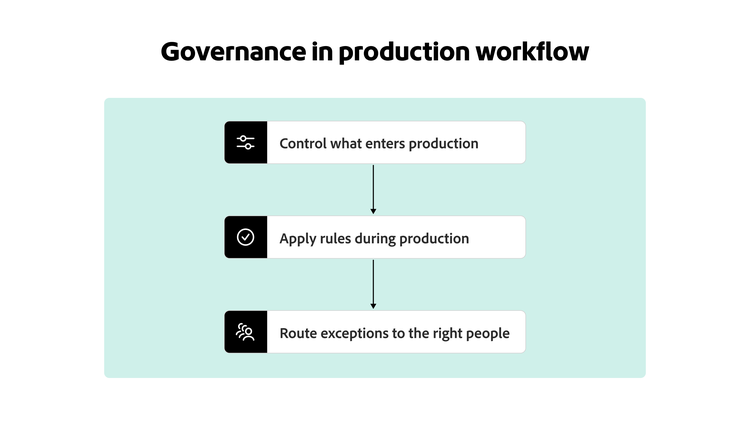
Here are the three steps to operationalize it:

Three-stage framework showing how to embed content governance into production workflows.

1. Control what enters production.

Define approved resources and content specifications that teams and systems can work with during production. These inputs may include templates, source assets, data, AI models, claims, and tools. Permissions and access requirements help prevent the use of unapproved resources from the outset.

Teams should also capture key context early in the process. Information such as the campaign, market, channel, or content type helps workflows automatically select the appropriate inputs.

Example: A cosmetics brand's project brief captures the target market and channel before work begins. When a team selects the EU market, the workflow provides only approved product claims and licensed assets that meet regional requirements.

2. Apply rules during production.

Once the approved inputs are in place, the focus shifts to guiding content creation. Structured workflows, required metadata, production standards, and automated validation help teams and systems adhere to rules and requirements.

Agentic AI can support routine governance checks within the workflow by validating content against established policies, identifying potential compliance issues, escalating exceptions for human teams to review, and documenting decisions for future reference.

Example: An automotive brand allows regional teams to generate localized asset variations with an approved AI model. The workflow ensures mandatory disclosures and approved templates are used throughout production.

3. Route exceptions to the right people.

During the production of higher-risk content, workflows should route content to the appropriate experts for review. Reviewers can apply nuanced judgment, such as assessing whether a claim could mislead consumers or whether content complies with local regulations.

Reviewers should have the authority, information, and guidance needed to make timely decisions. Additionally, recording each decision and its rationale provides a reliable reference for similar situations, helping teams make more consistent decisions over time.

Example: A beverage brand’s content workflow routes new health-related claims and assets intended for highly regulated markets to legal or compliance teams, rather than relying on routine checks.

Governance built into workflows helps maintain production momentum while ensuring that higher-risk decisions receive appropriate scrutiny. Its long-term effectiveness, however, depends on how consistently it is evaluated and refined.

How to evaluate the efficiency of a governance framework.

Teams can evaluate the efficiency of a content governance model by tracking a combination of metrics. They help identify where the model is performing well and where processes or controls may need improvement.

Governance metric
What it highlights
How it can help
Workflow adherence
Percentage of content that follows required governance processes
Identifies adoption and guidance gaps
Exception rate
Frequency of additional review or governance exceptions
Helps refine controls and escalation criteria
Governance-related rework
Revisions caused by missed or misapplied governance requirements
Reveals unclear standards, training gaps, and late controls
Resolution time
Time required to resolve governance-related issues
Identifies bottlenecks and improves exception routing
Recurring issues
Repeated violations, unapproved inputs, or other failures
Reveals systemic problems and recurring control gaps

Building content governance at scale.

Organizations that scale content governance successfully do not treat it as a separate step in the content lifecycle. Instead, it becomes part of how content moves from planning to publishing. When governance principles are embedded into everyday operations, teams can increase output while maintaining consistency across channels, regions, and teams.

Building that capability starts with a strong foundation of clear ownership, defined standards, and shared accountability. As content volumes grow, enterprises can introduce additional controls, tailoring oversight to different content types, workflows, and risk levels rather than applying the same approach everywhere. This helps enterprises meet growing demands while striking the right balance between speed, quality, and compliance.

Scaling governance is easier when enterprises can adjust planning, production, and oversight in a connected workflow. Explore how Adobe Content Supply Chain helps enterprise teams bring them together.

Let’s talk about what Adobe can do for your business.

Get started

New message from advisor