Travel and hospitality brands are rethinking how they connect with travelers as expectations for digital experiences continue to rise. From researching a destination and booking a trip to navigating an airport or responding to a change in plans, every stage of the journey creates demand for useful, relevant information.
This requires a steady stream of creative assets. Adobe research found that 71% of marketers expect content demand to increase at least fivefold by 2027, with 61% of marketers stating that consumer expectations for personalized experiences is the top factor driving this demand for content.
For travel brands, meeting that demand is not simply a matter of producing more assets. It means creating more relevant content, adapting it quickly to different moments in the journey, and doing so without sacrificing brand quality. Increasingly, that content also needs to work in new discovery environments as travelers turn to AI-powered services for information and recommendations.
Across Virgin Australia, MakeMyTrip, Auckland Airport, Seibu Railway, and Philippine Airlines, Adobe Express and Adobe Firefly are helping more employees create and adapt content within established brand guardrails. Professional creative teams remain central, but they can spend less time on repetitive production and more time on the work where their expertise adds the greatest value.
Make more room for creative thinking.
Growing content demand can quickly put pressure on a central creative team, particularly when designers spend time resizing, adapting, or making routine changes to existing assets.
At Virgin Australia, that pressure was being felt by a Creative Studio of just five people. Creative requests increased 44% quarter over quarter for six consecutive quarters, leaving designers with a backlog of more than 25 projects.
Instead of routing every request through the studio, the airline created branded templates in Adobe Express with locked elements and approved visuals, allowing marketers to produce many everyday assets themselves while working within clear brand guidelines.
Content volume increased across owned channels by 40%, while final campaign assets moved through production up to 40% faster. The Creative Studio also reclaimed approximately 40 hours each month for more strategic work.
“Small teams can do big things when they’re equipped with the right tools and empowered with the time to focus on high-impact, strategic work,” says Zubair Khatry, Creative Studio lead at Virgin Australia.
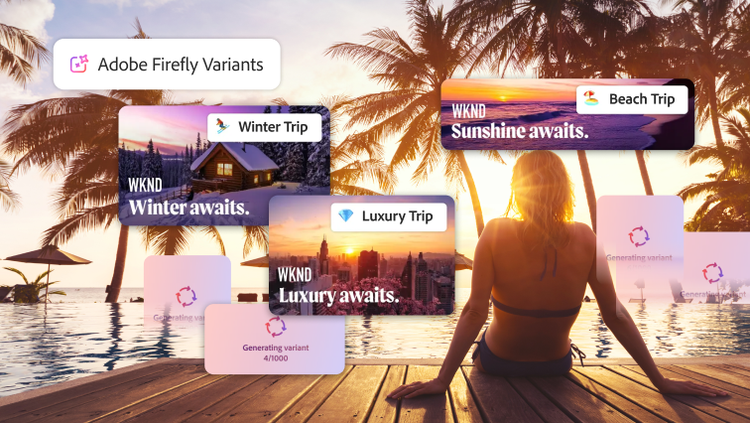
MakeMyTrip is also finding ways to give designers more room to focus on creative projects. Adobe Firefly helps designers generate variations across its brands, while the social team uses Adobe Express to resize and adapt approved content for different formats.
The goal is not to remove designers from the process. It is to move routine production closer to the people who need the asset while giving creative specialists more room for ideas, storytelling, and higher-value brand work.
Put content creation closer to the moment.
Travel businesses also must respond quickly when circumstances change. Weather or operational issues require immediate communications, making it valuable for the employees closest to the situation to create content themselves.
At Auckland Airport, reusable templates and AI-assisted content generation have helped reduce email production-to-delivery time by approximately 40%. Marketing managers also use Firefly to create supporting imagery without relying on designers for routine work. Digital channels manager Paloma Vivanco-Coutts sees some of the biggest AI opportunities from practical capabilities already appearing in everyday workflows.
“Look for AI-powered features in your favorite solutions and start incorporating them into their daily process,” she says. “Write subject lines, test out variations, and you will quickly see the results.”
This example illustrates how content creation is becoming less centralized, but creative governance is becoming more important.
Scale content while protecting the brand.
As content creation expands across teams and generative AI becomes part of creative workflows, travel brands need ways to increase speed without weakening consistency.
Adobe research found that nearly 7 in 10 creatives believe AI design tools help them generate more assets. As AI toolkits widen, the governance around them is strengthening. More than half of organizations have now established guidelines around approved design tools, which almost all creatives (94%) say they follow.
Virgin Australia uses approved templates and locked brand elements in Adobe Express to give marketers creative flexibility within established guidelines.
Seibu Railway is making content creation accessible to employees with different levels of creative experience through Adobe Express and Firefly while ensuring ethical and copyright compliance. Marketing employees now produce some promotional materials in-house, including a 15-second video advertisement for screens inside trains that was completed in approximately one week. Other employees use templates to create event posters, while engineering teams create videos explaining construction projects to local communities.
Shigeki Sato from Seibu Railway’s IT Systems Department explains, “With respect to AI tools, copyright issues were a major challenge for us. However, we confirmed that flyers, banners, logos, and other materials created using Adobe Express templates and assets could generally be used commercially without issues. That played a significant role in our decision.”
Philippine Airlines is exploring how generative AI can support its growing need for personalized content. The airline is experimenting with Adobe Firefly Custom Models to create airline-specific imagery for more tailored experiences while maintaining control over how its brand is represented.
That balance matters for Philippine Airlines, whose brand promise centers on “care that comes from the heart.” Technology can help its teams create more efficiently, but people still determine how that promise should look and feel for travelers.
Prepare content for a new kind of discovery.
The same focus on useful, accurate, and brand-consistent content is becoming important to how travelers discover information. One in four customers identify AI-powered platforms as a primary source when searching for information, making purchase decisions, or seeking recommendations.
For brands, that means the content challenge increasingly extends beyond their own websites, emails, and social channels. They also need to understand how AI systems represent them when answering traveler questions.
Emmanuel Cruz, assistant vice president of digital marketing at Philippine Airlines, saw the implications firsthand when he asked an AI assistant: “Can you tell me something about Philippine Airlines?”
The answer prompted a bigger question about how the airline is represented as travelers increasingly rely on AI-generated information. Philippine Airlines is exploring Adobe Brand Visibility to better understand and improve how it appears in AI-powered discovery experiences.
“Brand visibility takes on a different meaning in an AI environment,” says Cruz. “Adobe AI technology will help us show up in a way that accurately reflects who we are and what we offer.”
AI-powered discovery may be an emerging part of the travel journey, but it reinforces the same principle driving changes in creative production: quality and consistency matter wherever content appears.
Build creative capacity for the journey ahead.
Travel content now has to work harder and in more places than ever. It supports travelers throughout their journey, adapts to changing expectations, and increasingly shapes how brands appear in AI-powered experiences.
Adobe is helping travel brands respond to this change with a distributed approach where more people can contribute, creative professionals can focus on the work that most needs their expertise, and brands can respond faster without losing the identity travelers recognize and trust.
As expectations continue to rise, greater creative capacity becomes a customer experience advantage, helping travel organizations deliver more relevant content for the journey, wherever it begins.
Recommended for you
https://business.adobe.com/fragments/resources/cards/thank-you-collections/travel-hospitality