
Brand guidelines can document how a brand should look and sound, but they cannot capture each judgment that teams make when applying those standards in practice. Applying those standards still requires teams to make judgment calls based on the specific circumstances surrounding the work.
Decision traces preserve that context, so individual judgment calls or choices can be recorded and become reusable brand knowledge. They capture how teams interpret and apply brand standards in real situations, helping organizations retain expertise that might otherwise remain with individuals or scattered across review workflows. As part of a broader brand intelligence foundation, decision traces help accumulated expertise inform future brand decisions.
In this article, you will learn:
What are decision traces?
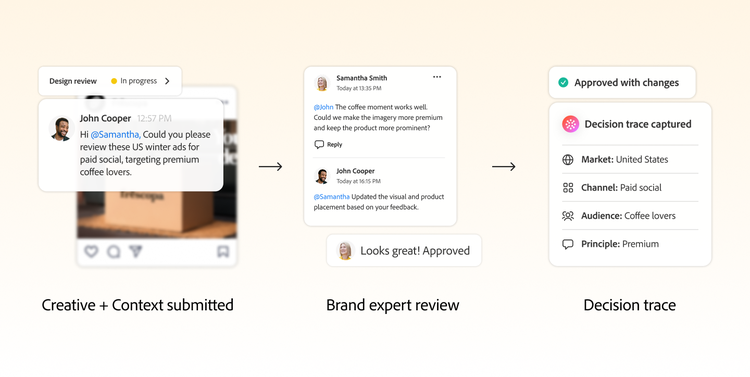
Decision traces are structured records of meaningful brand judgments that preserve the reasoning, context, and circumstances behind how teams interpret and apply brand standards. They capture what was decided and why that judgment was appropriate, enabling organizations to learn from accumulated expertise and apply past decisions to future challenges. Decision traces can include comments, redlines, edits, approvals, or rejections that are denoted during review cycles for content or creative assets.
Where do decision traces come from?
Decision traces emerge from signals generated during creative asset and content review workflows, but they need to be recorded to become reusable knowledge. When teams evaluate work against brand standards, they produce valuable contextual information about brand judgment. Signals such as reviewer comments explaining why something does or does not work, requested revisions that clarify expectations, and approved exceptions can help expand meaningful context within brand knowledge.
However, not every workflow event should automatically become meaningful brand knowledge. For example, an approval timestamp indicates an event occurred, but not why the event was significant. Useful decision traces identify individual choices with enough context to understand when and how that choice should inform future decisions.
What context makes a decision trace useful?
The value of a decision trace depends heavily on the context preserved and the choice itself. Relevant context can include the target audience, geographic market, distribution channel, campaign or initiative, asset type, messaging purpose, and the specific brand principle being applied or interpreted.
Context distinguishes a reusable precedent from a one-time exception. A decision about tone flexibility for a youth-focused social campaign may not apply to executive communications, or a visual style approved for a specific regional market may require different considerations elsewhere. When teams create on-brand content, context establishes the scope of previous decisions, clarifying when, where, and under what conditions a past judgment should or should not inform future work.
Why brand knowledge goes beyond written guidelines.
Brand guidelines document standards such as approved colors, typography, logo usage, and voice principles. But experienced teams also rely on tacit and institutional knowledge that guidelines rarely capture. Implicit knowledge develops through repeated decisions about messaging nuance, image selection, compositional choices, audience expectations, and channel-specific adaptations.
This knowledge often remains fragmented in review and approval workflows or scattered across individual project files. When a senior brand manager explains why a particular headline approach works better for one audience segment than another, that insight stays in a single conversation. Recording these previous choices through decision traces retains brand knowledge that might otherwise disappear when people leave an organization or when projects conclude.
How are decision traces different?
Organizations capture various records related to decisions and approvals. Understanding how decision traces differ from these existing records helps clarify their distinct purpose:
These records often provide inputs or evidence that help inform decision traces. An approval history might indicate that a decision occurred, while approval workflows generate the data points from which meaningful traces can be constructed. But the records themselves are not equivalent to decision traces unless they preserve the brand judgment and context that make them reusable. Together, these distinctions show that the value of a decision trace lies in preserving the reasoning that allows past brand decisions to inform future work.
How do decision traces support brand intelligence?
Decision traces transform isolated brand judgments into contextual knowledge that can inform future decisions. When a brand team makes a judgment about tone, imagery, or messaging, that decision reflects their understanding of the brand in a specific context. Without a way to preserve and access that judgment, the next team facing a similar situation will have to repeat the same steps other team members took to resolve the issue.
A decision trace repository makes previous choices available when comparable brand questions come up. Teams working across different markets, channels, or campaigns can consult prior choices in comparable situations. They gain insights into why decisions were made, helping them apply precedents appropriately or recognize when their situation differs enough to warrant a different approach.
Accumulated knowledge supports more consistent and explainable brand guidance across both human and AI-enabled workflows. When content feedback references previous decisions, reviewers can provide a clearer direction. When AI systems assist with brand evaluation, decision traces offer contextual precedent rather than just static rules.
As decision traces accumulate, they become a form of institutional brand knowledge. They preserve how standards have been interpreted across changing circumstances, giving new team members access to past reasoning and experienced practitioners a body of work they can draw on when unfamiliar questions arise.
Decision traces represent one component of brand intelligence rather than a standalone governance or review system. They work alongside brand ontologies, knowledge graphs, and other foundational elements to make brand knowledge more accessible and actionable. By preserving how teams have interpreted brand standards in practice, decision traces ensure that tacit knowledge becomes explicit and available for future use.
How should enterprises govern decision traces?
Past decisions should not automatically become permanent brand rules. A choice made in a specific context may not apply broadly, and thoughtful approaches should be established to govern how previous decisions inform current brand knowledge.
Governance frameworks should determine how decision traces are made available to the teams that rely on them so that a precedent is set to inform future work without losing appropriate oversight. This includes defining which decisions warrant the effort to capture and preserve them, assigning responsibility for reviewing and validating them over time, and removing decisions that no longer reflect the current brand strategy.
Organizations need to determine the significance of individual decision traces. The circumstances surrounding a decision can affect how broadly it applies. Teams should also distinguish between decisions that reflect standard brand practice and those that were approved as exceptions, since the two should not inform future work in the same way.
Not every preserved decision should carry equal weight indefinitely. Organizations must also address decisions that become outdated as brand strategy shifts, decisions that conflict with one another, decisions captured with incomplete context, and highly situational choices that may not be generalizable.
Ultimately, brand experts should determine how previous choices inform current brand knowledge. Human judgment remains essential. Effective governance balances the value of accumulated precedent against the need for brand evolution and contextual flexibility. Well-governed decision traces preserve useful precedent while allowing knowledge to evolve with the brand.
Turning judgments into reusable brand knowledge.
Formal brand standards capture only part of what an experienced brand knows. The decisions teams make as they interpret those standards add another layer of knowledge — one shaped by the audiences, markets, campaigns, and circumstances in which the brand operates. Decision traces give organizations a way to preserve that judgment and make it available beyond the moment in which it was made.
Adobe Brand Intelligence brings this type of knowledge into a broader intelligence layer for the brand. It uses decision traces alongside sources such as brand guidelines, approved assets, and design systems to strengthen a continuously evolving brand ontology. As teams review and refine content, the resulting signals can help Brand Intelligence learn how standards are applied in practice and help inform future validation and content workflows.
Adobe Brand Intelligence helps organizations use what their teams know by turning the expertise embedded in everyday brand decisions into reusable knowledge as their brand and content operations evolve.
Explore Adobe Brand Intelligence to learn how organizations can embed brand knowledge into AI-assisted content creation and governance.
Recommended for you
https://business.adobe.com/fragments/resources/cards/thank-you-collections/brand-intelligence