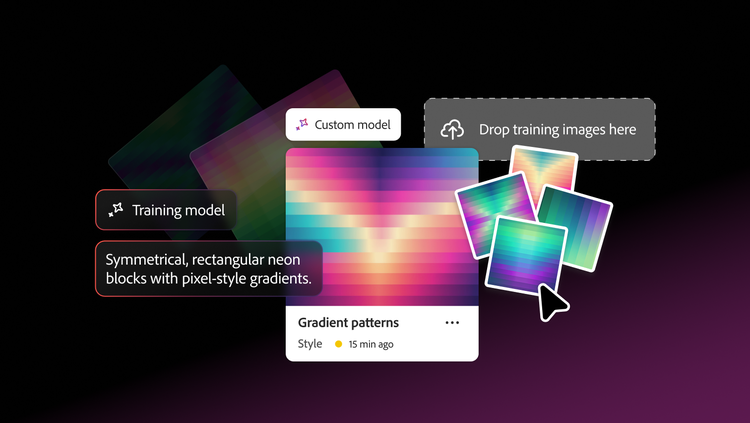
Enterprise generative AI model training.

Marketing teams are feeling the pressure to create more campaign variations, localize experiences across regions and audiences, and personalize content across multiple channels. In parallel, creative teams need to maintain brand consistency, manage approvals, and ensure every asset meets legal, compliance, and governance requirements.

Generative AI can help solve this challenge but generating content at scale and generating the right content at scale are two very different things.

That's why many organizations are moving beyond public AI tools and investing in enterprise generative AI model training. Instead of relying on models built on broad public datasets, enterprises can train custom models on approved brand assets and campaign styles.

Successful training, however, involves much more than the technology behind the model. Organizations also need clearly defined business goals, well-governed training assets, operational workflows, and processes for ongoing improvement.

Rather than diving into machine learning theory, this blog examines the five phases of fine-tuning custom AI models. You'll learn how to build scalable, AI-powered creative workflows while maintaining quality, governance, and control.

In this post, we'll explore:

Why enterprises are investing in custom models.

For many organizations, publicly available LLMs are a good place to start. They can accelerate ideation, generate content quickly, and demonstrate how AI can support creative work. When those same tools are introduced into complex enterprise environments, challenges emerge.

Enterprise content operations require a level of consistency and control that generic AI models can’t deliver. What works for general-purpose content creation might not always work for organizations managing established brand standards, approval processes, and governance requirements.

Custom AI models help address that challenge.

Custom models are generative AI models that are fine-tuned on brand-approved assets. Rather than generating generic content, custom models can produce outputs that better reflect a company's distinct style, characteristics, or other visual elements.

This enables enterprises to move beyond experimentation and build sustainable systems. They can accelerate content production without sacrificing quality, support personalization initiatives at a larger scale, and create more consistent experiences across customer touchpoints.

Above all, enterprises gain greater control over how AI contributes to the creative process.

Visual callout explaining enterprise generative AI model training and its benefits.

Enterprise concerns around governance.

AI models learn from the assets, information, and creative materials organizations choose to make available to them. That creates important questions around intellectual property, asset usage rights, licensing, permissions, and compliance.

Without clear governance processes, those questions can become operational risks.

Successful AI adoption depends as much on governance as on model performance. Teams need confidence that training assets have been properly approved, rights have been validated, and outputs align with both internal standards and external requirements.

Organizations that approach governance proactively often see a more successful outcome. By establishing clear ownership structures, usage policies, review processes, and approval workflows early, it becomes easier to create an environment where teams can scale AI adoption with confidence.

The five phases of enterprise custom model training.

Custom model training doesn’t start with the model itself.

The organizations extracting the most value from AI aren't necessarily using fundamentally different models. Rather, they’re building stronger systems around those models, including everything from governance and digital asset management to review workflows and performance measurements.

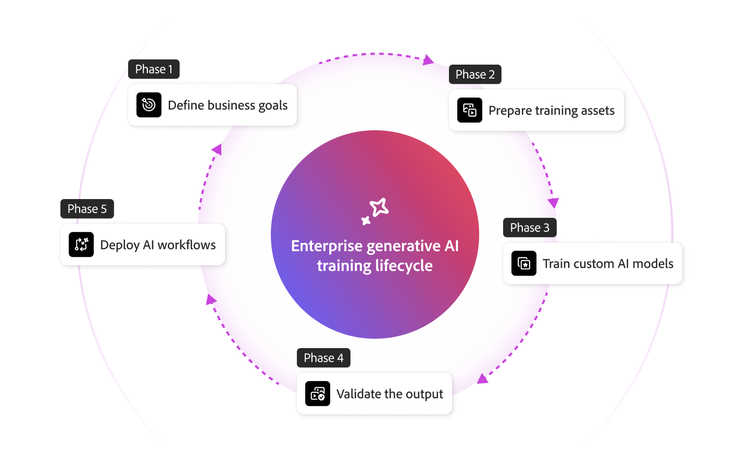
The five phases below provide a practical framework for how enterprises train custom AI models and operationalize them at scale. While implementation may vary across organizations, these phases offer a repeatable process for building AI-powered creative workflows responsibly.

Diagram illustrating the five phases of enterprise AI model training lifecycle.

Phase 1: Define business goals and creative use cases.

Before evaluating tools, selecting training assets, or redesigning workflows, organizations need to establish what they're trying to achieve and where AI can create the greatest impact.

The most effective use cases often emerge from existing operational challenges. A global marketing team may need to localize campaigns across dozens of markets without extending production timelines. A retailer might require thousands of product image variations to support seasonal promotions. Another organization may be looking for a faster way to create personalized content across multiple audience segments.

In each case, the objective is to remove a bottleneck that prevents teams from reaching their full potential. This phase also provides an opportunity to evaluate how content moves through the organization today. Where do approvals create delays? Which tasks consume the most creative resources? What prevents teams from meeting growing content demands?

Answering these questions early helps ensure AI investments remain tied to measurable business outcomes rather than isolated technology experiments. It also creates clear success criteria for every phase that follows.

Phase 2: Prepare and govern training assets.

Enterprise AI models inherit the strengths and weaknesses of the assets they're trained on. If training assets are inconsistent, outdated, poorly governed, or disconnected from current brand standards, the resulting outputs will reflect those shortcomings.

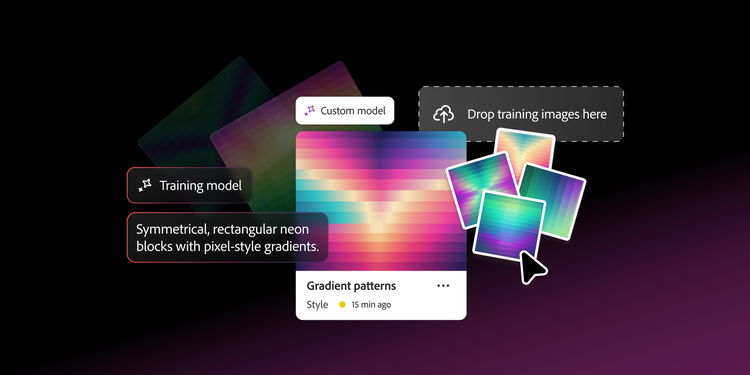
You can train a custom model with as few as 10 style-consistent or subject-consistent images. The asset preparation phase focuses on identifying, organizing, and validating these images that will shape model behavior. Depending on the use case, this may include photography libraries, product imagery, design systems, campaign assets, templates, and metadata structures.

This phase also establishes the governance foundations that support long-term AI adoption.

Organizations need clear processes for managing asset ownership, usage permissions, rights management, licensing validation, review requirements, and brand standards. Without those controls, they are exposed to unnecessary complexity and risk.

This step also presents an opportunity to improve content operations. Preparing training assets often highlights gaps in content governance, creates greater visibility across creative repositories, and improves how approved assets are managed across the business.

Visual callout explaining how generative AI models are trained on brand assets.

Phase 3: Train custom AI models.

At this stage, organizations can start training custom models to generate outputs that align with specific brand requirements and creative expectations.

Custom models learn from approved brand assets, visual styles, and established creative patterns to generate imagery that reflects the brand.

For example, a retail brand may train a model using approved photography, campaign imagery, and design assets, while a global enterprise may use regionally approved creative to support localized content creation. This allows organizations to generate content that feels more consistent, relevant, and aligned with their brand.

The objective isn't to replicate existing assets but to extend their use. A well-trained model helps teams create new content that follows established brand principles while giving them the flexibility to scale production more efficiently.

Prompts, model guidance, and creative constraints also play an important role in this phase. While prompting is a discipline of its own, these controls help operationalize brand standards and ensure generated outputs remain aligned with business objectives after training is complete.

Phase 4: Validate outputs and maintain governance.

Before organizations deploy AI-generated imagery, they must validate outputs for quality, usability, compliance, and brand alignment.

Depending on the organization, validation may involve creative reviewers, brand teams, legal stakeholders, compliance specialists, or other subject matter experts. These human-in-the-loop workflows help identify inaccuracies, inconsistencies, or governance concerns before content is published.

Rather than reviewing every output individually, organizations should establish repeatable mechanisms that maintain quality. This often includes defining performance criteria for brand consistency, asset usage compliance, and overall output quality.

Organizations that invest in thoughtful review and approval processes early are often better positioned to scale because they can build confidence in both the content and the workflows used to create it.

Phase 5: Deploy, monitor, and optimize AI workflows.

Enterprise custom model training doesn't end when a model is trained. Content evolves, campaign priorities shift, brand standards change, and customer expectations increase. Therefore, organizations should treat model deployment as the beginning of an ongoing process.

Once AI-powered workflows are operational, teams should continuously evaluate both the quality of outputs and the effectiveness of the processes supporting them. Performance data, human feedback, approval trends, and content outcomes can all provide insights into where improvements are needed.

Over time, it’s straightforward to train a model again on updated assets based on learnings, strengthen governance processes, improve model performance, and identify new opportunities for automation.

This creates a feedback loop in which every output contributes to future improvements. The model becomes better informed, and workflows become more efficient.

As adoption matures, many organizations also begin looking beyond individual models and toward broader workflow orchestration with agentic AI. Agentic AI can support content creation, review, localization, activation, and optimization across the content supply chain.

Enterprise KPIs for successful custom model training.

Generative AI model training is designed to create business value. To understand whether those efforts are succeeding, organizations need metrics that go beyond the number of content pieces that are published.

While the right KPIs will vary by use case, most organizations can evaluate success across these areas:

  • Brand alignment: How consistently generated content reflects the approved brand aesthetic.
  • Content production velocity: Whether teams can create and deliver assets faster without compromising quality.
  • Personalization at scale: The ability to efficiently produce localized and audience-specific content variations.
  • Asset utilization: How effectively approved content and creative assets are used across workflows.
  • Governance compliance: Adherence to permissions, licensing requirements, and review processes.
  • Workflow efficiency: Reductions in production bottlenecks, review cycles, and manual effort.

This evaluation helps organizations understand whether their AI investments are creating measurable impact across their content operations. It also provides a roadmap for continuous improvement, helping teams identify where models, workflows, and governance processes can be refined.

Best practices for enterprise generative AI model training.

Technology alone doesn't determine the success of enterprise AI initiatives. Organizations also need the right assets, governance structures, and operational practices to support successful adoption.

Several best practices can help organizations scale AI effectively:

  • Establishing governance frameworks early: Clear guidelines around permissions, brand standards, asset ownership, and review workflows help teams scale AI adoption without introducing unnecessary risk.
  • Balancing automation with human expertise: While AI creative automation can help accelerate production, people remain the essential component for strategic thinking, creative judgment, and contextual decision-making.
  • Treating optimization as an ongoing process: As business priorities, customer expectations, and content needs evolve, organizations should continuously refine their training assets, workflows, and AI-assisted content strategies to improve performance over time.
  • Approaching AI as a cross-functional initiative: The strongest programs bring together creative, marketing, legal, IT, and governance teams to ensure AI supports both business objectives and organizational requirements.

When these practices are in place, enterprises can scale content creation while maintaining the quality, consistency, and control that their customers expect.

Scaling enterprise content creation with generative AI.

Generative AI helps organizations streamline personalization, support localization efforts, and increase creative output across channels. As these capabilities mature, workflow orchestration and agentic systems may further automate how content moves through the supply chain, helping teams manage increasingly complex content operations without adding friction.

The organizations that get the most value from AI will be those built on strong foundations. Governance, brand consistency, high-quality training assets, and human oversight remain essential for ensuring that AI-generated outputs are accurate, compliant, and align with brand standards.

As businesses increasingly rely on AI-powered image generation, enterprise generative AI training becomes a foundational business capability. It enables organizations to create images at scale responsibly while preserving the brand standards that customers recognize and trust.

Scale brand-aligned image creation with Adobe Firefly Custom AI Models and extend creative capacity across teams, channels, and markets.

Let’s talk about what Adobe can do for your business.

Get started


I'm the Adobe Assistant. How can I help you today?

1