Every customer experience depends on a chain of decisions — from what a shopper sees next, to how teams respond to performance signals, to how quickly new ideas become live experiences.
When decisions move slowly, customers feel it. But intelligent, agentic AI systems are beginning to change that dynamic by helping teams interpret context, recommend next steps, and move from insights to action — and ultimately delivery — faster. At this year’s Adobe Summit, three Experience Makers took to the stage for the inaugural AI Rockstars session to show what happens when these capabilities move from concept into production.
Across customer experience, data insights, and content operations, demos from Merkle, Lenovo, and Cox Communications brought this shift to life — showing how AI agents help teams reduce friction, accelerate decision-making, and deliver more responsive customer experiences.
Personalization that reads the room.
Mary Alice Orr, alliance solution lead at Merkle, kicked things off by reimagining the digital shopping experience as a conversational journey built on Adobe’s specialized AI agents working in concert. The experience unfolded across coordinated steps, with each agent handling a specific phase of the customer journey — validating shopper intent, curating relevant products, building a personalized solution, and guiding the customer through checkout.
In the demo, a shopper named Taylor, preparing for a destination beach wedding, moved seamlessly from an opening question to a personalized product kit. Her journey began on a landing page built with Adobe Experience Manager Sites and Adobe Experience Manager Assets, where the hero image had already been personalized for her by Adobe Target.
As Taylor discussed her specific skincare needs with the AI-powered concierge, the experience continued to draw on her customer profile in real time, adapting to both what she said in the moment and what her past preferences were. Adobe Real-Time CDP connected customer signals behind the scenes, while Adobe Customer Journey Analytics captured conversational insights to inform future personalization and retargeting.
By the end of the conversation, Taylor had a makeup kit built for her specific needs, as if she had spent hours in-store. After checkout, Adobe Journey Optimizer triggered follow-up messages with tutorials to help her get started with a new makeup kit and upcoming relevant promotions. Throughout Taylor’s entire experience, the connected loop between data, conversation, and action never stopped. “With these agents, retailers can reduce shopping friction, boost conversion rates, and increase basket size, while brands retain their identity and improve discoverability,” Orr noted.
Merkle also plans to integrate Adobe CX Enterprise Coworker and Adobe Brand Concierge into this experience, further strengthening orchestration and brand-aligned, conversational guidance across the journey.
Analytics that answer back.
While Merkle’s presentation focused on customer-facing, AI-guided experiences, Lokesh Alluri, senior manager of digital and customer analytics at Lenovo, showed how agentic AI can help accelerate decision-making behind the scenes.
Business users often know the answers exist somewhere in their data. The challenge is getting to them quickly enough to adjust accordingly. “Analysis and insights in general are a slow and iterative process where delayed insights mean that we get the answers, but we can’t do anything with them,” Alluri said.
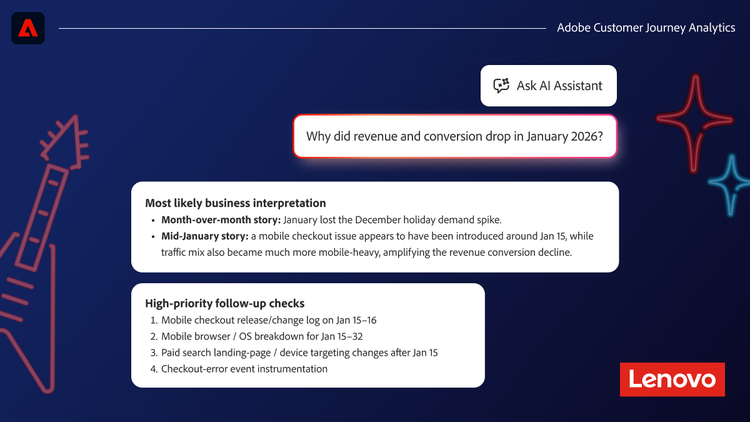
To address this, Alluri’s demo began with a seemingly simple question in AI Assistant in Customer Journey Analytics: Why did hypothetical revenue and conversion drop in January 2026?
Using natural language, he was able to prompt Adobe Data Insights Agent to analyze cross-channel customer data — no dashboards to build, no queries to write. In seconds, it surfaced a structured root cause analysis spanning several factors. It identified two holiday campaigns that increased December revenue but weren’t repeated in January. It also flagged a shift in marketing channel strategy toward mobile — a lower converting channel for high-value purchases — and pinpointed a checkout error on mobile beginning on January 15, tracing the conversion dip directly to that moment.
By leveraging these agentic capabilities to uncover deep insights, Alluri moved from reporting to real-time analysis, where getting specific answers, complete with recommended next steps, now happens in seconds, not days. “This accelerates the time it takes to get insights and frees analysts to spend more time on deeper analysis and better questions,” said Alluri. Business users who once hesitated to ask questions, knowing they might wait weeks for answers, now have reason to ask more.
Turning designs into digital experiences.
Wilson Faure, director of digital marketing platforms at Cox Communications, turned the focus to the production layer. Today, teams are under pressure to launch and update experiences faster — but production workflows can still be highly manual. Content authors often spend hours rebuilding pages from existing UX designs, working through multiple cycles of authoring, QA, revisions, and approvals before an experience goes live.
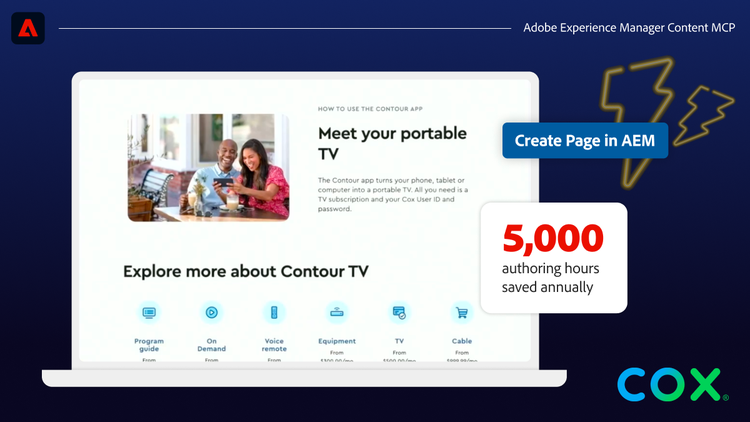
Using Experience Manager Content MCP (Model Context Protocol), Faure showed how teams can move from a design mockup to an Experience Manager page in minutes. The workflow brings AI-assisted automation into Experience Manager, enabling teams to use natural language to orchestrate content and workflows — reducing manual authoring while keeping content teams in control of reviews and approvals.
“When the elements and components in the design match what exists in Experience Manager, we can accelerate the entire process,” Faure said. “Content authors can shift from manually building pages to reviewing and refining them.”
For Cox Communications, that shift is making a measurable difference. UX designs can be converted to Experience Manager pages in under three minutes, compared to a process that can take up to 14 hours. Across hundreds of pages, that adds up to roughly 5,000 authoring hours saved annually. Just as important, the automation is building on existing Experience Manager components rather than re-creating them — reducing rework and avoiding unnecessary technical debt. As a result, content authors can shift their focus from rebuilding to refining — improving quality, accuracy, and the customer experience.
A practical path for agentic AI.
Each AI Rockstars demo showcased a different use case, but together they revealed a clear pattern: intelligent AI helps teams move from insight to action faster — translating complexity into decisions and real outcomes.
For brands looking for a practical place to start, there’s no single entry point — but the path is more accessible than it may seem.
Whether reducing friction in a personalized journey like Merkle, accelerating time to insight like Lenovo, or streamlining content production like Cox Communications, the approach is consistent: start with a clear business problem, guide the solution with human expertise, and anchor success in defined outcomes.
These examples also reinforce that human judgment remains essential. AI can help interpret context, recommend next steps, and accelerate execution, but people set the strategy, establish guardrails, and ensure quality and brand alignment. That balance is what makes these use cases scalable and sustainable — moving beyond experimentation into repeatable impact.
The technology is moving fast, but these AI Rockstars show how teams can create value now — and how today’s focused experiments can scale into tomorrow’s production-ready advantage.
Watch the session to see how Merkle, Lenovo, and Cox Communications are putting agentic AI to work across customer experiences, data insights, and content operations.
Capabilities referenced as Adobe Data Insights Agent and AI Assistant in this blog are now part of Adobe CX Enterprise Coworker.