What if email became your brand’s most powerful growth channel instead of a production burden or inexpensive reach channel?
The brands winning with email today aren’t sending more. They’re sending smarter, moving faster, and building experiences that earn their place in an inbox that’s changing fast.
That’s the opportunity in front of email marketers right now. AI is reshaping how emails are created and sent. It’s also changing how customers — and the AI systems between brands and customers — receive, surface, and evaluate them. This blog explores where Adobe Journey Optimizer stands today, why Forrester named Adobe a Leader among email marketing service providers, and how it thinks about what comes next — including the AI inbox era that’s already underway.
Recognized as a Leader, and why it matters.
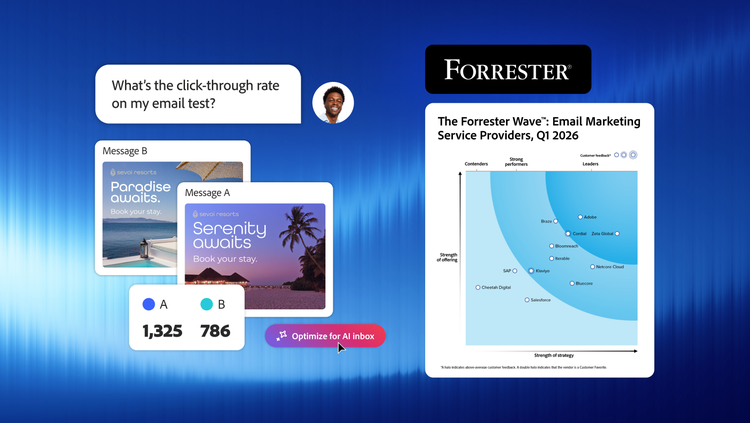
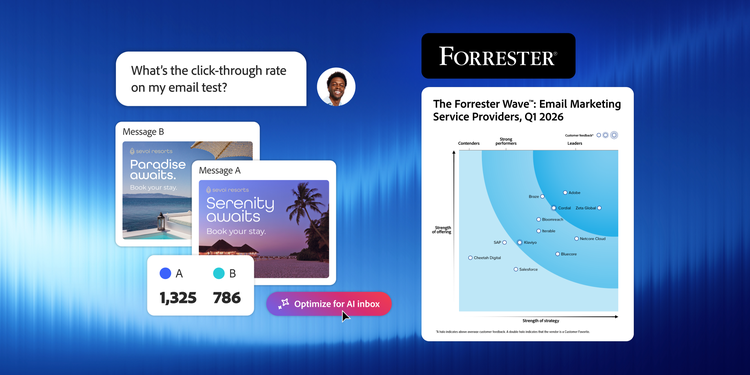
Forrester named Adobe a Leader in The Forrester Wave™: Email Marketing Service Providers, Q1 2026, evaluating the strength of its current platform and the direction it’s headed in. Forrester’s research shows how AI is unlocking what email teams can achieve now by pushing the limits of what the channel can do beyond what has remained unchanged for years. They evaluated how vendors are building toward the future of email marketing, applying AI to automate and streamline core use cases rather than treating it as a bolt-on feature.
Forrester’s analysis described our vision in this way: “Adobe’s vision for Journey Optimizer is to bring together data, content, decisioning, and delivery to make messages relevant and human”. The report cited how Adobe’s “AI Assistant can build complete, brand-compliant messages, while [Adobe] Experimentation Agent summarizes test results, explains performance drivers, and recommends tests to perform.” Customers, Forrester noted, “express confidence in Adobe’s stable, scalable multichannel support.”
The Forrester Wave evaluates vendors across three axes: current offering, strategy, and customer feedback. The sections below use all three as a lens for what email marketers should be thinking about right now. This includes where the channel is heading, what you should prioritize, and what a modern foundation needs to get you there.
Adobe’s vision: Email marketing in the AI era.
Adobe’s vision for Journey Optimizer is to help brands turn email into an intelligent engagement channel rather than just a send engine. Every message the subscriber receives is shaped by real-time context — who they are, what they’ve done, and what matters in that moment. Data, content, and decisioning work together, so messages adapt at the time of engagement. They work together to tailor each experience at the time of engagement. Email connects channels, journeys, and AI-assisted conversations that are increasingly part of how consumers experience brands.
Adobe’s vision is shaped by the structural shift that is unfolding in how consumers experience email.
AI in the inbox presents one of the most significant opportunities for email marketers who are willing to raise the bar on relevance — one that deserves strategic attention.
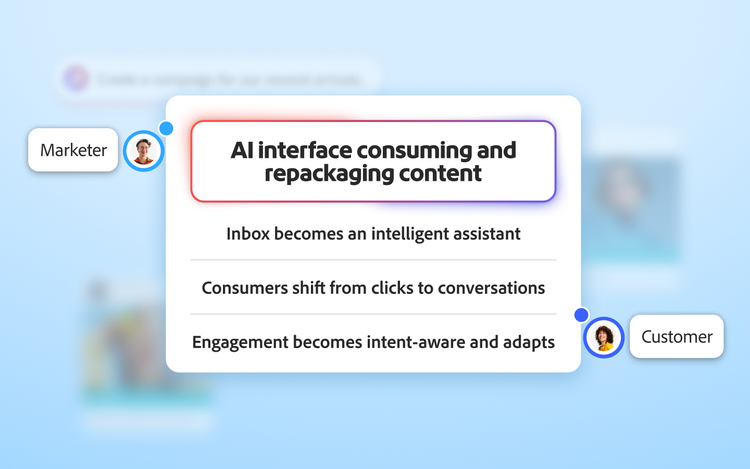
Google, Apple, and Yahoo have all deployed AI that now sits between your brand and your customers — filtering, summarizing, prioritizing, and retrieving email content before a reader ever makes an active choice. The user can opt into Gmail’s Personal Intelligence to connect Gmail to Gemini. This turns the inbox into an AI context source capable of surfacing relevant content in response to queries and organizing communications by intent — the present — rather than just chronology — the past. Apple’s inbox uses AI to prioritize what’s time-sensitive. Yahoo applies intelligent grouping and focus-mode filtering.
With all these developments, the inbox is no longer a passive list — it is an AI-managed workspace. The infrastructure being built by all three major providers is explicitly designed to surface messages based on relevance and engagement signals, and the trajectory is clear even as measurable impact is still emerging.
The implications of these shifts are structural, not cosmetic. AI inboxes reward genuine relevance. AI-generated summaries that brands don’t author or control are increasingly replacing marketer-controlled preview texts. Image-heavy emails overloaded with visual offers that lack meaningful text or clear intent are less readable by AI. This can significantly reduce visibility or prioritization in the inbox.
This is ultimately good news for marketers who are thinking about and prioritizing the customer experience. What's changing with the emergence of the agentic web is the mediation layer. AI has established a growing presence between senders and readers, often deciding what gets surfaced, seen, and acted upon. For brands that clear the bar on relevance, email becomes a higher-signal, more meaningful channel than ever.
3 connected ways to adapt to the AI inbox era.
So what does adaptation look like? It falls into the following three connected areas:
- Deliverability and visibility
- Content and design
- Measurement
For deliverability and visibility, brands need to shift the question from Did my email land in the inbox? to Did AI surface and prioritize it? List hygiene, engagement signals, and sender reputation have always mattered. In an AI-mediated inbox, they become the primary signals determining whether your message gets seen. Transactional emails, which AI systems treat as actionable and high intent, become a strategic asset rather than an operational after thought.
In content and design, teams need to craft emails for clarity and genuine relevance by emphasizing value and thinking about what an AI-generated summary of your message will say. Writing for AI and writing for humans aren’t in conflict here. They both point to the same discipline — be genuinely clear and relevant, and engagement from both will follow.
To help succeed in measurement, teams should move beyond the traditional open and click rates. Today, they need to go deeper and look closely at the signals that reflect real engagement. These include intent depth, downstream conversion, and ultimately, how often emails are being surfaced and prioritized by AI systems.
Across these areas, Journey Optimizer’s existing foundation positions marketers well. Real-time customer data and decisioning drive the relevance that AI inboxes reward. Adobe’s AI Assistant is already scoring brand compliance and message quality, a natural foundation for understanding how well a message will be understood and rated by AI systems. Journey analytics that can connect email engagement to downstream outcomes help provide a solid starting point for next-generation measurement. AI inbox optimization requires this combination of content, orchestration, and data in a unified platform.
We’re actively thinking about what it looks like to go further. An example of this is giving marketers the ability to see how the AI inbox layer might summarize or categorize their emails before they send — with new metrics that reflect inbox placement in an AI-mediated environment. Adobe is committed to making sure Journey Optimizer customers are ready for this shift.
Designed for the future of email.
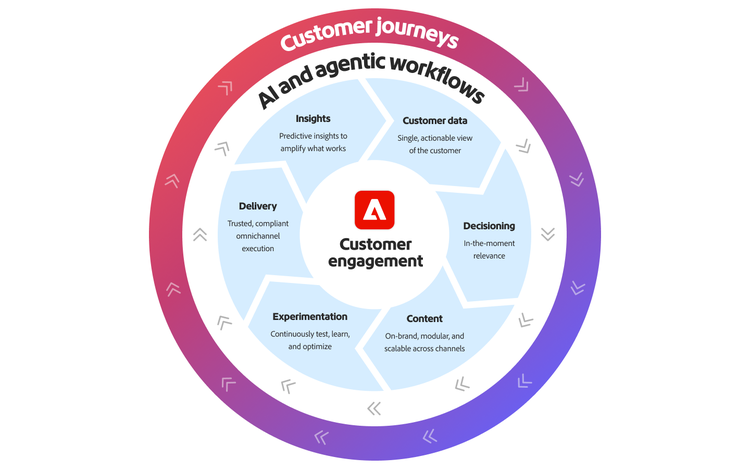
Brands need a platform built for the next wave of email innovation. They need a platform where all the core elements — data, content, decisioning, experimentation, insights, and delivery — work together as a single AI-powered flywheel, not as disconnected tools stitched together. Most email platforms were designed to send messages. Journey Optimizer was designed to connect and engage with customers regardless of channel, and that difference shows up at every layer.
Real-time data that’s ready to act on.
It starts with data. Journey Optimizer is built on Adobe Experience Platform, giving every marketer access to real-time unified customer profiles drawing on behavioral signals, transaction history, loyalty data, location, preferences, and more. Static lists, middleware, and waiting on data from other teams just don’t cut it anymore. When a customer abandons a cart, upgrades their loyalty tier, or walks into one of your retail stores, Journey Optimizer knows, so your brand can act in the moment when it really matters.
Content that scales without the handoffs.
For customer engagement, data is only as valuable as the content and insights it’s been set up to inform. And this is where its depth of capability genuinely sets Journey Optimizer apart. From AI-powered email template creation to modular dynamic content and robust asset management, Journey Optimizer gives marketers the ability to produce on-brand, personalized emails at scale without the handoffs that slow most programs down.
AI Assistant in Journey Optimizer now extends beyond content generation to include fuller brand and quality checks. Teams can use it to automatically evaluate emails against brand guidelines — identify tone and style inconsistencies — and assess the readability and CTA effectiveness before anything goes live. The themes feature allows marketers to apply pre-approved visual systems instantly, cutting down design dependencies without sacrificing brand consistency. A new image to HTML converter uses AI to turn static screenshots or mockups into fully responsive, editable email templates without requiring technical expertise. This can be a game-changer for teams migrating templates, ramping campaigns quickly, and scaling creative production. The tighter integrations with Adobe GenStudio for Performance Marketing and Adobe Express mean creative and email teams can collaborate without the cumbersome delays due to tool-switching and file-passing.
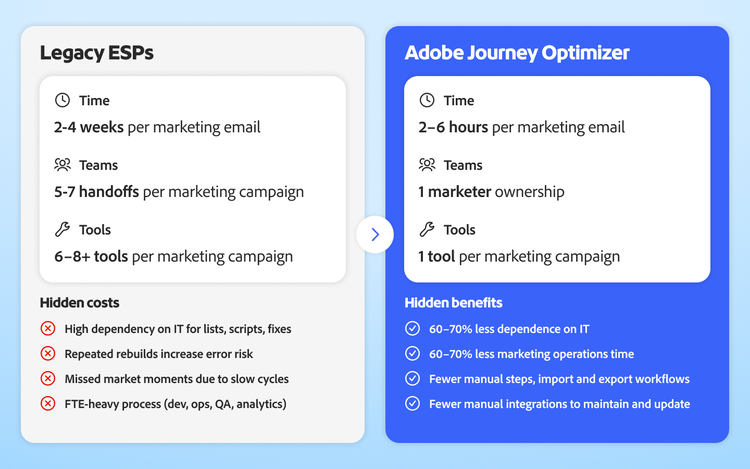
The results that Adobe’s customers see tell the real story. Here are just a few examples of AI-driven emails' impact:
- Real Madrid saw 4 times faster personalized content delivery
- World Vision Canada experienced 4 times faster campaign creation workflows
- AAA Northeast reduced its campaign creation time by 30%, while increasing its conversion rates by 60%
Orchestration and optimization that learn with every send.
Alongside data and content sits optimization — experimentation, decisioning, and actionable insights that determine the right message, offer, and experience for each customer at the right moment.
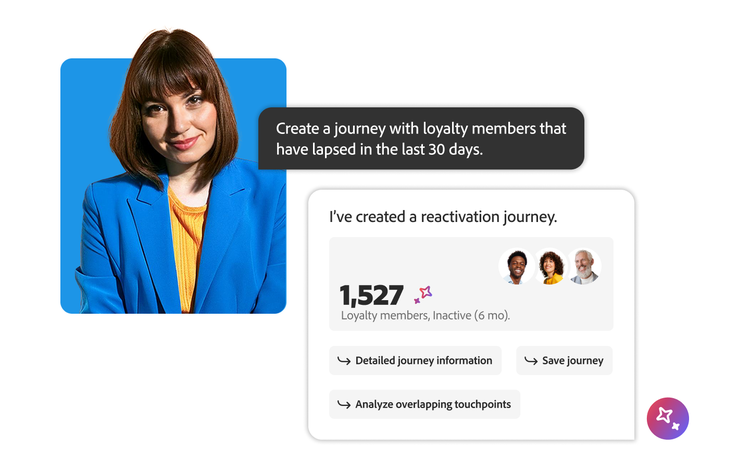
Over the past year, we’ve invested significantly in making this layer smarter. The new Journey Agent in Journey Optimizer enables marketers to build and configure journeys through natural language prompts rather than manual canvas configuration. It also analyzes audience conflicts, detects schedule overlaps, and surfaces operational insights across live programs.
With journey arbitration, you can help ensure the most relevant experience wins by rank formulas that prioritize which journey a customer enters based on their profile and contextual signals. The journey path optimization capability is designed to find the best path to a given business goal using an optimize node that lets you test, vary, and learn across sequences, timing, and messaging.
On the experimentation side, Journey Optimizer Experimentation Accelerator and its Experimentation Agent work together to shift testing from a periodic reporting exercise to an always-on discipline. This AI-first application automatically surfaces actionable insights, identifies top conversion drives, and recommends what to test next based on predicted lift, not guesswork.
Delivery across the full email marketing portfolio.
A single customer relationship can touch broad campaigns, personalized lifecycle journeys, loyalty programs, and mission-critical transactional messages like order confirmations, account alerts, and policy updates. Each of these shapes how a customer feels about a brand, and each deserves to be handled with the same care and reliability.
Journey Optimizer supports all of these from a single platform. This past year, Adobe invested in increasing scale and throughput for the most time-sensitive transactional use cases, ensuring high-volume operational messages are delivered with the speed and reliability they require. These included PDF attachments that expand the range of transactional experiences you can deliver directly within the email, as well as a new Message Export capability that helps teams support archival and compliance requirements — from HIPAA to customer care. When campaigns, journeys, and operational messages all run from the same foundation, the customer experience stays coherent, and your teams stay in control.
The path forward.
Email has proven that it isn’t disappearing in the AI era. Instead, it’s becoming more important as the trusted, brand-controlled touchpoint that can tie digital experiences together across web, app, service, and AI assistant interactions into a more uniform, coherent relationship. To succeed, email marketing must be built on the right foundation.
There’s never been a bigger opportunity for email marketers. They need a solution built on a foundation that truly unifies data, content, decisioning, and delivery, and a partner that’s thinking seriously about what the inbox looks like in years down the road, so they’re well positioned to meet the challenges of today and tomorrow.
Are you and your team ready to explore what’s possible? See how Adobe Journey Optimizer can help you build a smarter, faster, more connected email program.
Objectivity Disclaimer: Forrester does not endorse any company, product, brand, or service included in its research publications and does not advise any person to select the products or services of any company or brand based on the ratings included in such publications. Information is based on the best available resources. Opinions reflect judgment at the time and are subject to change. For more information, read about Forrester’s objectivity here. This report is part of a broader collection of Forrester resources, including interactive models, frameworks, tools, data, and access to analyst guidance.
Rohan Bhatt is a Senior Product Marketing Manager for Adobe’s B2C customer journey management portfolio, including Adobe Journey Optimizer and Adobe Campaign. He is passionate about helping brands deepen customer engagement through compelling, personalized experiences. Prior to Adobe, Bhatt spent over five years in technology and payments consulting, advising some of the world’s largest technology companies on product and go-to-market strategies. Bhatt has a Master of Business Administration and a Master of Science in Design Innovation from the Kellogg School of Management at Northwestern University.