AI Personalisation: Deliver Adaptive Experiences | Adobe UK
.

From segment-based targeting to one-to-one customer experiences.

Personalisation is more than reaching the right audience. Today, it is the art of understanding, anticipating and responding to everyone's unique needs. As a result, the challenge has shifted from gathering customer data to interpreting and acting on it effectively and consistently.

At the same time, customers increasingly expect every interaction to be relevant and tailored to their preferences, regardless of the channel they use. To keep up, enterprises need intelligent systems to uncover deeper insights, adapt in real time and continuously refine engagement strategies.

Discover how AI transforms personalisation and how predictive, generative and agentic AI enable teams to deliver contextual and timely experiences. Learn how these AI capabilities help turn data into action, scale one-to-one engagement and build stronger, more meaningful customer relationships across every touchpoint.

Your customers expect you to understand them as individuals, not as members of broad audience segments. They want you to recognise their unique challenges, anticipate their needs and remove friction before they have to ask. Traditional personalisation (grouping similar audiences and targeting them with rule-based messages) can no longer keep pace. Customers also increasingly compare every interaction with the best experience they've had anywhere. Meeting today's expectations requires more than better targeting and AI personalisation helps you to move beyond traditional approaches.

Research shows that 67% of consumers value personalisation when it proactively resolves an issue they have. As customer behaviour becomes more dynamic and less predictable, simply creating more segments, more journeys and more rules isn’t enough. You need the ability to make decisions based on real-time signals and context.

AI improves personalisation in both concept and execution. It lets you deliver experiences that adapt to each customer's evolving needs, preferences and circumstances — at a speed and scale beyond what manual efforts alone can achieve. As a result, every customer interaction becomes an opportunity to build trust, strengthen loyalty and inspire meaningful actions that drive conversion.

The next step of personalisation is powered by different types of AI, each contributing distinct capabilities. Let’s explore how these technologies work together in practise to deliver adaptive customer experiences.

What is AI personalisation?

The core principle of personalisation remains the same — delivering the right experience to the right person at the right time. What has changed is how AI allows this continuously and consistently, across millions of interactions.

AI personalisation is the use of artificial intelligence to tailor content, offers, recommendations, messages and journeys based on customer data, behaviour, context and predicted needs. It continuously analyses customer signals to understand what is most relevant to each person, helping organisations deliver timely, relevant experiences at scale.

AI-powered personalisation combines predictive, generative and agentic AI capabilities to help you to identify emerging patterns, anticipate likely outcomes, tailor content at scale and coordinate interactions. This creates an evolving model of engagement in which every experience is shaped by changing customer intent and enriched through continuous learning.

It differs from traditional approaches in several ways.

Aspect
Traditional personalisation
AI personalisation
Data sources
Siloed data from CRM, surveys and purchase history.
Unified data from behavioural, transactional, contextual and real-time interactions.
Segmentation
Broad customer groups based on demographics or predefined rules.
Dynamic micro-segments and individual-level personalisation.
Decision-making
Rule- and assumption-based decisions.
Data-driven decisions with a continuous feedback loop.
Content delivery
Same content delivered to large audience segments.
Real-time, personalised content delivered to individuals.
Recommendations
Static recommendations based on simple rules.
Predictive recommendations based on preferences and intent.
Scale and speed
Requires manual updates and is time-intensive to scale.
Learns, adapts and scales quickly across millions of users.
Business impact
Improved engagement compared to mass marketing.
Higher conversion rates, customer satisfaction, retention and lifetime value.
Personalisation at scale demands real-time intelligence. When executed the right way, it becomes a powerful catalyst for building meaningful customer relationships.

How different AI capabilities support personalisation.

Relevance is now a fluid concept, influenced by immediate context and long-term preferences. Customers rarely move through their journey in a straight line. They research, pause, compare, seek advice and revisit decisions as new information emerges. AI personalisation techniques allow you to identify, understand and act on these changing moments.

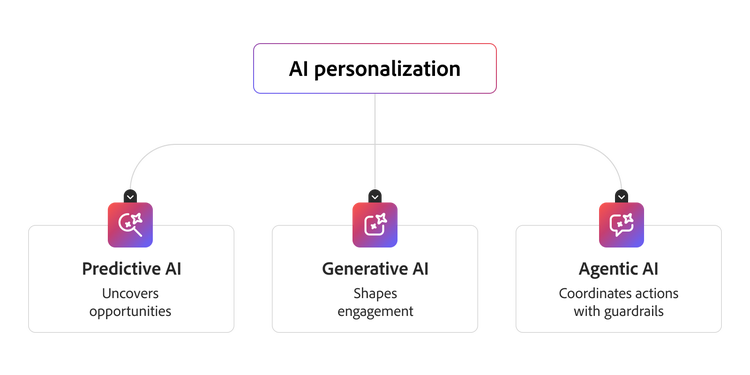
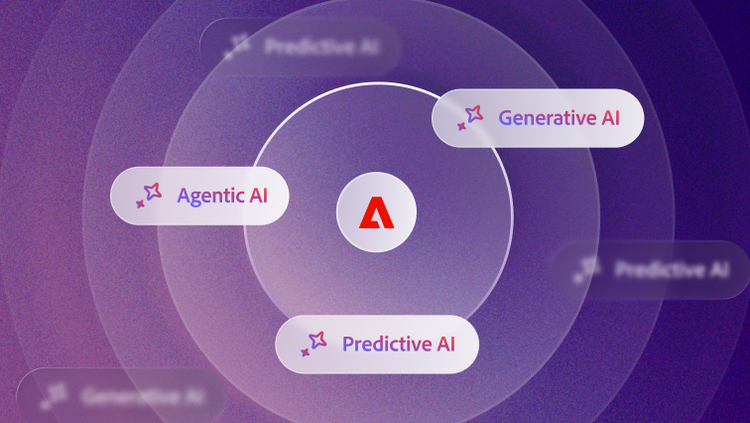
This is powered by three core AI capabilities.

Three core AI capabilities that support effective personalisation, including predictive AI, generative AI and agentic AI.

Predictive AI: Anticipating customer intent.

Predictive AI uses data and machine learning to uncover patterns and forecast likely customer behaviours. It helps you to understand what a customer may need, when they may need it and what action is most relevant. This shifts personalisation from simply reacting to customer behaviour to anticipating customer needs.

However, because predictive AI operates on probabilities rather than certainties, continuous monitoring and validation are essential to keep outcomes accurate, fair and reliable.

Example: An ecommerce site recommends new products based on a customer’s past purchases, before they actively search for them.

Generative AI: Creating relevant experiences at scale.

Generative AI helps you to create and adapt content for different audiences, channels, regions and moments in the customer journey. Its strength lies in scalability, enabling you to deliver more relevant experiences across a wide range of contexts.

However, effective personalisation still depends on clear brand guidelines, content from trusted sources, human oversight and strong governance to ensure quality, consistency and trust.

Example: A retailer generates multiple versions of a product email tailored to first-time buyers, loyal customers and high-value shoppers.

Agentic AI: Coordinating decisions across touchpoints.

Agentic AI helps you to coordinate decisions and actions across connected systems and workflows. In personalisation, this matters because delivering the right experience often depends on coordinating data, content, channels, timing and business rules. By bringing these elements together, agentic AI allows more responsive and adaptive customer experiences.

However, because agentic systems can act on incomplete information or reflect biases in the data they use, human oversight remains essential to ensure decisions are accurate, responsible and aligned with business goals.

Example: After a customer downloads a guide, an AI-enabled workflow helps teams trigger follow-up content, personalise future messaging and coordinate the next steps across channels.

Today's customers are surrounded by endless choices, promotions and messages competing for their attention. To stand out in a crowded marketplace and earn trust, you must go beyond visibility and consistently surprise, delight and inspire. That kind of impact doesn't stem from creativity or strategy alone. It happens when bold ideas are brought to life through deeply personal and relevant experiences.

How AI personalises the entire customer journey.

AI personalisation is not limited to marketing campaigns. It can support multiple customer touchpoints across many industries, helping you to move beyond channel-level personalisation and toward journey-level personalisation.


1. Content and experience personalisation: Every customer arrives with different goals, interests and intent. In digital marketing, AI helps tailor experiences in real time using signals such as a customer’s digital behaviour, preferences, engagement history and context, across the marketing funnel. Today, many customers arrive at your site through AI-powered search and discovery experiences, so it’s important that your page provides the information they need immediately.

This can include personalised articles, learning modules, landing pages, creative assets, product recommendations, calls to action and more. By using AI across email, websites, mobile experiences and other digital touchpoints, marketers can help customers discover the information that matters most instead of navigating a one-size-fits-all experience.


2. Sales personalisation: AI can help sales teams move beyond generic outreach and personalise interactions by using CRM data, account activity, engagement signals and buying behaviour. Teams can tailor prospecting messages, demo experiences, recommendations and follow-up communications based on what matters most to each account. This allows sales conversations to feel more informed, relevant and valuable throughout the buying process.


3. Customer onboarding and enablement: AI can personalise onboarding journeys based on customer goals, product usage, skill level or role. Instead of giving every customer the same introduction, it can guide each customer toward the actions most relevant to their desired outcomes. This helps customers reach their first meaningful success faster, building confidence and long-term engagement from the start.


4. Product experiences: Increasingly, personalisation happens inside the product itself. AI can customise dashboards, workflows, recommendations, notifications and feature discovery based on customers’ product usage. The result is a more intuitive experience that helps them to realise value faster and engage more deeply over time.


5. Customer support and retention: AI can make support experiences more contextual by personalising responses, recommending relevant help content, predicting customer needs and routing enquiries based on customer history or intent. This helps teams resolve issues more efficiently while delivering service experiences that feel more tailored and proactive.

Similarly, AI can identify engagement patterns, predict churn risks, recommend next-best actions and deliver personalised adoption guidance to proactively strengthen customer relationships waiting for issues to arise.


Discover how DICK’S Sporting Goods uses AI to deliver personalised experiences that reflect each athlete's unique journey, making every digital interaction more relevant, engaging and valuable.

Story highlighting how DICK'S Sporting Goods used AI to deliver relevant, personalised customer experiences.
AI personalisation drives value across industries. Below are the key sectors and areas where it has the greatest impact.
Industry
Use cases
Retail and ecommerce
Personalised product discovery, recommendations, promotions, targeted offers, replenishment reminders, basket recovery programmes and loyalty experiences based on browsing and purchase behaviour.
Financial services
Personalised financial guidance, onboarding experiences, product recommendations and customer communications aligned with individual goals, life events and risk profiles.
Healthcare
Tailored educational content, wellness recommendations, appointment reminders and follow-up communications based on individual health needs and engagement patterns.
Travel and hospitality
Recommendations for destinations, itineraries, upgrades and loyalty offers based on travel history, preferences, seasonality and trip purposes.
Media and entertainment
Content recommendations, personalised subscription experiences, audience engagement and retention initiatives based on viewing or listening behaviour.
Telecommunications
Personalised plans, add-on services, upgrades, retention offers, support experiences and identification of customers at risk of switching providers.
Education
Adaptive learning paths, course recommendations, student support and success programmes, identification of students who may need additional support and guidance for learners toward relevant next steps.
Manufacturing
Personalised content for buyers, partners, distributors and service teams across complex B2B buying and support journeys.
Public sector
More relevant citizen communications, service recommendations, personalised digital communications, resource recommendations based on needs or eligibility and simplified navigation across government programmes.
More than optimising individual channels, the future of personalisation is about creating continuity across the entire customer journey. AI helps you to build a richer understanding of customer intent and shape experiences that are more aligned with specific needs and objectives.

How AI-powered personalisation works.

Every personalised experience a customer encounters is the result of a much larger system operating behind the scenes. AI can generate insights, recommendations and messages, but personalisation only works when data, technology, human stakeholders and governance work together.

In essence, AI personalisation is a coordinated workflow that brings together several key functions to deliver more relevant customer experiences.

1. Connecting customer data and signals.

AI personalisation starts with signals. Every interaction, purchase and behaviour helps build a clearer understanding of what a customer needs. AI connects these signals across touchpoints to understand who the customer is, where they are in their journey and what is most relevant to them. But more data does not automatically lead to better personalisation. Incomplete, outdated or siloed data often creates random experiences instead of meaningful ones.

The differentiator: AI can identify patterns, but it cannot manufacture trust from low-quality signals. Focus on building a foundation of accurate, connected and permissioned data that AI can act on, while respecting customer consent, preferences and privacy requirements.

2. Analysing behaviour, context and intent.

Data alone does not reveal what a customer wants. Predictive AI helps you to analyse behaviour, engagement patterns, past interactions and real-time context to anticipate needs and uncover opportunities to make the experience more useful. However, predictive models should be monitored for inaccuracies and biases. Rather than reacting to every signal, the goal is to understand what the customer is trying to achieve.

The differentiator: Personalisation should be guided by customer intent, not just available data. Focus on a clear customer need or business problem and personalise where it adds meaningful value, not simply wherever AI makes it technically possible.

3. Determining the most relevant experience.

This is the point where intelligence becomes action. Using available indicators and predictions, AI can help you to determine the next-best action to take to improve a customer's experience. Examples include providing a recommendation, offer, content module or service action to your customers. The strongest personalisation strategies combine AI with human judgement.

The differentiator: Personalisation is responsible decision-making at scale. Use AI to manage complexity, but human oversight to define boundaries. Reserve greater oversight for sensitive, regulated or high-impact experiences.

4. Creating or selecting personalised content.

Once you identify the right experience, generative AI can help to accelerate content creation by producing tailored variations for different audiences, contexts and moments. In other cases, AI may help you to select from approved content, offers, products, recommendations or journey paths. But scale alone is not the goal — relevance, accuracy and brand consistency matter just as much.

The differentiator: AI can increase content volume, but governance and human oversight protect a brand's reputation. Ensure content follows brand guidelines, approved messaging, legal requirements and appropriate review workflows.

5. Delivering experiences across the right touchpoints.

Personalisation creates the greatest impact when it reaches customers at the right time and through the right channel. This is where agentic AI creates value. AI agents help coordinate actions across systems and suggest the most appropriate message, timing, channel or workflow in response to changing customer needs. Humans remain in control, using these recommendations to make informed decisions.

The differentiator: Personalisation should feel useful, not intrusive. Customers should experience relevance, not surveillance. Create experiences that feel connected, consistent and respectful across every touchpoint.

6. Measuring relevance, trust and performance.

Personalisation requires a broader definition of success. Clicks, conversions and engagement matter, but long-term success also depends on relevance, usefulness and trust. Your system should continuously learn and improve through measurement, testing and feedback.

The differentiator: The best personalisation feels like a helpful experience rather than a targeted one. Evaluate both business outcomes and customer experience to understand whether your approach truly delivers value.

AI transforms personalisation from a static exercise to a dynamic, real-time capability, helping tailor each experience in ways that maximise impact and business outcomes.

What are the benefits of AI-powered personalisation?

Personalisation has traditionally been constrained by two factors — human capacity and operational complexity. AI helps address both. It allows you to process more data at scale and optimise more customer journeys than would be practical through manual effort alone. It makes personalisation more sustainable as customer expectations and business demands change. Its benefits can be summarised as:

1. Relevant customer experiences.

AI helps uncover patterns that would otherwise remain hidden across countless customer interactions. Instead of relying on assumptions about what customers might want, organisations can anticipate what resonates with customers.

2. Improved decision-making.

Knowing what to say is only part of the challenge. Equally important is knowing when to engage, what action to recommend and when to step back. AI helps you to evaluate these decisions using a broader set of customer and contextual signals.

3. Faster content adaptation.

Customer expectations, content needs and campaign priorities evolve quickly. AI helps you to adapt content to different audiences and contexts without creating every variation from scratch, allowing marketers to focus on strategy and creative direction.

4. Scalable campaign execution.

As audiences and their journeys grow, manual segmentation and campaign optimisation become harder to manage. AI helps automate these processes, helping you to extend personalisation across larger audiences and more use cases.

5. Stronger cross-channel consistency.

Customers interact with brands across many touchpoints. AI helps unify insights and decision-making across web, email, advertising, sales and support experiences, enabling customers to enjoy a connected experience.

The most significant benefit of AI-powered personalisation is that instead of constantly updating segments, workflows and manual processes, teams can build a system that proactively closes the gap between what customers need and how organisations meet those needs.

What are the key considerations for AI personalisation?

AI has dramatically expanded what's possible in personalisation. However, the most successful personalisation frameworks are built on a combination of AI intelligence and operational discipline.

1. Quality data and unified customer profiles lay the foundation.

AI needs trusted, well-governed customer data to operate on. Inaccurate data, outdated preferences or missing key interactions hamper relevance. Moreover, as customer interactions span multiple channels, fragmented data misrepresents where customers are in their journey. A customer researching products online, interacting with support and visiting a shop may appear to be at different stages across systems.

AI can help to unify and enrich profiles, making customer data connected, accessible and usable across the business. However, achieving this requires investments in data governance, identity resolution and a shared customer view. Ultimately, personalisation accuracy depends on building a trusted understanding of the customer that AI can continuously refine and activate across every interaction.

2. Relevance can’t come at the expense of trust.

Effective personalisation also requires using customer data responsibly. Customers value experiences that help them to save time, discover relevant information and make better decisions. At the same time, they also expect transparency, control and respect for their privacy.

Privacy and consent should be viewed as trust-building foundations, not compliance tickboxes. With 144 countries having already enacted national data privacy laws, organisations need to be clear about how data is used, give customers meaningful control over their preferences and ensure the value exchange is obvious and beneficial. As AI further integrates into customer journeys, trust will increasingly determine which personalised experiences customers welcome rather than question.

3. AI needs governance, not just automation.

There's a growing temptation to automate personalisation from start to finish. But scale without oversight introduces risks. AI-generated content, recommendations and next-best actions can sometimes miss context, misinterpret intent or drift from brand standards. In regulated industries, the consequences can be even more significant.

The key is redefining the role of humans to provide judgement and accountability, while AI handles analysis and execution. In practice, this means clear governance frameworks, review processes and ongoing monitoring of AI outputs.

4. Measuring impact is harder than measuring activity.

One of the biggest challenges in AI personalisation is proving what works. In complex customer journeys, it can be difficult to attribute a purchase to personalisation, a pricing change, a shop visit or dozens of other factors. Research reveals 52% of organisations struggle to demonstrate measurable returns on AI investments using customer experience-related metrics.

Techniques such as experimentation, control groups and incrementality testing are helpful in addressing these challenges. In simple terms, they compare outcomes driven by AI-personalised experiences against outcomes achieved without personalisation in similar customer groups. This helps isolate AI's contribution and identify where personalisation is genuinely influencing customer behaviour and business results.

Enterprises that address these key considerations are better positioned to evolve from reactive engagement to adaptive experiences and unlock the full value of personalisation with AI.

How to deliver adaptive customer experiences with AI.

Customers recognise the difference between truly relevant experiences and generic personalisation. Deloitte reports that while 92% of retailers believe they deliver personalised experiences, only 48% of consumers agree. This gap highlights the need for a more customer-centric approach. Closing it requires a personalisation strategy that brings together customer intelligence, content, channels, decisions and continuous learning.

The goal is to create experiences that feel less like targeting and more like understanding. As AI capabilities become increasingly accessible, simply embedding AI into the workflow is not enough. Enterprises realise the greatest benefits when they use AI personalisation consistently, responsibly and in ways that create measurable value for both customers and the business.

Explore how Adobe AI for Business can help your team scale personalisation to deliver meaningful experiences.

Let’s talk about what Adobe can do for your business.

Get started