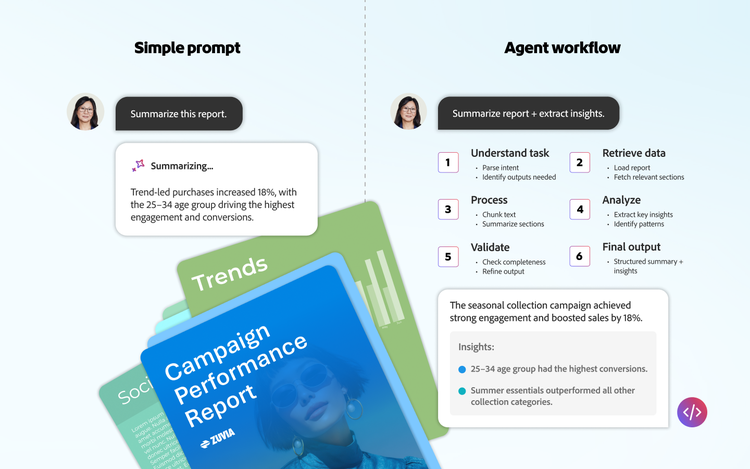
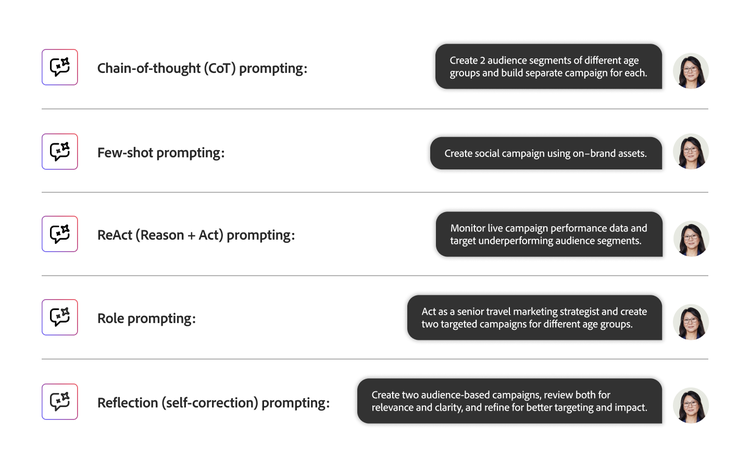
Effective agent prompting mirrors how real-world work gets done — sequentially, anchored in context, and with clear checkpoints along the way. A well-designed prompt helps AI agents become more reliable, useful, and scalable over time. The core principles behind an effective prompt include:
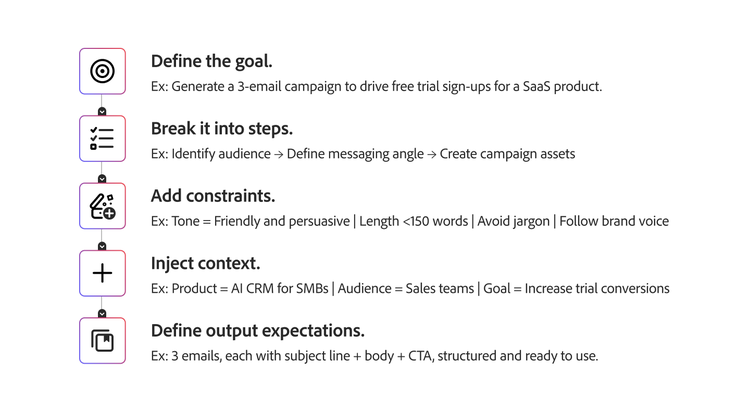
Start by clearly defining the goal rather than sharing a broad idea. AI prompts for goal setting help break the task into smaller steps, making the path visible and achievable. For instance, a multi-step prompting for a digital marketing campaign may include instructions like:
- Collect and organize into a structured format.
- Examine the dataset to identify trends and insights.
- Use insights to create relevant and personalized content.
- Adapt the content for different platforms.
Each step should clearly define the input, action, and expected output for the given task.
Constraints are the rules that shape the result. If you don’t set clear guardrails, outputs can become inconsistent. Constraints take different forms depending on the task. For a marketing team, it can look like:
- Tone, brand voice, required terminology.
- Format, length, output schema (e.g., JSON, table).
- Legal disclaimers, regulated wording.
A detailed instruction like “generate output in bullet format with no more than 5 points, aligned to brand tone” removes guesswork and sharpens focus. It reduces variation by fixing the structure, lowers risk by preventing off-brand or incorrect messaging, and minimizes rework by clearly defining expectations.
Context determines whether the output is generic or genuinely useful. The more relevant background you provide, the sharper, more actionable is the result. Context typically falls under three categories:
- Campaign goals, KPIs, target audience, positioning, and constraints.
- Performance and customer insights, behavioral trends, and real-time signals.
- Channels, output format, tone, platform requirements.
Too little context leads to vague, generic outputs, while too much irrelevant information introduces noise, dilution, and misalignment. Prioritizing first-party data and real-time signals ensures relevance and accuracy.
Actual workflows aren’t perfect, and your prompts shouldn’t assume they are.
Strong prompts prepare for what might go wrong and include clear fallback instructions such as:
- Missing or incomplete data: Flag and request input before continuing.
- Tool or API failures: Retry once, then escalate.
- Low-confidence or ambiguous outputs: Label output and route for review.
This can make your system more resilient in dealing with non-ideal scenarios and handling conflicting inputs. Without this, agents can over-trust low-quality information or execute irrelevant actions.
When your prompt is built on these core principles, you can orchestrate truly intelligent and effective workflows. This is often the key difference between a basic prompt and one that’s ready for production.