



6 Must-Have CMS Capabilities for the Agentic AI Era | Adobe UK

How to choose the right CMS for the agentic AI era.

The right enterprise content management system (CMS) helps teams create, govern and deliver experiences that are structured and optimised for both human and AI audiences.

6 capabilities that define the next generation of CMS.

From agentic workflows to structured content and enterprise governance, the capabilities you prioritise today will shape how efficiently your teams work and how effectively your brand competes tomorrow.

Your website content now has two audiences and only one of them is your customers. AI systems now parse, interpret and assess your content, forming a view of your brand before a customer ever lands on your site. If you’re not recommended by AI, many customers will never find their way to you.

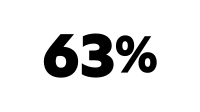
customers now use AI-powered platforms as their primary source for searching, making purchase decisions and finding recommendations ahead of brand websites and online reviews.1

of organisations are preparing to refine their content for AI-powered discovery, even as customers rely on these tools.1

People want to experience your brand, while AI wants to evaluate it. Delivering both rests on the same foundation — a complete web experience built on content that is structured, authoritative and consistent across every digital property. This makes the content on your website one of the most strategically valuable assets your brand owns and the system that manages it has to be just as strategic, delivering consistent, engaging experiences to your customers while strengthening how your brand is understood by AI systems. At the same time, the way teams produce content is shifting toward AI-powered tools and agentic systems that monitor workflows, respond to data triggers and execute multi-step tasks autonomously.

A modern content management system (CMS) sits at the centre of both shifts. It must help your teams create and govern content and has to structure and deliver that content to a dual audience of humans and AI. Choosing a CMS built for this moment requires a set of foundational capabilities. Here are six must-haves when evaluating a CMS.

1. Agentic content creation.

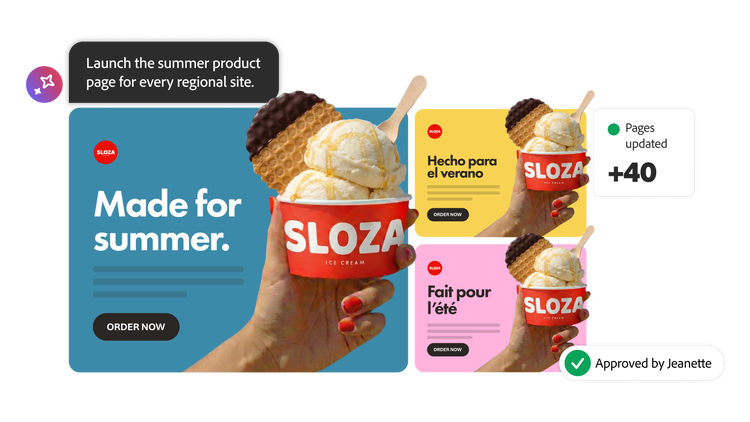
Summer promotion displayed across localised web pages with approval status and updates across 40 pages.
Personalisation at scale only works if your team can produce and manage content as fast as audiences expect it. Agentic AI helps by automating workflows, generating on-brand content variations and reusing structured content across sites and markets. The result is a stronger content foundation for personalisation — while marketers stay in control of what gets reviewed, approved and published.

of organisations say generative AI has improved their content volume.1

say it has improved their non-creative teams’ ability to generate content.1

expect agentic AI to give employees more time for strategic and creative work.1

What to look for:

  • Agentic AI content workflows. Agents that automate repetitive tasks, apply changes at scale across pages, templates and live copy and generate content directly from briefs.
  • Agentic site migration. Ability to move legacy content into structured, AI-ready formats without rebuilding page by page.
  • Human oversight. Built-in review and approval so marketers sign off before anything goes live.
  • Flexible authoring. Support for both visual editing and document-based authoring, so every team can work with the tools it already knows.
  • Generative AI for content variations. Fast generation of image and copy variations for testing and optimisation, with brand guidelines built into prompts.
In practice:
A company scaling its digital presence across multiple markets — each needing localised content, seasonal campaigns and personalised product pages — struggles to make timely updates because teams spend their time on repetitive copy changes across templates and live pages. In Adobe Experience Manager Sites, agentic workflows handle those bulk updates across pages, generate localised copy from a single brief and produce on-brand image variations in minutes, freeing the team to focus on strategy and campaign quality.

How Adobe Experience Manager Sites delivers:

Adobe Experience Manager Sites provides a structured, governed foundation for AI-ready experiences, while Experience Manager modernisation and production capabilities can help to transform legacy content and automate repetitive work such as content updates, localisation and page drafting from a brief.

Teams can author wherever they work best — using Microsoft Word or Google Docs for document-based authoring, Universal Editor for visual, in-context editing or Generate Variations in Adobe Experience Manager Sites to create copy variations. Where available, image generation can be accessed through Adobe Express using Adobe Firefly capabilities. Agentic workflows can include human review and approval before publishing, helping marketers retain control over what is created and what goes live.

2. Site performance and AI discoverability.

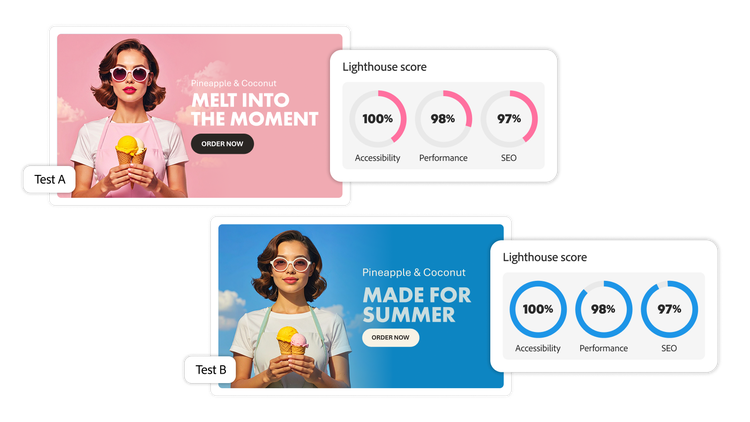
Comparison of two campaign versions showing higher citation scores and passed web vitals after content optimisation.
A slow, badly structured page used to cost you a few bouncing visitors. Now it costs you visibility. AI systems weigh the structure, semantics and performance signals of your content when deciding whether to surface, summarise or cite it and a page that loads too slowly can be crawled as empty, leaving your content unseen. Fast load times and clean structure are what make your content legible for AI— and they keep human visitors from bouncing too.

What to look for:

  • Edge delivery architecture. Content served from the network edge for consistently fast load times, high Core Web Vitals and strong Lighthouse scores.
  • Structured content for AI readability. Content fragments and models that make pages easier for search engines and LLMs to interpret, index and retrieve.
  • Built-in experimentation. Capability to conduct A/B tests across content, layouts and components without engineering support.
  • Real-user monitoring. Live performance tracking with insights when scores slip, not just a dashboard of data.

Customer spotlight:

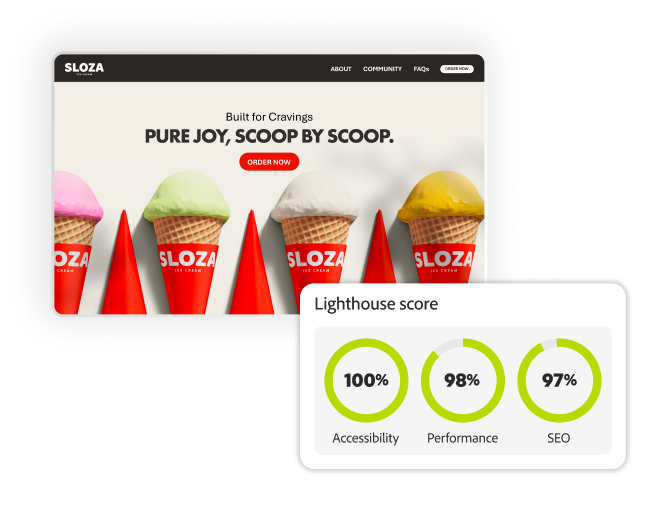
Maidenform, a HanesBrands brand took its Google Lighthouse score from 1 to 100 overnight.

HanesBrands rebuilt its Maidenform site to run on Edge Delivery Services in Adobe Experience Manager Sites. The day before launch, its Lighthouse score read 1. The morning after launch, it reached 100, making Maidenform one of the fastest ecommerce sites in the world.
How Adobe Experience Manager Sites delivers:
Websites built on Edge Delivery Services in Adobe Experience Manager Sites use lightweight HTML, minimal JavaScript and global edge infrastructure to achieve consistently high-performance scores and fast load times through phased rendering and persistent caching. Structured content models and Content Fragment Models make pages easy for both search engines and LLMs to interpret. Marketers can set up and track A/B tests directly in their authoring environment, with real-user monitoring providing live insights.

3. Rapid web development.

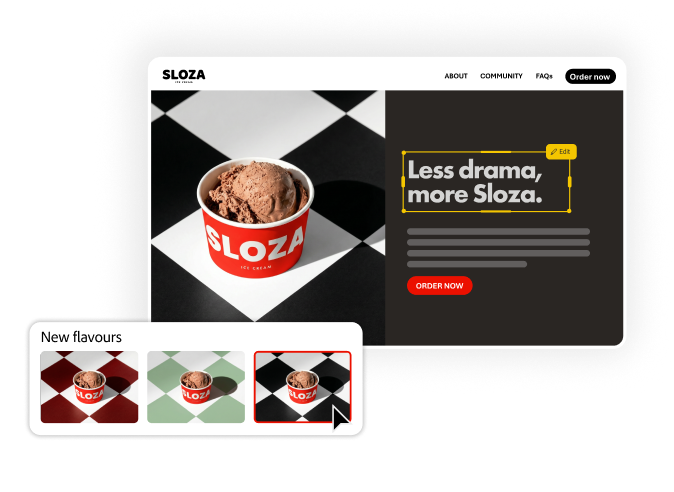
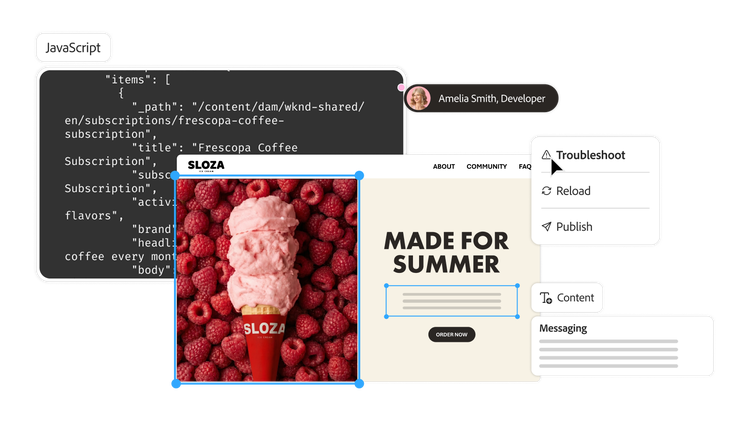
Content management dashboard linking structured content to page layout, messaging and publishing workflows.
Most enterprise sites still take quarters to launch and a standing team to maintain — and every new property in the portfolio adds to the bill. The right CMS lets developers work in the languages and tools they already know, start from a foundation that performs out of the box and stand up new pages and sites in days or weeks, without trading quality, performance or control.

What to look for:

  • Standards-based development. A platform built on HTML, CSS and JavaScript, so developers use the tools, workflows and AI coding assistants they already know.
  • Separation of concerns. Content authoring that runs in parallel with design and development, so teams don’t block each other.
  • Boilerplate and pre-built components. A starting point that minimises code and delivers fast page loads out of the box.
  • Agentic developer support. Agents that assist with implementation, code generation, debugging and pipeline troubleshooting.
  • Headless and API-first capabilities. APIs to deliver content to any channel or application, with flexibility to integrate third-party systems.
  • Structured content output. Lean, semantic HTML that is as readable to LLMs and search engines as it is to browsers.
https://main--da-bacom--adobecom.aem.page/fragments/resources/reports/how-to-select-the-right-content-management-system/customer-spotlight-kyndryl
How Adobe Experience Manager Sites delivers:
Adobe Experience Manager Sites provides a developer-friendly, standards-based foundation, including HTML, CSS and JavaScript with optimised boilerplate, pre-built performance blocks and a separation of concerns that lets teams focus on content, design and development simultaneously. GraphQL APIs and Content Fragment Models deliver structured, reusable content across any framework or channel, from React and Angular to iOS. The architecture supports serverless and cloud-native set-up with Adobe and third-party integrations suited to AI-assisted development.

4. Omnichannel content delivery.

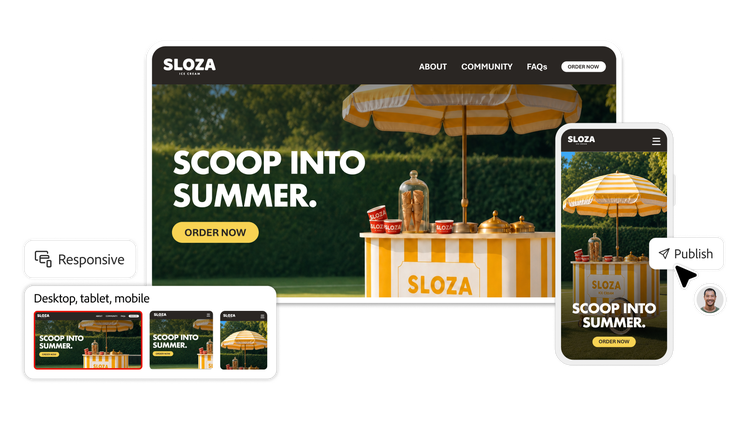
Website publishing workflow with responsive previews optimised for desktop, tablet and mobile screens.
Your customers don't experience your brand on a single channel. They move across your website, mobile apps, in-store screens and AI-driven surfaces and expect a consistent, relevant brand everywhere. As those touchpoints multiply, a site-by-site approach breaks down when content gets copied, versions drift apart and a single update means hands-on work in a dozen places. The CMS has to treat content as reusable building blocks: create once, deliver everywhere. And when a single change is made, it flows to every surface that uses it.

What to look for:

  • Content reuse across properties. Ability to create once and deploy across web, mobile, apps and other touchpoints without recreating the same content.
  • Multi-site management. Centralised control over multiple websites, microsites and regional properties, pushing updates globally while local teams adapt.
  • Translation and localisation at scale. Built-in services that move content through translation workflows quickly, not a third-party add-on.
  • Template-based governance. Capability to manage and update templates centrally across large portfolios without extra cost or effort per site.
  • Consistent brand identity at scale. Governance that protects brand standards globally while allowing local execution.

Customer spotlight:

Henkel published around 300 web domains across 30+ brands and 40+ countries in two years. The company built its "RAQN" digital platform on Adobe Experience Cloud, with Adobe Experience Manager Sites as the CMS foundation.

How Adobe Experience Manager Sites delivers:
Multi-site management syncs updates from source to localised pages automatically, while Content Fragment Models are reusable across any property and a template management system streamlines creation across sites, microsites and pages. AI translation uses the contextual awareness of LLMs to deliver human-like results at machine speed, reducing the need for post-processing.

5. Flexibility with a headless, hybrid and composable architecture.

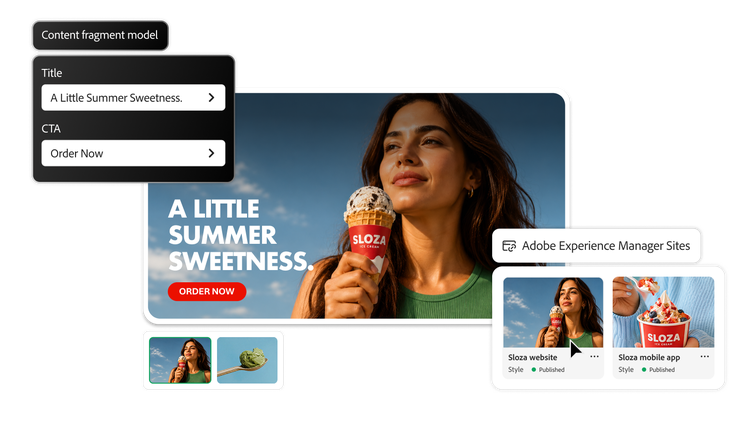
Centralised content and media assets reused across website and mobile app experiences.
Your CMS has to fit the stack you already run, working smoothly with your digital asset management system (DAM), product information management (PIM), commerce platform, analytics and marketing tools. A headless, composable architecture separates content from presentation, so you can deliver to any front-end and swap or add tools as your needs change instead of being locked to one vendor. And it has to stay usable on both sides, open and API-first for developers and simple enough for marketers to update content as needed.

What to look for:

  • Open, headless architecture. APIs that deliver content to any front-end framework or application, without locking you to a single presentation layer.
  • Native integrations with your existing stack. Pre-built connections to common enterprise tools, not just a list of theoretical compatibility.
  • MCP and agentic interoperability. Support for model context protocol (MCP) so AI agents from different vendors and platforms can interact with your content system.
  • Composability. Ability to extend core capabilities and build customised solutions on cloud-native architectures, rather than being limited to what the platform ships.
  • Partner ecosystem. Access to validated third-party services and integrations that reduce time to market.
https://main--da-bacom--adobecom.aem.page/fragments/resources/reports/how-to-select-the-right-content-management-system/customer-spotlight-real-madrid

How Adobe Experience Manager Sites delivers:

An API-first, headless architecture delivers content in JSON via GraphQL or any API, giving developers the freedom to work in any language or framework. Content Fragment Models power consistent experiences across web, mobile and any digital surface, with integrations connecting both Adobe and third-party applications.

6. Governance, security and enterprise-grade control.

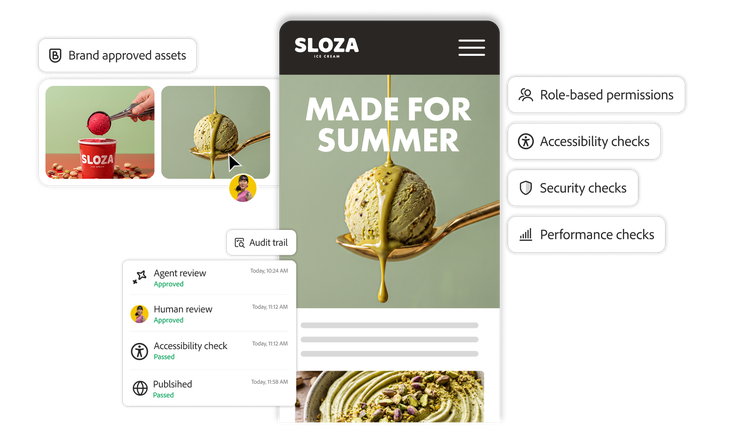
Brand-approved content reviewed through workflows with audit logs, versioning and quality assurance checks.
As content scales across teams, regions, channels and AI agents, consistent governance, security and auditable workflows become more critical, not less. The more you automate, the more it matters that a person can see and control what gets published. Yet responsible-AI maturity lags, only 21% of organisations say they have fully developed their responsible-AI priorities, with 78% still planning or in progress.2

What to look for:

  1. Human-in-the-loop controls. Clear mechanisms that mandate human review before content goes live, configurable by content type, risk level or workflow stage.
  2. Auditability. A complete log of actions taken by agents and humans, including what was approved before publishing.
  3. Role-based access and permissions. Granular control over who can do what across large, distributed teams.
  4. Brand governance. Built-in standards that keep off-brand content from publishing at scale, even as AI automates more of the creation.
  5. Security and compliance. Enterprise-grade cloud infrastructure that meets regulatory and compliance requirements across regions.
How Adobe Experience Manager Sites delivers:
Governance is embedded throughout Adobe Experience Manager Sites. Role-based permissions, workflows and controlled publishing keep enterprise content operations in order and every agentic workflow includes a mandatory human review and approval step. Agentic capabilities continually scan for accessibility, security and performance issues and enforce best practices automatically.2 Editable templates, component policies and reusable Experience Fragments enforce design consistency, while structured content models and governance guardrails maintain brand standards across global portfolios.

One CMS, built for humans and AI.

Adobe Experience Manager Sites is a complete, AI-ready CMS built to help enterprise teams create, manage and deliver content at scale without trading away performance, governance or flexibility.

For your teams, this means less of the work that slows delivery. AI takes on the tasks of repetitive production, updates and translations, so people move from idea to published experience faster and spend their time on strategy and creativity, while staying in control of everything that goes live. For your audiences, it means fast, consistent, personalised experiences for the people who engage with your brand and content that AI systems can just as easily find, read and recommend.

Learn how Adobe Experience Manager Sites builds for people and AI — structured, high-performing pages with agentic execution and human control built in.

Let’s talk about what Adobe can do for your business.

Get started